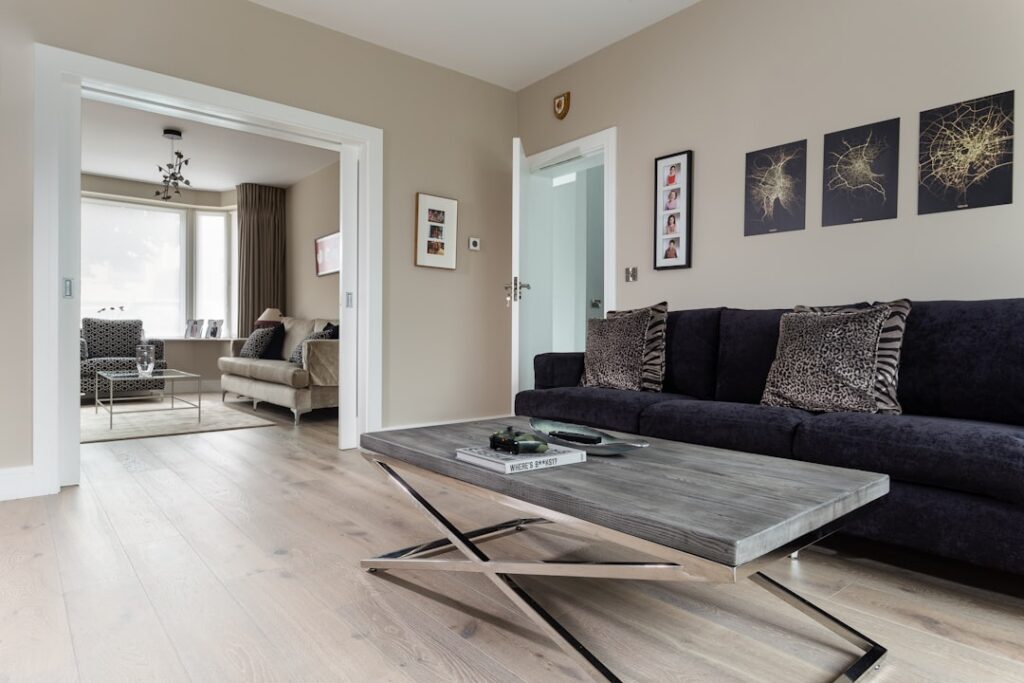
Wide, long boards have quietly taken over the laminate aisle, and for good reason. Large laminate flooring covers more area with each plank, leaving fewer seams across the room and a cleaner, more contemporary look than the narrow strips that dominated a decade ago.
I’ve installed plenty of both, and the visual difference in a finished room is obvious — big planks read as one continuous surface instead of a busy patchwork. But the bigger format also changes how you prep the subfloor and how the floor expands. Get those details right and large-format laminate is one of the best values in flooring today.
What Makes a Laminate Plank “Large Format”
Standard laminate planks have long run around 48 in. long and 5 in. wide. Large-format boards stretch well beyond that. Today you’ll find planks from 48 in. up to 72 in. long and 7 to 9+ in. wide, plus square and rectangular tile-look pieces that mimic 12×24 in. or 18×18 in. stone and porcelain.
The extra real estate per board is the whole point. A 7.5 in. wide by 54 in. long plank covers nearly three times the area of an old narrow strip, so you set fewer pieces and create fewer joints. Wide planks also flatter open-concept spaces, where long sight lines make narrow boards look chopped up.
Why Fewer Seams Matter
Every seam in a floor is a place that can chip, collect grime, or telegraph an uneven subfloor. Cutting the seam count by half does three things: it looks more seamless and high-end, it gives moisture fewer entry points, and it speeds up installation because there’s less clicking and locking per square foot.
There’s a trade-off, though. Big rigid planks don’t hide a bumpy subfloor the way small boards do. A long plank that bridges a low spot will flex, click, and eventually loosen at the joint. That’s why subfloor flatness becomes non-negotiable as plank size grows.
AC Ratings and Quality
The Abrasion Class (AC) rating tells you how much wear the surface handles. Don’t skip it — a beautiful large plank with a weak wear layer scratches fast in a busy home.
- AC3: general residential — fine for bedrooms and light-traffic rooms.
- AC4: heavy residential and light commercial — my default for kitchens, halls, and homes with kids or pets.
- AC5: commercial-grade — overkill for most houses but bulletproof.
Also check the core. Water-resistant HDF cores with sealed edges resist swelling far better than basic laminate, and many large-format lines now carry 24- to 72-hour spill warranties. A thicker plank — 10 to 12 mm versus 7 to 8 mm — feels more solid underfoot and tolerates minor subfloor imperfections better.
How Much Does Large Laminate Flooring Cost
Large-format laminate runs roughly $1.50 to $4 per sq ft for the material in 2026. Budget AC3 lines sit near the bottom; thick AC4 and AC5 planks with realistic embossed-in-register textures and beveled edges climb toward the top. Add an underlayment at $0.30 to $0.70 per sq ft if it isn’t pre-attached.
Professional installation typically adds $1.50 to $3 per sq ft. Because the planks are floating and click together, a confident DIYer can install a rectangular room over a weekend and save that labor — just respect the prep and expansion rules below.
Installation and Expansion Gaps
Two things make or break a large laminate install. First, the subfloor must be flat — most manufacturers spec within 3/16 in. over a 10 ft span. Skim-level low spots and sand down high ones before a single plank goes down. Second, laminate expands and contracts with humidity, and bigger floors move more in total.
Follow these rules:
- Acclimate the planks flat in the room for 48 to 72 hours at normal living temperature and humidity.
- Leave a 1/4 to 3/8 in. expansion gap at every wall and fixed object, hidden by baseboard or quarter-round.
- Add a T-molding transition for any run longer than about 40 ft, or across doorways into other rooms.
- Stagger end joints at least 8 to 12 in. so seams don’t line up and weaken the floor.
- Use the right underlayment for noise and moisture, especially over concrete where a vapor barrier is essential.
Skip the expansion gap and a wide-plank floor will peak and buckle the first humid summer — I’ve been called to fix exactly that more than once.
Tile-Look Large-Format Laminate
Plank isn’t the only big format. Manufacturers now make square and rectangular laminate tiles that mimic 12×24 in. porcelain, slate, and travertine, often with a grout-line groove pressed into the edge. These give you the cool, stone look of tile with the warmth and DIY-friendliness of a floating click floor, and no mortar or grout to mix.
They suit kitchens, entryways, and laundry rooms where you want a tile aesthetic without the cold underfoot feel or the all-day installation. The same flatness and expansion rules apply — maybe more so, because the rigid stone-look pieces show subfloor dips just as readily as long planks. If you’ve always liked the look of large-format tile but dreaded the install, this is a smart middle path at a fraction of the labor cost.
Large Laminate Flooring Pros and Cons
Pros
- Fewer seams for a clean, modern, high-end look
- Faster install — less clicking per square foot
- Strong value at $1.50 to $4 per sq ft
- Realistic wood and stone visuals with embossed textures
- Scratch- and dent-resistant AC4/AC5 wear layers
- Floating install works over many existing floors
Cons
- Demands a very flat subfloor — little tolerance for dips
- Bigger floors move more, so expansion gaps are critical
- Cheaper cores still swell if water sits on a seam
- Long planks are awkward to handle and cut solo
- Sounds hollower than real wood without good underlayment
Buying Guide: How to Choose
Match the AC rating to your traffic first — AC4 is the sweet spot for most family homes. Then look for a water-resistant core with sealed edges if the floor goes anywhere near a kitchen, entry, or bath. Choose plank thickness of at least 10 mm for a solid feel, and pick embossed-in-register texture with a beveled edge if you want the most convincing wood look.
Buy 8 to 10 percent extra for cuts and future repairs, confirm the warranty length and what voids it, and request a sample to view in your own light before ordering. Above all, be realistic about your subfloor — if it’s wavy, factor in leveling cost or step down to a smaller plank. Done right, large laminate flooring gives you a sleek, durable surface for a fraction of what real hardwood or tile would cost.
Prefer to explore on your own?
See how new flooring looks in your actual room in seconds — free, no signup.
Try the free Floor Studio →