The appeal is obvious: light your yard, path, or patio with no wiring, no trenching, and no addition to your electric bill. LED solar outdoor lighting has gone from dim novelty to genuinely capable in the past few years, thanks to better lithium batteries, brighter LEDs, and smarter light sensors. That said, the market is flooded with cheap fixtures that barely glow past dusk, so knowing which specs actually matter is the difference between lighting that performs for years and a set of stakes you replace every season. This guide covers how it works, what to look for, and where to put it.
How Solar LED Lighting Actually Works
Every solar light is a small self-contained power system with four parts: a photovoltaic panel, a rechargeable battery, an LED, and a control circuit. During the day the panel converts sunlight into electricity and stores it in the battery. At dusk, a light sensor detects the drop in ambient light and switches the LED on, drawing from the stored charge through the night.
The performance of the whole system hinges on how well those parts are matched. A big bright LED paired with a tiny panel and battery will drain long before morning. Cheap fixtures cut corners on the panel size and battery capacity, which is why they fade after a couple of hours. Quality units size the panel and battery to keep the LED running from dusk to dawn, even after a cloudy day, and that balance is what you are really paying for.
The Specs That Matter
Ignore vague marketing claims and look at the actual numbers. A few specifications tell you almost everything about how a fixture will perform:
- Lumens: Actual brightness. Path lights need 40 to 100 lumens; accent lights 10 to 50; security floodlights 500 to 2,000 or more.
- Battery type and capacity: Lithium (Li-ion or LiFePO4) far outlasts older Ni-MH; look for capacity in mAh, higher is longer runtime.
- Panel type: Monocrystalline panels are more efficient than polycrystalline and charge better in weak light.
- Color temperature: Measured in Kelvin. 2700K to 3000K is warm and inviting; 5000K to 6000K is bright white, better for security.
- IP rating: Weatherproofing. Look for IP65 or higher for real all-weather durability.
Battery type is the single biggest predictor of longevity. Lithium chemistries handle heat and cold far better and last many more charge cycles than the nickel batteries in bargain lights, which is why premium fixtures keep working for years while cheap ones die in a season.
Types of Solar Outdoor Lighting
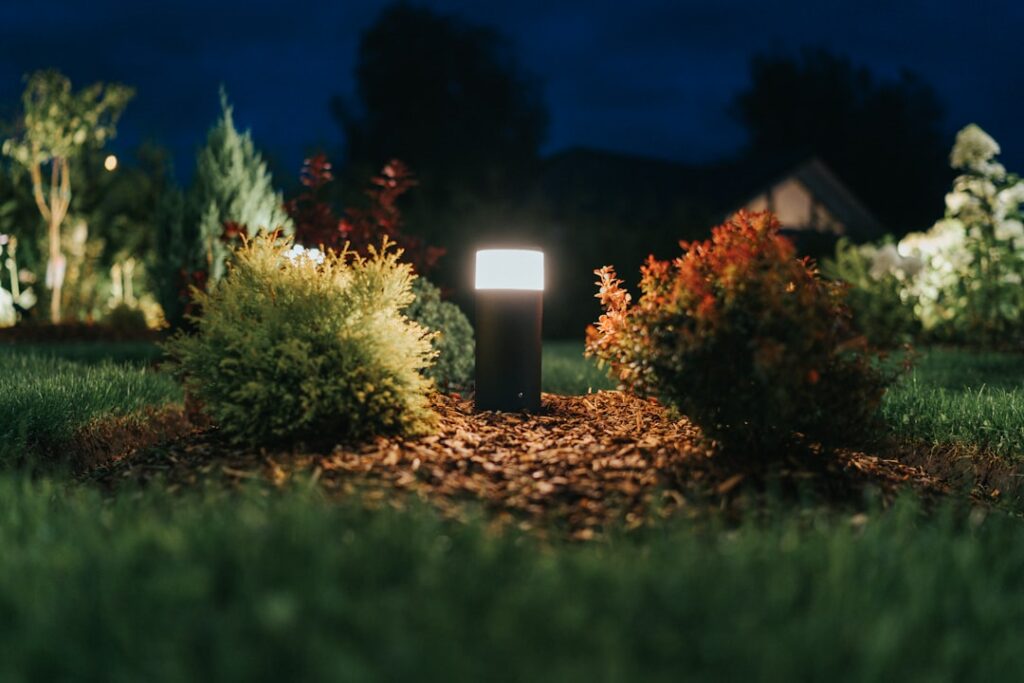
Match the fixture to the job. Path lights on stakes line walkways and garden beds, casting a soft pool of light every few feet; space them 6 to 8 feet apart for even coverage. String lights and cafe lights add ambiance to patios and pergolas and now come in warm, dimmable versions with a separate panel you mount in the sun.
Solar security floodlights combine bright output with a motion sensor and are the fastest-growing category, offering wired-floodlight brightness with no electrician. Spotlights and accent lights uplight trees, signs, and architectural features. Deck and step lights, wall sconces, and post-cap lights integrate into structures for a finished look. Decide what you are lighting first, then choose the type built for it, rather than buying a generic multipack and hoping it fits every need.
Placement: Sun Is Everything
The most common reason solar lights disappoint is poor sun exposure, not a bad product. The panel needs direct sunlight for six or more hours a day to fully charge, so placement is not just about where you want light at night; it is about where the panel gets sun during the day. A path light tucked under a dense tree or on a north-facing wall will never charge properly no matter how good it is.
For fixtures where the light and the panel are one unit, you have to compromise between ideal light position and ideal sun. This is where separate-panel designs shine: the LED goes exactly where you want illumination, in shade if needed, while the panel mounts on a sunny wall or post up to 10 or 15 feet away via a cable. For any solar light, keep the panel clean; a film of dust, pollen, or bird droppings noticeably cuts charging, so wipe panels every few weeks.
Managing Seasons and Weather
Solar output varies with the seasons, and expectations should too. Summer’s long, high sun gives abundant charge and long runtimes; short, low, cloudy winter days deliver less, so lights may run dimmer or for fewer hours. Snow covering a panel stops charging entirely, so brush panels clear after storms. In climates with long dark winters, choose fixtures with oversized panels and higher-capacity lithium batteries to bank enough energy.
Cold itself reduces battery capacity temporarily, another reason lithium, especially LiFePO4, is worth paying for, since it tolerates temperature swings far better than nickel batteries. A quality IP65-rated fixture handles rain, snow, and heat without issue, but bargain lights often fail at the seals, letting moisture corrode the electronics after a season or two. The weatherproof rating is not a minor detail; it directly determines how many winters the light survives.
Maintenance and Replacing Batteries
Solar lights are low-maintenance, not no-maintenance, and a little upkeep dramatically extends their useful life. The most important task is keeping the panel clean, since a film of dust, pollen, or grime can cut charging by 20 percent or more; wipe panels with a damp cloth every few weeks and after storms. Position matters over time too, as trees leaf out and shadows shift with the seasons, so a light that charged well in winter may sit in shade by midsummer.
The rechargeable battery is the part that eventually wears out, typically after two to four years depending on chemistry and climate. The good news is that on quality fixtures the battery is a standard, replaceable cell, often an 18650 lithium or an AA-size rechargeable, that you can swap for a few dollars rather than tossing the whole light. Before assuming a dim light has failed, try a fresh battery; it often restores full performance. Cheap sealed fixtures that do not allow battery replacement are a false economy, since you discard the entire unit when the cell dies.
Motion Sensors and Smart Features
Many newer solar lights add features that improve both function and efficiency. Motion sensors are the most useful, especially for security floodlights: the light stays off or dim to conserve battery, then jumps to full brightness when it detects movement, which saves power and startles intruders. Some offer selectable modes, such as always-on dim with a motion-triggered bright burst, giving you both ambient light and an alert.
Other worthwhile features include adjustable panels that let you angle the collector toward the sun independent of the light, remote controls or app connectivity for setting brightness and timers, and multiple lighting modes to balance brightness against runtime. For pathways and patios you generally want steady light; for driveways, entries, and dark yard corners, motion activation extends battery life and provides security. Match the feature set to the job rather than paying for smart features you will not use, but a good motion sensor is nearly always worth it on security-oriented lights.
Cost, Value, and When to Choose Solar
Solar lighting spans a wide price range, from $3 stake lights in a 12-pack to $80 or more for a serious solar floodlight. The cheap multipacks have their place for temporary or purely decorative accent lighting, but for anything you rely on, spending more per fixture buys the lithium battery, monocrystalline panel, and real weatherproofing that make the difference between years of service and a landfill trip.
The strongest case for solar is where running wire would be expensive or impractical: a far corner of the yard, a detached shed, a long driveway, or a rental where you cannot alter wiring. You save the trenching and conduit costs of a hardwired low-voltage system, which can run hundreds to thousands of dollars, and you add nothing to your power bill. Where you need guaranteed brightness every night regardless of weather, such as critical security lighting, a hardwired or hybrid solution is more dependable, but for most residential path, accent, and ambiance lighting, quality LED solar is now the practical, low-hassle choice.
The Bottom Line
LED solar outdoor lighting has matured into a legitimately good option, provided you buy on specs rather than price alone. Prioritize a lithium battery, a monocrystalline panel, an honest lumen rating that matches the task, and an IP65-or-better weather seal. Place fixtures, or at least their panels, where they get six-plus hours of direct daily sun, keep the panels clean, and set realistic expectations for winter. Do that, and you get years of maintenance-free, wire-free light that costs nothing to run, which is exactly what solar promised all along.