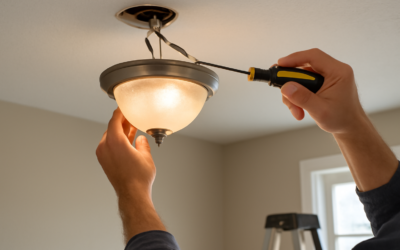
A dead light is annoying, but it is usually one of a handful of simple causes. When a light fixture not working sends you reaching for the toolbox, start with the easiest, cheapest checks before assuming the worst. Most of the time the culprit is a burned-out bulb, a tripped breaker, or a switch that has quietly failed. The key is to work through the possibilities in order and, above all, to treat anything involving wiring with respect for the danger that electricity poses.
- Safety First: Cut the Power Before You Open Anything
- Check the Bulb First
- Test the Wall Switch
- Look at the Breaker or Fuse
- Check Nearby GFCI Outlets
- Inspect for Loose Wire Connections
- Troubleshooting a Whole-Fixture vs. Single-Bulb Problem
- Common Causes by Fixture Type
- When to Call a Licensed Electrician
Safety First: Cut the Power Before You Open Anything
This cannot be overstated. The moment your troubleshooting goes beyond swapping a bulb, turn off the circuit at the breaker panel, not just at the wall switch. A switch can leave wires live in some configurations. After flipping the breaker, confirm the fixture is truly dead with a non-contact voltage tester before you touch any wiring. If you smell burning, see scorch marks, or feel heat on the switch plate, stop and call a licensed electrician immediately.
Check the Bulb First
It sounds obvious, but a failed bulb is the single most common reason a fixture goes dark. Even new bulbs can be defective straight out of the box. Swap in a bulb you know works, and make sure it is screwed in firmly, since a slightly loose bulb will not make contact.
- Confirm the new bulb matches the fixture’s wattage and base type.
- For LED fixtures, remember the bulb may not be replaceable at all.
- Check that the bulb is rated for the fixture (enclosed, dimmable, or damp-rated as needed).
If a fresh bulb lights up, you are done. If it does not, move on to the switch and the panel.
Test the Wall Switch
A worn-out switch is a frequent cause of a dead fixture. Toggle it firmly a few times in case the contacts are dirty. If the switch feels loose, mushy, or makes no click, it may have failed internally. You can confirm by turning off the breaker and testing the switch with a multimeter, or simply by having it replaced.
If the fixture is controlled by two switches, such as at the top and bottom of a staircase, a failed three-way switch can leave the light dead in certain positions. Test both switches in every combination before concluding the fixture itself is at fault.
Look at the Breaker or Fuse
Head to your electrical panel and inspect the breaker for that circuit. A tripped breaker often sits in a middle position rather than fully off. To reset it, push it firmly all the way to off, then back to on. In older homes with a fuse box, look for a blown fuse with a cloudy or broken metal strip and replace it with the correct amperage.
If the breaker trips again immediately, do not keep resetting it. A breaker that trips repeatedly is doing its job by warning you of a fault such as a short or an overload, and that requires professional diagnosis.
Check Nearby GFCI Outlets
Some light fixtures, particularly in bathrooms, kitchens, garages, basements, and outdoor areas, are protected by a GFCI device upstream. If that GFCI outlet trips, it can cut power to lights and outlets downstream on the same circuit. Find the nearest GFCI outlet, look for a tripped reset button, and press it firmly to restore power.
It is easy to forget about a GFCI in another room, so check garages, exterior walls, and unfinished spaces. A single tripped GFCI can be the hidden reason a light across the house has gone dark.
Inspect for Loose Wire Connections
With the breaker off and the circuit verified dead, you can check the fixture’s connections. Vibration and heat over the years can loosen the wire nuts inside a fixture’s electrical box. Gently confirm the black-to-black, white-to-white, and ground connections are snug and that no wire has slipped free of its connector.
Be honest about your comfort level here. Reconnecting a wire nut is within reach for a careful DIYer, but if you find melted insulation, corroded wires, an overheated box, or anything you do not understand, button it back up and bring in a professional.
Troubleshooting a Whole-Fixture vs. Single-Bulb Problem
Narrowing down the fault saves time. If a multi-bulb fixture has some bulbs working and others dark, the problem is almost certainly the individual bulbs or their sockets, not the wiring or breaker. If the entire fixture is dead but other lights and outlets on the same circuit work, suspect the bulb, the switch, or that fixture’s own connections. If the whole circuit is dead, focus on the breaker and any upstream GFCI.
Pay attention to patterns over time, too. A light that flickers, dims, or works intermittently often points to a loose connection somewhere in the circuit, while a light that buzzes may indicate a dimmer incompatible with the installed bulb type. These clues help you and any electrician zero in on the real cause faster.
Common Causes by Fixture Type
Different fixtures fail in their own ways. Recessed can lights sometimes have a thermal cutoff that shuts the light off when it overheats, often from using a bulb above the rated wattage, so check that you are within spec. Fluorescent fixtures can fail at the ballast or the starter rather than the tube. Older fixtures may simply have a corroded socket that no longer makes contact.
- Recessed cans: check wattage rating and the thermal cutoff if the light cycles off when hot.
- Fluorescent: a humming or flickering tube can mean a failing ballast.
- Dimmable fixtures: confirm the bulb is dimmable and matched to the dimmer.
- Outdoor fixtures: moisture intrusion and corroded sockets are common culprits.
Matching the symptom to the fixture type tells you whether a quick fix will do or whether the issue runs deeper.
When to Call a Licensed Electrician
Some symptoms are not DIY territory. Call an electrician if a breaker keeps tripping, if you smell burning or see scorching, if lights flicker across multiple fixtures, if you find aluminum wiring or backstabbed connections you are unsure about, or if you simply are not confident working in the panel. The cost of a service call is far less than the cost of a fire or a shock, and licensed electricians can diagnose hidden faults that a homeowner cannot safely chase down.
Work through the checks in order, respect the power, and know your limits. Most dead fixtures come back to life with a new bulb or a reset breaker, and the ones that do not are exactly the ones worth handing to a pro.