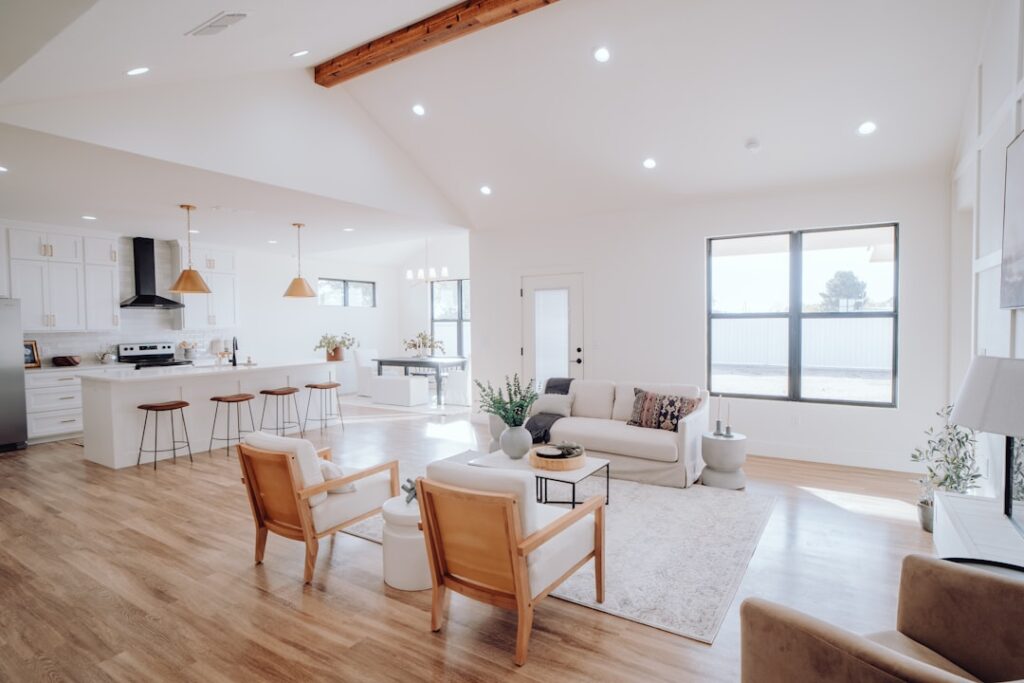
The plain white “fifth wall” is finally getting some attention, and light grey ceiling paint is the reason. A soft grey overhead adds quiet depth and a designer touch without the cave-like effect of a dark ceiling — it reads as a considered choice rather than a builder default. Done right, most people cannot even name why the room feels more finished; they just feel it.
- Why Paint a Ceiling Grey at All
- When It Works — and When to Skip It
- Choosing the Right Shade and Undertone
- The Right Finish for a Ceiling
- How Much Paint You Need
- How to Paint a Ceiling Cleanly
- Coordinating With Walls and Trim
- Light Grey Ceilings in Specific Rooms
- Common Mistakes to Avoid
- Does It Affect Resale?
- Final Take
This guide covers when light grey ceiling paint works, the best shades and undertones, the finish to use, and how to paint a ceiling cleanly.
Why Paint a Ceiling Grey at All
A pure flat white ceiling is fine, but it can look stark and it draws the eye to every imperfection and shadow. A light grey does a few things white cannot:
- Adds subtle depth so the ceiling recedes softly instead of glaring.
- Ties the room together when it echoes a grey or greige on the walls or trim.
- Hides minor flaws and shadowing better than bright white, which spotlights them.
- Reads as intentional and slightly luxe, the way trim and ceilings in older, well-designed homes often carried a tint.
The key word is light. A pale grey keeps the room feeling open; a mid or dark grey lowers the perceived ceiling height and is a different, moodier decision.
When It Works — and When to Skip It
Light grey ceilings shine in rooms with decent natural light and at least 8-foot ceilings, and in spaces with white or greige walls where the grey adds a gentle layer. They are excellent in bedrooms, living rooms, and offices.
Be cautious in rooms that are already dim, north-facing, or have low 7-to-8-foot ceilings — grey overhead can make them feel heavier and shorter. In those spaces, either go with the very palest grey (barely off white) or keep the ceiling white and add depth elsewhere. And in a room with warm-white walls, a cool grey ceiling can clash, so match undertones.
Choosing the Right Shade and Undertone
Grey is never just grey — it leans blue, green, or purple, and that undertone decides whether it harmonizes with your walls. Warm greys (greige) lean beige and pair with warm whites and wood; cool greys lean blue and pair with crisp whites and cooler palettes. A few well-loved light grey ceiling options:
- Benjamin Moore Gray Owl: a light, slightly cool grey with a hint of green — versatile and popular for ceilings.
- Sherwin-Williams Repose Gray: a warm-leaning light greige, forgiving in most light.
- Benjamin Moore Classic Gray: so pale it reads as a soft warm off-white — perfect when you want just a whisper of grey.
- Sherwin-Williams Agreeable Gray: a greige that works overhead when it is also on or near the walls.
- Benjamin Moore Silver Satin / Stonington Gray: gentle light greys for a clean, airy feel.
The designer trick: have your wall color mixed at 25 to 50 percent strength and use that on the ceiling. It guarantees the undertones match and creates a seamless, custom look. Always test a sample overhead, because ceilings get less direct light and colors read darker up there than on the wall.
The Right Finish for a Ceiling
Use a flat or matte finish on the ceiling, almost always. Here is why:
- Flat hides imperfections — ceilings show every roller mark, seam, and bit of unevenness under raking light, and flat sheen absorbs it.
- No glare: a shiny ceiling reflects light fixtures and creates hot spots. Flat keeps the surface calm.
- Exception — bathrooms and kitchens: in high-moisture rooms, step up to a matte or eggshell with mildew resistance so you can wipe it and it resists moisture.
Many brands sell a dedicated “ceiling paint” that is ultra-flat and often goes on pink or blue and dries white so you can see your coverage — you can have those tinted to a light grey at the store.
How Much Paint You Need
Ceiling paint covers roughly 350 to 400 square feet per gallon. Measure the room’s floor area (length times width) since the ceiling matches it. A 12-by-15-foot room is 180 square feet, so a gallon covers it with margin for a second coat on part of it. Buy enough for two coats on anything but a repaint of a similar color — one coat rarely covers evenly overhead, and grey over white usually wants two.
How to Paint a Ceiling Cleanly
- Clear and cover. Remove or sheet furniture, drop-cloth the floor, and take down or loosen ceiling fixtures.
- Prep the surface. Fill cracks and holes, sand smooth, and spot-prime any patches or stains — a water stain will bleed through, so hit it with a stain-blocking primer first.
- Cut in the edges. Use an angled brush to paint a 2-to-3-inch band where the ceiling meets the walls, going around the whole room.
- Roll with an extension pole. Use a 3/8-inch nap roller for smooth ceilings, thicker nap for texture, on a pole so you keep a wet edge and consistent pressure.
- Work in sections of about 3 by 3 feet, rolling in one direction then back across, always keeping a wet edge to avoid lap marks.
- Roll the final pass toward the main window so any subtle roller lines run with the light and disappear.
- Second coat after the recoat window, rolling perpendicular to the first for full, even coverage.
Good ceiling technique is all about the wet edge and steady pace — stop-and-start with a drying ceiling is what creates visible lap marks.
Coordinating With Walls and Trim
The cleanest looks pair a light grey ceiling with white or off-white walls and crisp white trim, letting the grey read as a soft canopy. Or carry a greige onto the walls and use a lighter version of it on the ceiling for a tonal, cocooning effect. Avoid pairing a cool grey ceiling with warm-cream walls — the mismatch looks like a mistake. When in doubt, the reduced-strength wall-color trick removes all the guesswork.
Light Grey Ceilings in Specific Rooms
The effect changes room to room, so tailor the shade to the space:
- Bedroom: a soft warm grey overhead makes the room feel cocooning and restful without going dark. Pair with white or greige walls and it reads calm and hotel-like.
- Living room: in a well-lit living room with 9-foot ceilings, a light grey adds a subtle architectural layer, especially with crown molding painted crisp white to frame it.
- Kitchen: a pale grey ceiling above white or grey cabinets ties the palette together; step up to a wipeable matte for the humidity and grease.
- Bathroom: a spa-like light grey overhead works beautifully, but use a moisture- and mildew-resistant matte or eggshell so it survives the steam.
- Home office: a light grey ceiling reduces glare and reads as a considered, professional space on camera.
Common Mistakes to Avoid
- Going too dark. A mid-grey overhead can make a room feel low and heavy — keep it genuinely light unless you want a deliberately moody effect.
- Undertone clash. A cool blue-grey ceiling over warm cream walls looks like a mistake. Match the undertone or use the reduced-strength wall color.
- Using the wrong sheen. A shiny ceiling reflects fixtures and spotlights every flaw. Stick with flat except in wet rooms.
- Skipping the sample overhead. Ceilings get less light and read darker than the same color on a wall, so always test the swatch on the actual ceiling.
- Ignoring imperfections. Grey does hide minor flaws, but a badly patched or cracked ceiling still shows — repair and sand first.
Does It Affect Resale?
A tasteful light grey ceiling is a neutral, broadly appealing choice that will not scare off buyers the way a bold colored ceiling might. Because it reads as a subtle, high-end detail rather than a strong statement, it tends to help a room feel finished and considered in listing photos. If you are painting specifically to sell, keep the grey light and the undertone warm and safe, and the ceiling becomes a quiet asset rather than a liability. For your own enjoyment, you have more freedom, but even then the palest, most versatile greys age the best.
Final Take
Light grey ceiling paint is one of the highest-impact, lowest-cost upgrades in a room — a single gallon and an afternoon give a space a layered, designed feel that plain white cannot. Keep the shade pale, match the undertone to your walls, use a flat finish, and paint it with a wet edge toward the window. The result is a ceiling nobody notices consciously and everybody feels — which is exactly the point.