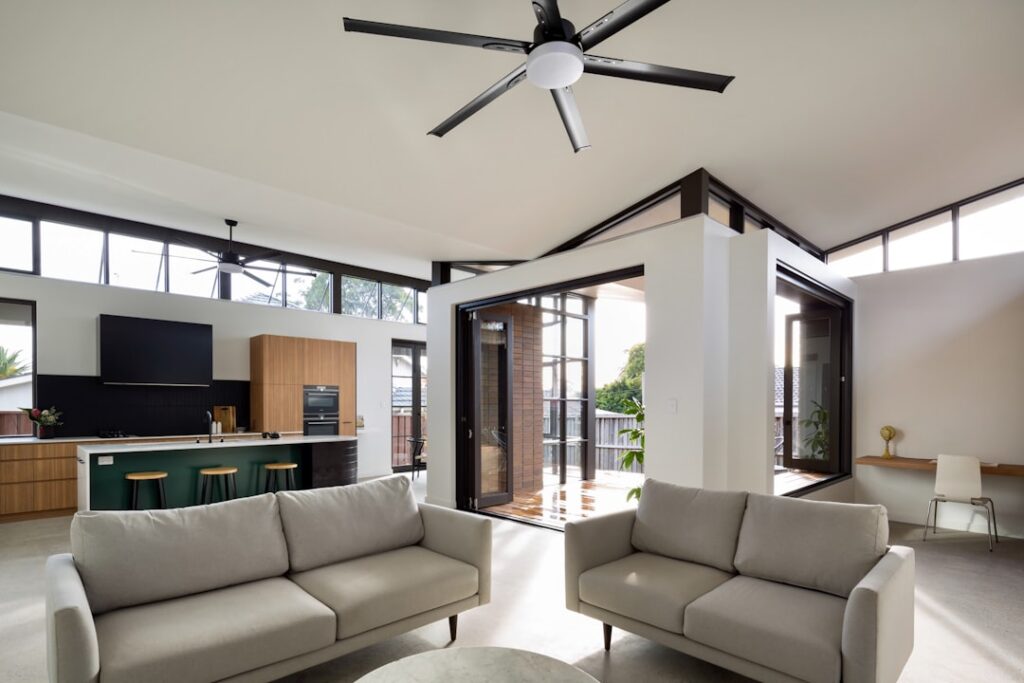
The living room is the hardest room in the house to buy a fan for — and the most punishing when you get it wrong. A living room ceiling fan has to move air across the largest floor area in the home, run silently under conversation, look deliberate rather than builder-grade, and often serve as the room’s primary light. A bedroom fan can hide its flaws behind a closed door; the living room fan is on display every day and running more hours than any other fan you own. Here is how to get all four jobs right.
- Size for the Room You Actually Have
- The Two-Fan Solution for Long Rooms
- Placement: Center the Seating, Not the Room
- Quiet Is Non-Negotiable: Buy a DC Motor
- Style: Make the Fan Match the Room's Argument
- Lighting: Decide Before You Buy, Not After
- Ceiling Height Scenarios, Solved
- Controls: How You'll Actually Run It
- Budget Guidance for the Long Haul
Size for the Room You Actually Have
Most American living rooms run 250 to 400 square feet, which pushes you past the default sizes. Rooms from 225 to 400 square feet want a 54- to 60-inch fan; over 400 square feet, go 60 to 72 inches or split the job between two fans. Only smaller living rooms — under about 15 by 15 feet — are well served by the ubiquitous 52-inch size, and if yours falls in that bracket, our 52 inch ceiling fan guide covers that class in depth, including the full room-by-room sizing chart.
Great rooms with cathedral ceilings change the math again. Volume, not just floor area, determines how hard the fan works: a 20-by-20 room with a 16-foot peak holds twice the air of the same footprint at 8 feet. Size up one bracket for vaulted spaces and prioritize CFM — 6,000 minimum on high, 8,000-plus for true great rooms. Big-box fans under $150 rarely clear that bar.
The Two-Fan Solution for Long Rooms
Open-concept spaces that run 25 or 30 feet end to end are better served by two matched 52- to 54-inch fans than one 72-inch monster. A single fan, however large, moves a column of air over its own footprint and leaves the room’s far ends still. Two fans centered over the two functional zones — seating area and dining or play area — cover the space evenly, run at lower speeds (quieter), and cost about the same as one premium large fan. Space them so each fan is centered over its zone with at least 3 feet between blade-tip circles.
Placement: Center the Seating, Not the Room
Center the fan over where people sit, not over the room’s geometric center. A fan centered on the floor plan but offset 6 feet from the sofa cools the empty half of the room. If the ceiling box is in the wrong place, moving it costs an electrician $150 to $400 — money better spent than living with a misplaced fan for a decade. Keep blades at least 18 inches from walls and bulkheads, 8 to 9 feet off the floor, and never directly under a ceiling-mounted air vent, which creates competing airflow and audible turbulence.
Quiet Is Non-Negotiable: Buy a DC Motor
Living room fans run during conversation, movies, and reading — the exact conditions where AC-motor hum and speed-control buzz become maddening. DC (brushless) motors are the fix. They run 5 to 10 dB quieter than comparable AC motors, offer six speeds instead of three, consume about 30 watts on high versus 60 to 90, and reverse from the remote instead of a motor-housing switch you cannot reach on a 12-foot ceiling. The premium is roughly $80 to $150 over an equivalent AC fan and it is the single best money you can spend in this room. Listen for bearing noise in reviews, and treat any fan without a published dB or CFM figure as a fan with something to hide.
Style: Make the Fan Match the Room’s Argument
A living room fan is a visual anchor the size of a coffee table hung at eye-catching height, so it should agree with the room’s design language. Matte black and brushed nickel with clean three-blade profiles suit contemporary and transitional rooms; distressed wood blades and bronze hardware read farmhouse; caged and metal-blade designs go industrial; woven rattan fits coastal and organic-modern schemes. Match the fan’s finish to the room’s dominant metal — door hardware, lamp bases, curtain rods — rather than to the ceiling color. When ceilings are white and you want the fan to disappear, a matte white low-profile model recedes almost completely.
Lighting: Decide Before You Buy, Not After
If the fan replaces the room’s main fixture, treat it as a light first. Look for an integrated LED kit rated at least 1,500 lumens — 2,000-plus for rooms over 300 square feet — with a color temperature you can live with (2700K to 3000K reads warm and residential; some models let you select 2700K/3500K/5000K at install). Confirm the LED is dimmable from the included remote and, if you use smart dimmers, that the fan supports them; many integrated kits fight external dimmers. In rooms with abundant lamps and cans, a light-free fan is the cleaner look and removes the glare point over the TV.
Ceiling Height Scenarios, Solved
Living rooms present every ceiling situation in the catalog, so match the mount to yours. Standard 8-foot ceilings force a low-profile hugger, and huggers give up some airflow because the blades run close to the ceiling — compensate by buying at the top of your size bracket and insisting on published CFM. Nine- and 10-foot ceilings are the sweet spot: a standard mount with a 4-to-12-inch downrod puts blades at the ideal 8-to-9-foot height. Vaulted and cathedral ceilings need real downrod math — roughly 12 inches of rod for each foot of ceiling height past 9 feet, so a 14-foot peak wants a 60-inch downrod, plus a sloped-ceiling adapter once pitch passes about 25 degrees. Long downrods amplify any imbalance, which is another argument for quality: a $120 fan that wobbles charmingly on a 6-inch rod becomes a slow pendulum on a 48-inch one. Check the fan’s maximum rated downrod before buying, and never exceed it.
Controls: How You’ll Actually Run It
Pull chains have no place on a living room fan — the room deserves a wall control or remote, and guests need to figure the fan out without a tutorial. A wall-mounted keypad is the most durable choice for shared spaces because it cannot vanish into the sectional. Handheld remotes suit households that fine-tune speed and light from the sofa. Smart control earns its premium here more than in any bedroom: scheduling the fan to spin up in the afternoon heat, voice control while your hands hold a tray, and thermostat integration that lets the fan carry 2 to 3 degrees of setpoint. If the fan includes a light, confirm the wall control dims it independently of speed — cheap combo switches that force you through light modes to change speed get old within a week.
Budget Guidance for the Long Haul
Plan on $250 to $500 for a living room fan and it will not feel extravagant per hour of use. That range buys a 54- to 60-inch DC-motor fan pushing 6,000 to 8,000 CFM with a dimmable light and remote — Minka-Aire, Fanimation, Hunter’s upper lines, and Modern Forms all field strong entries. Spending $100 on a builder special gets you a three-speed AC fan at 4,000 CFM that hums under load and looks like it came with the house. Amortized over a 12-year service life at 8 hours a day, the difference between those two fans is about a nickel a day.
Order of operations, then: measure the room and pick the size bracket, verify the box location over the seating, insist on a DC motor and honest CFM numbers, then choose finish and lighting. Style is the fun part — but it comes fourth, because a beautiful fan that cannot cool a 350-square-foot room is just an expensive sculpture that wobbles.