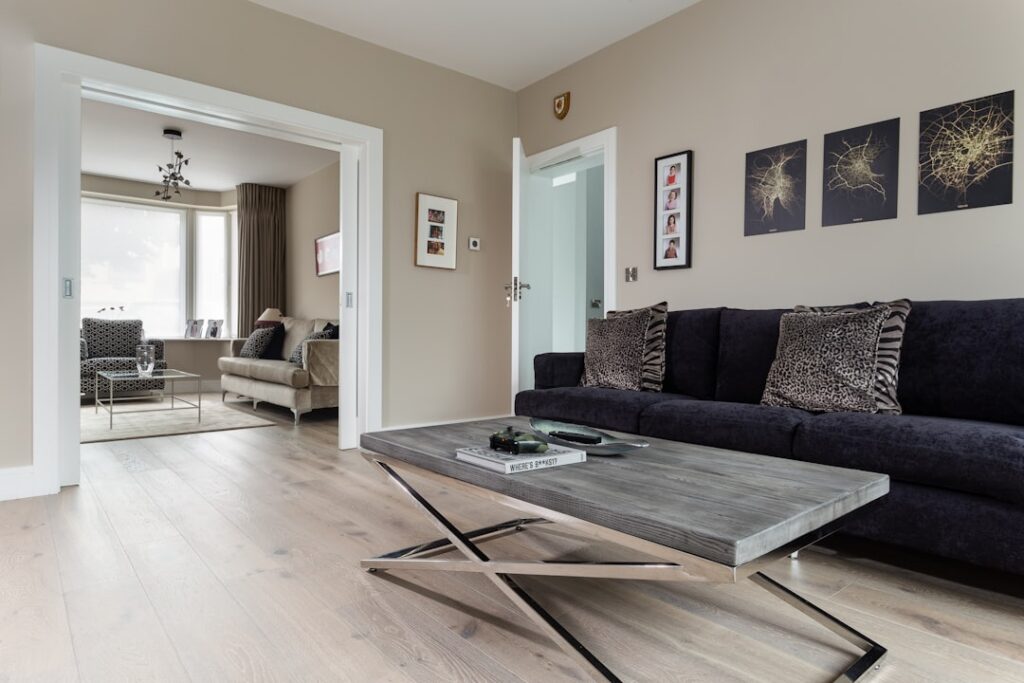
Standard laminate boards run roughly 48 inches long, but long plank laminate flooring stretches that to 60, 72, or even 84-plus inches per board. Those extra inches change how a finished floor reads to the eye, especially in large open spaces. Fewer end seams mean a calmer, more expansive look and a closer impression of a sawn timber floor. If you have a great room or open-plan kitchen, the format is worth understanding before you choose.
What Counts as a Long Plank
There is no single industry rule, but most retailers label anything 60 inches or longer as a long plank. Premium ranges push past 72 inches, and a few specialty lines top 84 inches. For comparison, a traditional laminate board is about 48 inches, so a long plank can add 25 to 75 percent more length per piece.
Width often grows alongside length. Many long-plank lines also run wider than the old 5-inch norm, landing between 7 and 9 inches. The combination of length and width is what produces that broad, contemporary plank look buyers ask for.
Why Length Matters Visually
Every board end creates a horizontal joint. In a 20-foot room, 48-inch planks force at least five end seams across each row, while 72-inch planks cut that to three or four. Multiply that across an entire floor and the reduction in visible lines is significant.
The result reads as more upscale and less busy. Long planks draw the eye down their length, which can make a room feel larger and more open. In hardwood, mills charge a premium for long, clear boards, so the long-plank laminate look borrows some of that high-end character at a fraction of the cost.
Pros of Long Plank Laminate Flooring
The format brings several practical and aesthetic upsides:
- Fewer seams: Less visual clutter and fewer potential weak points where moisture or wear can start.
- Faster installation: Each board covers more ground, so you click fewer pieces to fill a room.
- High-end appearance: Long, wide boards mimic the proportions of premium sawn hardwood.
- Great in big rooms: Open-plan layouts and long hallways benefit most from the uninterrupted runs.
- Durable surface: Quality laminate carries an AC3 to AC5 wear rating, handling kids, pets, and traffic well.
Cons and Trade-Offs
Longer boards are not automatically better for every situation. The biggest challenge is handling. A 72-inch plank is awkward to carry, cut, and click into place alone, so plan on a helper for the install day.
Keep these limitations in mind:
- Subfloor flatness is critical: Long boards bridge dips and humps, so an uneven subfloor causes flexing, gaps, or popping joints.
- More waste in small rooms: In a tight bathroom or closet, you cut down long planks and discard more offcut.
- Tougher to maneuver: Tight doorways and odd angles are harder to work around with a long, rigid board.
- Slightly higher cost: Long-plank ranges often sit at the top of a maker’s price ladder, commonly $2.50 to $5 per sq ft.
Subfloor and Installation Considerations
Flatness tolerance tightens as plank length grows. Aim for no more than 3/16 inch of deviation over a 10-foot span, and many manufacturers want closer to 1/8 inch for the longest boards. Use a long straightedge or a laser line to find high and low spots, then grind down peaks and fill valleys with leveling compound.
A few field tips that save headaches:
- Acclimate the boxes flat in the room for 48 hours before laying anything.
- Stagger end joints by at least 8 to 12 inches between adjacent rows for strength and a natural look.
- Maintain a 3/8 inch expansion gap at every wall and fixed object.
- Use a quality underlayment with a vapor barrier over concrete to manage moisture.
- Dry-lay the first three rows before committing, since long planks are harder to correct once locked.
Where Long Planks Work Best
Open-concept living areas, great rooms, and long hallways are the sweet spot. The continuous runs amplify the sense of space and let the eye travel without interruption. Wide foyers and finished basements also showcase the format well.
Small, chopped-up spaces are the weakest fit. In a powder room or a narrow galley kitchen, the length advantage disappears and the cutting waste climbs. For those rooms, a standard 48-inch plank is easier and more economical to fit.
Long Plank Versus Standard Laminate
Beyond the obvious length difference, the two formats behave differently in practice. Standard 48-inch planks are forgiving for beginners, easy to maneuver around tight corners, and produce less waste in small rooms. They are the safer pick for a first-time DIYer working solo or for a home full of small, segmented spaces.
Long planks reward planning. The payoff in a large room is real: a calmer floor with fewer interruptions and a distinctly more expensive look. But they punish a sloppy subfloor and demand two sets of hands. If your space is open and your subfloor is flat, the long plank is worth the extra effort. If the room is choppy or the floor is uneven, standard planks will frustrate you less.
Caring for Long Plank Laminate
Maintenance is the same regardless of plank length, and laminate keeps it easy. Sweep or vacuum with a hard-floor head to remove grit that can scratch the wear layer, then clean with a barely damp microfiber mop and a laminate-safe cleaner. Never flood the surface, since standing water can seep into the joints and swell the core, the one failure mode laminate cannot recover from.
Use felt pads under furniture, lift rather than drag heavy items, and keep entry mats at doors to catch abrasive debris. With long planks, pay extra attention to the few end seams you do have, wiping spills there promptly. Treated this way, a quality long-plank floor stays crisp and tight for well over a decade.
Buying Guide and Final Tips
When you shop, compare the actual board length printed on the spec sheet rather than trusting marketing language. Check the AC wear rating, the locking system, and whether an attached underlayment is included, since that affects total installed cost. Look for at least an AC4 rating for active households.
Order 7 to 10 percent extra to cover cuts, waste, and future repairs, and bump that toward the higher end for long planks in small rooms. Confirm the moisture and warranty terms, especially if you are laying over concrete. Done right, long plank laminate flooring delivers a clean, expansive, near-hardwood look that holds up to daily life without the price tag of solid timber.
Prefer to explore on your own?
See how new flooring looks in your actual room in seconds — free, no signup.
Try the free Floor Studio →