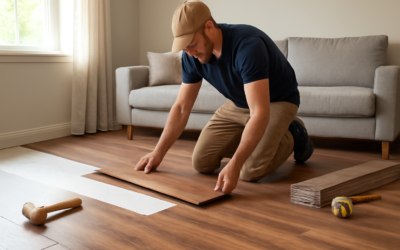
The luxury vinyl tile market exploded from a niche product to the dominant US residential flooring category in less than a decade, and the installer base scaled up just as fast — not always with the training to match. Hiring the right LVT flooring installers for your project means knowing what certifications matter, what fair labor pricing actually looks like in 2026, and which red flags signal that a low bid will cost you twice as much by year two. Get the homework right and you’ll land an installer who delivers a floor that performs for 20-plus years.
- What Separates a Pro Installer From a Crew of Helpers
- What LVT Installers Actually Charge
- Pros of Hiring a Specialist Crew
- Cons and Risks of Going Cheap
- Glue-Down vs Floating: Which Install Method to Specify
- Red Flags When Reading Bids
- Where to Find Qualified LVT Installers
- Questions to Ask Every Installer Before Hiring
- Bottom Line
What Separates a Pro Installer From a Crew of Helpers
LVT looks easy on YouTube. In reality, the difference between a 15-year service life and a year-three failure usually comes down to subfloor prep and moisture handling — neither of which shows on the finished surface. A certified installer carries credentials from CFI (Certified Flooring Installers), INSTALL (International Standards & Training Alliance), or the FCEF (Floor Covering Education Foundation). These programs require apprenticeship hours plus written and hands-on testing on resilient flooring specifically.
Ask any installer for their cert number and what manufacturer training they’ve completed. Shaw, Mohawk, Mannington, COREtec, and Karndean all run product-specific certification programs, and warranty claims usually require proof of trained-installer placement.
What LVT Installers Actually Charge
Labor rates for LVT split by install method. Floating click-lock SPC or WPC over a clean slab runs $1.50-2.50 per sq ft labor in most US markets. Full-spread glue-down LVT runs $2.50-4 per sq ft because it adds adhesive trowel work, roller passes, and longer total time on the floor. Loose-lay LVT with a perimeter or modular tab system splits the difference at $2-3 per sq ft.
Subfloor prep is billed separately and is where pricing varies most. Self-leveling underlayment with a product like Ardex K-15, Mapei Novoplan 2, or Bostik LevelMax runs $1.50-3.50 per sq ft. Moisture mitigation primer (Bostik D-720, Mapei Planiseal VS, Sika MB) adds $1.50-2.50 per sq ft. Demo of existing tile, hardwood, or carpet adds $1-2.50 per sq ft depending on disposal and asbestos abatement requirements.
Pros of Hiring a Specialist Crew
- Real moisture testing per ASTM F1869 (calcium chloride) or ASTM F2170 (RH probe) before adhesive selection.
- Self-leveling with documented flatness to ±1/8 inch over 10 ft (tighter than NWFA’s ±3/16 inch for hardwood).
- Manufacturer-approved trowels — typically a 1/16×1/16×1/16 inch U-notch for glue-down LVT.
- Three-section 100 lb roller pass within open time of the adhesive (usually 15-25 minutes).
- Proper 1/4 to 3/8-inch expansion gap at every wall and column with floating installs.
- Warranty paperwork filed so the manufacturer covers any product defect.
Cons and Risks of Going Cheap
The bottom-of-market handyman who quotes you $1 per sq ft to install LVT will typically skip three things: moisture testing, self-leveling, and roller passes on glue-down product. Each one is invisible at install but predicts a known failure mode. Skipped moisture test on a slab above 5 lb per 1,000 sq ft per 24 hours leads to adhesive release within 12-24 months. Skipped self-leveling shows up as visible humps and dips that telegraph through 4 mm SPC. Skipped roller pass leaves the wear layer with pinhole hollow spots that crack open under chair legs and pet claws.
Low bids also tend to skip expansion gaps. Tight perimeter installs on floating LVT cause lateral buckling the first summer the home runs over 78°F. The fix is a full tear-out and re-lay, which is exactly what you were trying to avoid by going cheap.
Glue-Down vs Floating: Which Install Method to Specify
Floating click-lock is the right call for residential rooms under 1,200 sq ft contiguous, slab-on-grade with managed humidity, and any second-story install where acoustics matter. Glue-down is the better choice for commercial spaces, rooms over 1,500 sq ft, high-temperature exposure areas (sunrooms, south-facing kitchens), and any subfloor with shallow imperfections you can’t fully self-level. Ask your installer to recommend method based on your specific subfloor and traffic, not on what they prefer to install.
Red Flags When Reading Bids
Watch for installers who can’t name a manufacturer-required trowel notch, won’t quote moisture testing as a line item, won’t put the brand and model number on the contract, or bid below $1.25 per sq ft labor. Also be suspicious of any bid that doesn’t include T-molding, 1/4-round, or transition pricing — these always cost $4-8 per linear foot installed and should be itemized.
Reputable installers carry general liability insurance ($1M minimum) and workers’ comp if they have employees. Ask for both certificates before signing.
Where to Find Qualified LVT Installers
Start with manufacturer locator tools — COREtec, Shaw, and Mohawk all list their certified installer networks online. Cross-check with INSTALL.org and CFI’s national directory. Independent specialty flooring retailers usually have a small bench of trusted installers and stake their reputation on them. Avoid lead-aggregator sites that match you with the cheapest available crew regardless of training.
Questions to Ask Every Installer Before Hiring
A 10-minute vetting call separates the trained installers from the helpers:
- What CFI, INSTALL, or manufacturer cert do you hold? Provide cert number.
- What method do you use to test slab moisture? (Correct answers reference ASTM F1869 or F2170.)
- What trowel notch size do you use for glue-down LVT? (Correct: 1/16×1/16×1/16 inch U-notch typically.)
- How do you handle subfloor flatness deviations beyond ±1/8 inch over 10 ft?
- What expansion gap do you maintain at perimeters?
- Are transitions, quarter-round, and T-molding included or itemized separately?
- Do you carry general liability insurance? Can you email a current certificate?
- Who registers the manufacturer warranty after install completion?
Bottom Line
A well-installed LVT floor outlasts the warranty period by years. A poorly installed one fails before the financing is paid off. Spend 30 minutes vetting installer credentials and ask the questions above — it’s the cheapest insurance you can buy on a $6,000-15,000 project.
Prefer to explore on your own?
See how new flooring looks in your actual room in seconds — free, no signup.
Try the free Floor Studio →