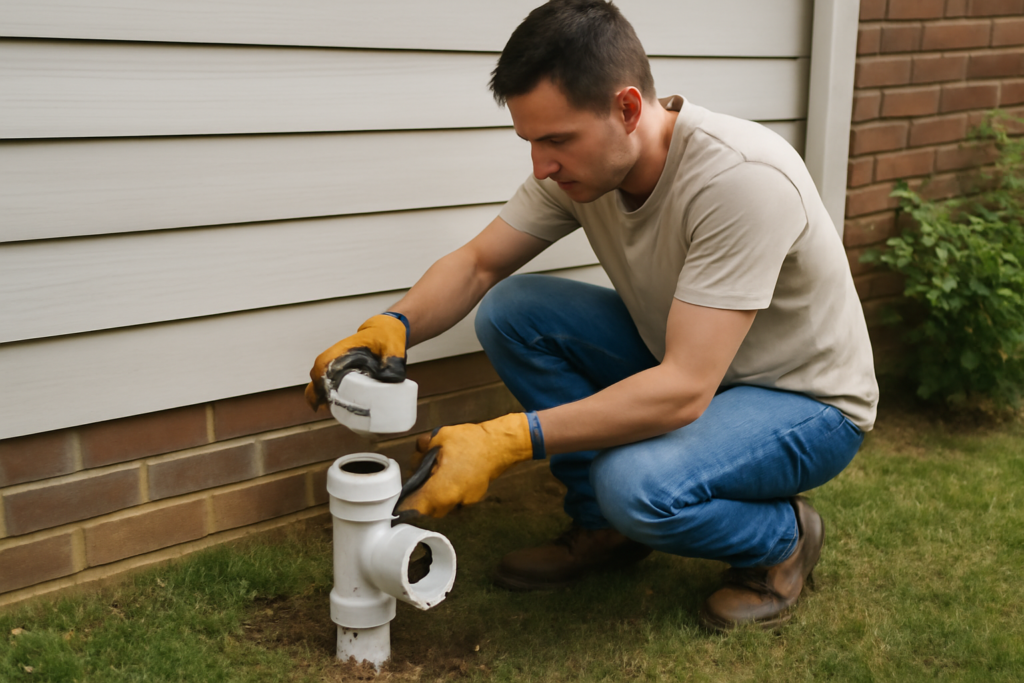
When a whole-house backup sends wastewater bubbling up through the lowest drain in your home, the single most useful thing you can own is a main sewer line cleanout. This capped pipe is your direct access point to the main drain line that carries all your home’s wastewater out to the city sewer or septic system, and it lets you clear a serious clog without tearing anything apart. Knowing where yours is, how to open it, and how to use it can turn a $300 emergency plumber call into a job you handle yourself, or at least let you relieve a backup before disaster spreads.
What a Sewer Cleanout Actually Is
A sewer cleanout is a capped vertical or angled pipe that ties directly into your home’s main sewer line. It provides a straight shot for a drain snake or hydro-jet to reach clogs in the main line, the big pipe that collects everything from every sink, toilet, shower, and washing machine in the house.
The cleanout is usually a 3 or 4 inch diameter pipe made of PVC, cast iron, or ABS, sealed with a threaded or push-fit cap. Some homes have more than one cleanout, positioned at key points along the line. Building codes have required accessible cleanouts on new construction for decades, so most homes built after the 1970s have at least one. Older homes may have them hidden or, in some cases, may lack an accessible cleanout entirely, which complicates clearing a main-line clog.
Where to Find Your Cleanout
Locating your cleanout before you need it saves precious time during a backup. It shows up in a few predictable spots.
- Outside near the foundation: Look for a capped white or black pipe sticking a few inches out of the ground close to the house, often on the side facing the street.
- In the yard along the sewer path: A cleanout may sit partway between the house and the street where the line runs.
- In the basement or crawlspace: Many homes have an indoor cleanout on the main drain before it exits the foundation.
- In the garage or utility area: Some builders place it near the water heater or laundry hookups.
The cap is usually marked, sometimes stamped with the letters CO or the word cleanout, and has a square nut or notch on top for a wrench. If you cannot find one, check inside where the main drain leaves the house and look for a Y-shaped fitting with a capped branch pointing upward.
Signs You Have a Main Line Clog
Knowing when the problem is in the main line, versus a single fixture, tells you whether the cleanout is the right tool. A main-line clog affects multiple fixtures at once because everything drains through that one pipe.
- Multiple drains back up at the same time, especially the lowest ones in the house
- Water backs up into a shower or tub when you flush a toilet
- Gurgling sounds from drains or toilets when you run water elsewhere
- The lowest-level toilet or floor drain overflows first
- Sewage odor or standing water near the floor drain in a basement
If only one sink or toilet is clogged, the problem is local and a plunger or fixture-level snake handles it. When the whole house backs up together, the clog is in the main line and the cleanout is your access point.
How to Open the Cleanout Safely
Opening a cleanout during a backup requires caution, because pressurized sewage may be waiting behind the cap. Stand to the side, never directly over it, and wear gloves and eye protection.
- Clear the area around the cleanout and lay down old towels or a bucket to catch overflow.
- Use a pipe wrench to slowly loosen the cap, turning it counterclockwise just a little at first.
- Listen and watch. If water or air hisses out, back off and let pressure equalize before continuing.
- Once pressure releases, remove the cap the rest of the way. Be ready for backed-up water to drain out, which actually relieves the immediate backup in your home.
Simply opening the cleanout often lets a backed-up main line drain down and relieves the pressure flooding your lowest fixtures, buying you time even before you clear the clog.
Clearing a Clog Through the Cleanout
With the cap off, you can run a drain auger, also called a plumber’s snake, directly into the main line. For a serious main-line clog, a powered auger works better than a hand-crank model, and you can rent a heavy-duty one for $50 to $100 a day.
Feed the cable into the pipe in the direction of the clog, usually toward the street. Push slowly and crank steadily until you feel resistance, which is the clog. Work the auger back and forth to break through it, then continue feeding to clear the full blockage. Run water down a nearby drain to flush the line and confirm it flows freely. Retract the cable slowly, since it will come back dirty, and have your bucket and towels ready. If the auger hits a hard, immovable obstruction, you may be dealing with tree roots or a collapsed pipe that needs professional equipment.
When to Call a Professional
Some main-line problems are beyond a DIY snake. Tree roots infiltrating the pipe are one of the most common causes of recurring main-line clogs, and clearing them fully often requires a professional hydro-jetter that blasts the line clean with high-pressure water.
Call a plumber when the clog returns quickly after you clear it, when your auger cannot break through, or when you suspect a broken or collapsed pipe. A pro can run a camera down the line to see exactly what is happening, which pinpoints roots, cracks, bellies, or offsets that no snake will fix. A camera inspection runs $200 to $500, and repairs range from spot fixes to full line replacement. If your home has no accessible cleanout at all, a plumber can install one, which pays for itself the first time you avoid pulling a toilet to reach the line.
Preventing Future Main Line Clogs
Keeping the main line clear beats clearing it after a backup. Most main-line clogs come from things that never should have gone down the drain, or from roots seeking water.
- Never flush wipes, paper towels, feminine products, or grease, the top causes of main-line blockages.
- Keep kitchen grease out of drains, since it congeals and traps debris in the line.
- Have the line professionally cleaned or hydro-jetted every few years if you have a history of clogs or trees near the sewer path.
- Consider a root-killing treatment if tree roots repeatedly invade an older clay or cast-iron line.
Locate your main sewer line cleanout today, learn how to open it, and keep a wrench and gloves nearby. When a whole-house backup strikes, that little capped pipe is the difference between a controlled fix and raw sewage spreading across your floors.