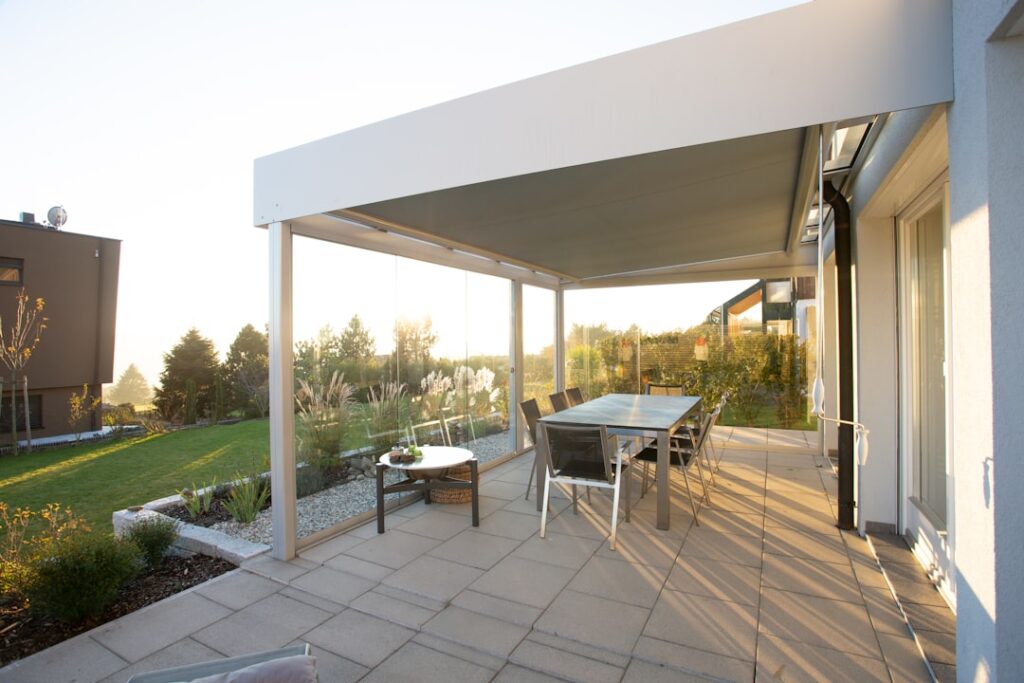
Motorized screen walls get all the marketing, but they start around $2,000 per opening installed — and for many porches, a hand-operated system does the same job for a fifth of the money. Manual retractable patio screens roll shade and insect mesh down from a cassette when you want an enclosed porch, then disappear back into the housing when you want open air, all without wiring, remotes, or motors that fail out of warranty. The category splits into two mechanisms with very different price points and use cases, and the difference between a screen that lasts a decade and one that jams in year two comes down to track design and honest wind limits. Here’s how the systems work, what they cost, and what to check before ordering.
Two Mechanisms: Spring-Balanced vs. Crank-Operated
Spring-balanced (pull-down) screens work like a heavy-duty window shade: the mesh wraps a spring-loaded roller tube inside an aluminum cassette mounted at the opening’s head, and you pull a bottom bar down along side tracks to any height, where it locks. Release the latch and the spring retracts it. These handle openings up to roughly 8 to 10 feet wide and are the affordable end of the category — $150 to $500 per opening for DIY kits.
Crank-operated screens use a gear mechanism and removable or fixed crank handle to drive the roller, the same hardware family as manual retractable awnings. The gearing gives you controlled travel on much larger spans — up to 12, sometimes 16 feet wide — and holds any intermediate position without a latch. Expect $400 to $1,200 per opening for quality manual crank systems, still roughly half the equivalent motorized price. Crank systems also accept heavier meshes (solar screen fabric, vinyl-coated privacy weaves) that overwhelm spring rollers on wide spans.
Track Design Is the Whole Ballgame
Cheap retractable screens fail at the edges: wind pops the mesh out of shallow tracks, and once a screen has blown out repeatedly, the edges fray and the roller tracks crooked. Quality systems solve this with a zipper track — the mesh edge is welded to a keder cord or zip strip that rides captive inside the side rail, so the fabric physically cannot leave the track. Zipper-tracked manual screens tolerate breezes in the 20 to 30 mph range while deployed; open-track budget screens should be retracted above about 10 to 15 mph. If your porch faces prevailing wind or you’re near open water, treat zipper track as mandatory and expect it to add $100 to $250 per opening. Whatever you buy, retract screens for storms — no residential screen system is rated to ride out severe weather deployed, and retracting is the entire point of the design.
Mesh Options and What They Do
- Standard fiberglass insect mesh (18×14): The default — keeps out mosquitoes and flies, nearly transparent, maximum airflow.
- No-see-um mesh (20×20): Tighter weave for gnats and midges near water; slightly reduces airflow and view.
- Solar mesh (80-95 percent shade factor): Blocks most solar heat gain and glare while preserving outward view — transforms a west-facing porch in July, cutting perceived temperature substantially. Doubles as daytime privacy screening.
- Pet-resistant mesh: Vinyl-coated polyester that shrugs off claws; heavier, so confirm the roller is rated for it.
Most manufacturers let you choose mesh per opening. A popular setup is solar mesh on the western exposure and standard insect mesh everywhere else. Note that insect protection only works if every opening in the porch is screened and the gaps are managed — brush seals at the bottom bar and tight track margins matter more than mesh count.
Real-World Pricing
For DIY kits: spring-balanced screens for a standard 6-to-8 foot opening run $150 to $350 (brands and lines to search include Snavely Kimberly Bay, EZ Screen room products, and various Amazon-direct cassette kits), while zipper-track spring systems run $300 to $600. Manual crank systems from serious screen brands run $400 to $900 per opening in common sizes, and custom-sized zipper-track crank screens from dealers land at $700 to $1,500 installed per opening. A three-opening porch, done well with manual zipper-track systems, totals roughly $1,500 to $3,500 installed — versus $6,000 to $12,000 for the same porch motorized. That gap buys a lot of forgiveness for the ten seconds of cranking per screen.
Ordering is measure-driven: width to the nearest 1/8 inch at top, middle, and bottom of each opening (use the smallest), plus height both sides. Out-of-square openings up to about 1/2 inch are absorbed by the tracks; worse than that needs shimming during install.
DIY Installation: A Half-Day Per Opening
Manual systems are genuinely DIY-friendly because there’s no wiring. The sequence: mount the cassette level across the head of the opening (into solid framing or with proper anchors into masonry — the cassette carries the roller’s weight plus pull loads), plumb and fasten the side tracks so they’re parallel within about 1/8 inch, feed the bottom bar into the tracks, and test travel. The two failure points are an unlevel cassette, which makes the mesh telescope to one side of the roller over time, and pinched or bowed tracks, which cause mid-travel sticking. A 4-foot level, a helper for the cassette lift, and patience with the track spacing solve both. Budget 3 to 5 hours for the first opening and half that for each additional one. Surface-mounting to the face of the opening is easier than recess-mounting between jambs and hides small measurement sins.
Living With Manual Screens
Day to day, a spring screen takes one hand and three seconds; a crank screen takes ten seconds of handle turns. The habits that extend their life: retract screens before storms and before winter (or at minimum lock them down fully — half-deployed is the most vulnerable position), brush tracks out seasonally and hit them with dry silicone spray (never oil, which gums with grit), and hose the mesh gently with the screen fully deployed a couple of times a season, letting it dry before retracting so the cassette doesn’t incubate mildew. Spring tension on pull-down units is adjustable at the roller end if retraction gets lazy after a few years — usually a quarter-turn or two. Replacement mesh-and-spline service, if a panel is ever damaged, runs $80 to $200 per opening from a screen shop, far cheaper than replacing the system.
Sizing Quirks and Odd Openings
Not every porch opening is a tidy rectangle, and this is where manual systems show their flexibility. Openings wider than a single system’s limit can be split with an intermediate post — a 16-foot span becomes two 8-foot zipper-track screens meeting at a 3-inch aluminum mullion, which costs far less than one oversized custom unit and gives you independent operation of each half. Angled gable ends can’t take a roll-down screen directly; the standard solution is a fixed screen panel in the triangle above a rectangular retractable below. For openings shallower than the cassette (some porch headers leave only 3 inches of mounting face), look for low-profile cassettes around 3-1/4 inches square, or mount to the ceiling plane instead of the face.
Height matters less than width mechanically, but reachability matters for spring systems — a pull-bar centered at 9 feet needs the included pull-stick, and past 10 feet a crank system becomes the practical choice regardless of width. Measure with the porch furniture in place, too; a bottom bar that lands behind the sofa back never gets used.
Manual or Motorized: The Honest Comparison
Choose manual retractable patio screens when your openings are 12 feet or narrower, you have a few of them rather than eight, and the users are able-bodied — the cost advantage is enormous and there is simply less to break. Motorization earns its price on very wide spans (14 feet-plus, where manual operation gets physically awkward), on high openings you can’t reach, for accessibility needs, and when you want wind sensors that auto-retract the screens while you’re away. Some crank-system frames accept motor retrofits later, which is worth confirming at purchase if you’re undecided — buy the zipper-track manual version now, add the motor in five years if you ever actually miss it. Most people never do.