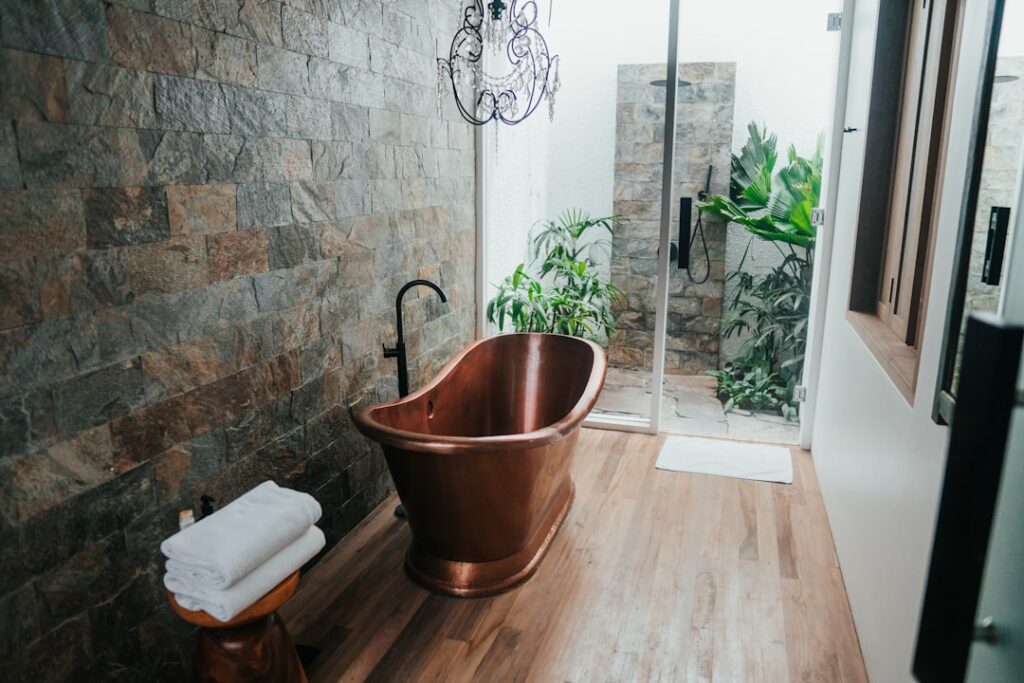
Scroll through enough mixed metals in bathroom images and you will notice the best ones never feel random, even though the whole point is combining finishes that do not match. The trick designers use is restraint: pick a dominant metal for most of the room, then add one or two accents on purpose. A common mistake is treating “mixed metals” as permission to buy every finish the store carries, which leaves a bathroom looking like a plumbing showroom instead of a designed space. Done right, the contrast between a matte black faucet and warm brass sconces adds depth that a single-finish room can never achieve.
- Why Mixing Metals Works
- The 2-3 Finish Rule
- Warm vs. Cool: Understanding Undertones
- Finish-by-Finish Pairing Guide
- Chrome and Matte Black
- Brushed Nickel and Brass
- Matte Black and Brass or Gold
- Oil-Rubbed Bronze and Brushed Nickel
- Coordinating the Key Elements
- Reading the Photos: What the Best Images Have in Common
- Style Examples That Work
- Cost Considerations
- Mistakes to Avoid
- Frequently Asked Questions
Why Mixing Metals Works
A room finished entirely in polished chrome is safe but flat. Introduce a second finish and you create visual layers, the same way a designer mixes textures in fabric or tones in flooring. Contrast reads as intentional and custom, which is exactly the feeling a builder-grade bathroom lacks. The eye pauses on the difference between a cool nickel faucet and a warm brass drawer pull, and that small pause is what makes a space feel curated rather than assembled from one catalog page.
The 2-3 Finish Rule
The single most useful guideline is to limit yourself to two or three metal finishes per bathroom. Two is elegant and low-risk. Three is the ceiling for most rooms; a fourth finish almost always tips into chaos. Within those two or three, assign roles:
- Dominant metal (about 60 to 70 percent): the finish that appears most often, usually the faucet, showerhead, and other plumbing.
- Secondary metal (about 20 to 30 percent): cabinet hardware, towel bars, or the mirror frame.
- Accent metal (about 10 percent): a light fixture, a single mirror, or a small tray, used sparingly to add a spark.
When one finish clearly leads and the others support, the room looks composed. When all three fight for equal space, it looks unplanned.
Warm vs. Cool: Understanding Undertones
Every metal finish leans warm or cool, and knowing which is the key to combinations that feel right.
- Cool tones: chrome (bright, blue-tinged), brushed nickel (soft, silvery), and stainless.
- Warm tones: brass, gold, champagne bronze, and copper.
- Neutral bridges: matte black and oil-rubbed bronze, which pair with almost anything because they read as near-neutral.
The most reliable formula is one cool plus one warm, tied together with a neutral. Brushed nickel plumbing (cool) with brass hardware (warm) and a matte black mirror frame (neutral) is a combination that looks designed every time. If you want a subtler, more tonal look, stay within one temperature family, for example champagne bronze with brass, and vary the finish sheen instead.
Finish-by-Finish Pairing Guide
Chrome and Matte Black
Crisp and modern. Chrome plumbing with matte black hardware and a black mirror frame reads clean and graphic, ideal for a contemporary or transitional bath.
Brushed Nickel and Brass
The most popular mix right now. The cool nickel grounds the room while warm brass adds glow. Works in nearly any style from farmhouse to modern traditional.
Matte Black and Brass or Gold
Dramatic and high-contrast. Black plumbing with brass sconces and a gold-framed mirror feels boutique-hotel luxe. Best in rooms with enough light to carry the drama.
Oil-Rubbed Bronze and Brushed Nickel
A softer, more traditional pairing. The bronze adds age and warmth; the nickel keeps it from feeling heavy. Great for craftsman and rustic baths.
Coordinating the Key Elements
Certain fixtures anchor the palette, so decide their finishes first.
- Faucet and shower trim: usually the dominant finish. If these two match, the room already feels cohesive.
- Cabinet hardware: the easiest place to introduce your secondary metal, and cheap to swap later.
- Lighting: a strong spot for your accent metal. A brass vanity light over nickel plumbing is a classic move.
- Mirror frame: can match the lighting to create a pair, tying the accent metal together across the wall.
- Towel bars and hooks: match these to either the plumbing or the hardware; do not introduce a fourth finish here.
A helpful rule: fixtures that sit close together should either match or contrast clearly. A brass faucet with a slightly different gold drain right beside it looks like a mistake, not a mix. Keep touching items in the same finish and reserve the contrast for elements across the room.
Reading the Photos: What the Best Images Have in Common
When you study a room that photographs well, look past the fixtures to the pattern underneath. The standout examples almost always follow the same quiet logic. First, one finish dominates the frame, usually the plumbing, so your eye has a home base. Second, the accent metal appears at least twice, never just once, so it looks deliberate rather than orphaned. A lone brass hook in a nickel room reads like a leftover; the same brass repeated in the lighting and the mirror reads as a designed thread. Third, the metals share the room with warm materials like wood, stone, and natural fiber, which soften the hardness and let the finishes glow instead of clash. Recreating that formula matters far more than matching the exact finishes in any single photo.
Another detail the best images share is repetition of the accent across the vertical plane. A brass sconce at eye level, a brass faucet at the counter, and a brass drawer pull below draw an invisible line down the wall that ties the whole vignette together. When you plan your own room, sketch where each finish will land and make sure the accent metal appears at two or three heights rather than clustering in one corner.
Style Examples That Work
Modern spa: matte black plumbing, warm oak vanity, brushed brass sconces and mirror, over large-format stone-look tile. Modern farmhouse: brushed nickel faucet, matte black cabinet pulls, black gooseneck lighting, and a wood-framed mirror. Boutique glam: polished chrome shower trim, champagne gold hardware, and a large gold sunburst mirror as the accent. Each of these limits itself to two or three finishes and gives one a clear lead.
Cost Considerations
Mixing metals does not have to be expensive because the accents are usually the cheapest items. Cabinet hardware runs $3 to $15 per piece, so swapping pulls to introduce a second finish is a low-cost, high-impact change. A statement light fixture in a contrasting metal runs $80 to $300. Faucets and shower systems, the priciest pieces, are where you commit to the dominant finish, so choose that first and build the accents around it. Because hardware and lighting are easy to change, you can evolve a mixed-metal scheme over time without redoing the plumbing.
Mistakes to Avoid
- Using four or more finishes. Beyond three, cohesion collapses. Edit down.
- Giving every metal equal weight. Without a clear dominant finish, the room looks accidental.
- Mismatching touching fixtures. Items side by side should match; save contrast for across the room.
- Ignoring undertones. Two warm metals that clash (a yellow brass next to a rose-gold) can look off even though both are “warm.”
- Forgetting the neutral bridge. A little matte black or bronze ties warm and cool together.
- Copying an image without checking your light. Bathroom images are staged with ideal lighting; matte black and dark bronze need adequate light to avoid looking gloomy.
Frequently Asked Questions
How many metal finishes can I mix in one bathroom?
Two or three. Two is the safest and most elegant; three is the maximum for most rooms. A fourth finish almost always looks cluttered.
Does the faucet have to match the shower head?
It is the easiest way to keep a room cohesive, so yes when possible. If they differ, make it a deliberate, clearly contrasting choice rather than a near-match.
Can I mix warm and cool metals together?
Absolutely, and it often looks best. Pair one cool finish with one warm finish and tie them together with a neutral like matte black or oil-rubbed bronze.
What metal goes with everything?
Matte black and oil-rubbed bronze are the most versatile because they read as near-neutral and bridge both warm and cool finishes.