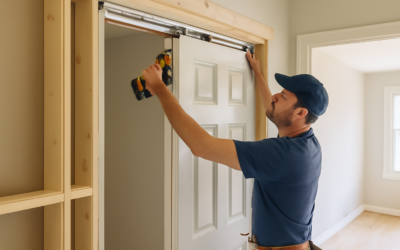
Pocket doors have shed their reputation as clunky, rattly relics that jump the track. Today’s modern pocket door systems glide on soft-close hardware, disappear cleanly into the wall, and come in sleek glass, flush-panel, and frameless designs that fit contemporary interiors perfectly. They reclaim the roughly 10 to 15 square feet of floor space that a swinging door needs to arc through — space that is priceless in small bathrooms, home offices, laundry rooms, and tight hallways. If you have ever fought a door that bangs into a vanity or blocks a light switch, a pocket door is the elegant fix.
Part of our Windows & Doors guide — explore the full guide →
This guide covers modern styles and hardware, the wall requirements you must plan for, and how installation actually works, so you can decide whether a pocket door fits your project.
Why Pocket Doors Are Having a Moment
The renewed popularity comes down to two things: better hardware and better design. Modern kits use precision-machined tracks, ball-bearing rollers, and soft-close dampers that eliminate the slamming and derailing that plagued old units. Meanwhile, designers love the clean, minimal look of a door that vanishes into the wall, leaving a flush, uninterrupted surface. In an era of open, space-efficient floor plans, a door that takes up zero swing space is a genuine asset.
Modern Pocket Door Styles
The door slab itself sets the aesthetic, and modern options go well beyond the plain hollow-core panel.
- Frosted or clear glass: A framed or frameless glass panel lets light pass between rooms while maintaining privacy with frosting or reeded (fluted) glass. Popular for bathrooms, offices, and laundry rooms that lack windows.
- Flush flat-panel: A smooth, minimalist slab with no molding, often painted to match the wall for a seamless, hidden-door effect.
- Reeded and fluted glass: A very on-trend choice that blurs the view for privacy while adding texture and a designer feel.
- Barn-style crossover: Some kits combine a rustic or shaker slab with concealed pocket hardware for a warmer look.
- Double pocket doors: Two slabs that meet in the middle and disappear into opposite walls, ideal for wide openings between living spaces.
Hardware That Makes the Difference
The single biggest upgrade over old pocket doors is the hardware. Look for these features when choosing a kit:
- Soft-close mechanism. Dampers slow and pull the door gently closed and open, eliminating slams and finger pinches.
- Heavy-duty track and rollers. Ball-bearing steel rollers rated for the door’s weight glide smoothly for years. Match the kit’s weight rating to a solid-core or glass slab.
- Flush and edge pulls. Because there is no room for a knob, modern pocket doors use recessed flush pulls and an edge pull that pops out to grab the leading edge.
- Privacy locks. Slim mortise-style privacy latches are essential for bathrooms and bedrooms.
- Adjustable hangers. Good kits let you fine-tune the door’s height and plumb after hanging, so it sits perfectly in the opening.
Well-known frame systems from brands like Johnson Hardware or Cavity Sliders are worth the small premium over bargain kits, because the frame and track are what you cannot easily replace once the wall is closed up.
The Wall Requirement You Must Plan For
Here is the catch that surprises many homeowners: a pocket door needs a hollow wall cavity to slide into that is roughly as wide as the door itself. For a standard 32-inch door, the wall needs enough space for a pocket about 66 inches wide — the door plus the frame. That means you cannot simply add a pocket door to any wall.
Two big constraints follow from this:
- No plumbing or electrical in the pocket wall. The cavity must be clear, so wiring and pipes have to be rerouted, and outlets and switches cannot sit where the pocket goes.
- Wall thickness and structure. The pocket frame replaces normal studs with a split-stud cage, so the wall’s load-bearing status matters. A load-bearing wall requires a proper header and careful framing — a job for a pro.
The best time to install a pocket door is during a remodel or new construction when the wall is already open. Retrofitting into a finished wall means opening the drywall on at least one side.
How Installation Works
A modern pocket door kit includes a pre-engineered frame that installs in the rough opening. The general sequence:
- Frame the rough opening. Build an opening about twice the door width plus clearance, per the kit’s spec, with a proper header if the wall bears load.
- Install the pocket frame. Set and level the manufacturer’s split-jamb frame and header track in the opening, shimming it plumb and square — this step determines whether the door glides or binds.
- Hang the door. Attach the roller hangers to the top of the slab and hook them onto the track, then adjust for height and plumb.
- Close in the wall. Screw drywall to the frame’s steel studs using the special short screws provided, so nothing protrudes into the pocket to scratch the door.
- Install hardware and trim. Add the flush pulls, edge pull, privacy lock, jamb stops, and the split casing that trims the opening.
Precise leveling of the frame is everything. A frame that is even slightly out of plumb causes the door to drift open or closed on its own and to bind in the pocket.
Where Pocket Doors Work Best
Pocket doors pay off most in specific situations. Small bathrooms are the classic case — a swinging door that hits the vanity or toilet is a daily annoyance a pocket door eliminates entirely. Home offices and dens benefit from a door that slides away when you want the room open to the house and closes for privacy on calls. Laundry rooms, pantries, and closets gain full use of the doorway with no swing arc eating into the space.
They also excel at connecting two rooms flexibly, like a dining room to a kitchen or a primary bedroom to an ensuite, where you want the option of a fully open passage most of the time. Double pocket doors make a dramatic, disappearing divider between living spaces. Where pocket doors make less sense is on exterior walls (no room for the pocket, and insulation concerns), heavily wired or plumbed walls, and narrow walls that cannot house the frame — in those cases a barn door sliding on the wall surface is the better space-saving alternative.
Maintenance and Troubleshooting
Modern pocket doors are far more reliable than their predecessors, but a little care keeps them gliding for decades. Because the track is at the top and the door hangs from rollers, keep the track clean and give the rollers an occasional shot of dry lubricant if operation gets stiff. Most quality kits allow height and plumb adjustments through access points, so if the door begins to drift open or rub, you can often re-level it without opening the wall.
If the door jumps the track or binds — the most common old-style complaints — it almost always traces to a frame that was installed out of plumb or a low-quality kit with undersized rollers, which is exactly why investing in a good frame system upfront matters. The soft-close dampers are typically replaceable if they wear out. Avoid slamming the door hard past the soft-close mechanism, and do not hang heavy items on the slab, which stresses the rollers beyond their rating.
Cost and Value
A quality pocket door kit runs roughly $150 to $400 for the frame and hardware, plus the door slab ($100 to $500+ depending on glass or solid-core). Professional installation, especially a retrofit into an existing or load-bearing wall, can add $500 to $1,500 or more because of the framing and drywall work. New construction and remodels are far cheaper since the wall is already open. Given the space it reclaims and the clean look it delivers, a modern pocket door is well worth the investment in the right spot.
Final Thoughts
A modern pocket door combines space savings with a sleek, contemporary look that swinging doors simply cannot match — provided you plan for the wall cavity it needs. Choose a quality frame and soft-close hardware, keep plumbing and wiring out of the pocket, and get the frame installed dead plumb and level. In small bathrooms, offices, closets, and tight passages, it is one of the smartest ways to gain usable floor space and a designer edge in a single upgrade.