Modern shiplap has quietly moved past the rustic farmhouse trend and become a flexible design tool you can use in almost any room. At its core, shiplap is a series of overlapping boards joined by a rabbet (a notched lip cut into the top and bottom edge), which creates that signature evenly spaced groove called the reveal. What makes the look feel current rather than country is how you handle the details: tighter spacing, smoother surfaces, bolder colors, and orientation choices that break from the expected horizontal run. Done well, it adds architectural texture without committing your home to a single decorating era.
What Shiplap Actually Is
The defining feature is the rabbet joint. Each board has a step cut into opposing edges so the pieces overlap and self-space, leaving a uniform channel between them. That channel, the reveal, is usually set by slipping a coin behind each board as you fasten it. A nickel gives you roughly a 1/8-inch reveal; a penny is closer to 1/16 inch for a tighter, more refined line.
True shiplap differs from tongue-and-groove and from nickel-gap paneling, though the finished appearance overlaps. For most homeowner projects the exact joint matters less than consistency, because a clean, repeating gap is what reads as intentional design rather than a patch job.
Modern vs. Farmhouse Styling
The boards are often the same; the styling is what changes. Farmhouse shiplap leans on wide white-painted boards, slight surface texture, and a cozy, distressed feel. Modern shiplap pushes in the opposite direction.
- Cleaner lines: Smooth, knot-free painted surfaces instead of visible wood grain.
- Board width: Either very wide (8 to 12 inches) for a calm, minimal grid, or narrow (3 to 4 inches) for a crisp, linear rhythm.
- Orientation: Vertical runs that raise the perceived ceiling height, or even diagonal layouts, rather than the default horizontal.
- Color: Dark, moody tones such as charcoal, deep navy, forest green, or near-black, instead of bright white.
- Micro-reveals: A tighter 1/16-inch gap that looks deliberate and architectural.
Pairing wide smooth boards in a saturated color with hidden fasteners is the fastest way to land a contemporary result.
Materials to Choose From
Primed MDF and Pine Boards
Pre-primed MDF is the most popular choice for painted modern shiplap because it has no grain or knots to telegraph through the paint, giving you that flawless, furniture-grade finish. Primed pine costs a little more but holds up better to bumps and is easier to repair. Both are ideal for dry interior walls.
PVC for Bathrooms and Wet Areas
In bathrooms, laundry rooms, or near tubs, use cellular PVC shiplap. It will not swell, rot, or grow mold the way MDF will if it gets repeatedly wet. It costs more per square foot but is the right call anywhere humidity spikes.
Real Wood
Solid wood (pine, poplar, cedar) lets you stain rather than paint and brings genuine grain. For a modern stained look, choose a rift or quarter-sawn board with straight grain and a matte sealer instead of a glossy varnish.
Where to Use Modern Shiplap
Accent walls behind a bed, sofa, or media console are the most common starting point and the lowest-risk way to test the look. From there, the options open up:
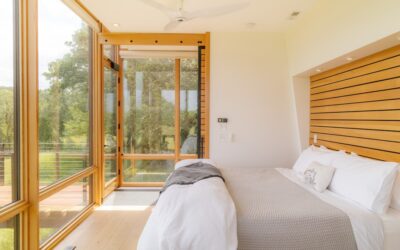
- Ceilings: A shiplap ceiling draws the eye up and adds quiet drama; vertical-grain ceilings feel especially clean.
- Fireplaces: A full floor-to-ceiling surround in a dark color makes the fireplace the room’s anchor.
- Kitchen islands: Wrapping an island base ties cabinetry into the wall treatment.
- Stairwells and entries: Vertical boards in a hallway add height and a tailored, finished feel.
Avoid covering every wall in a room. Modern design relies on contrast, so one feature surface usually has more impact than a fully clad space.
Installation Basics
The work is straightforward but unforgiving of shortcuts, since any wave or tilt is amplified by all those parallel lines. Start by mapping the wall.
- Find and mark the studs with a stud finder, typically every 16 inches on center. Fasteners must hit framing, not just drywall.
- Establish a level baseline. Snap a level line for your first board; never trust the floor or ceiling to be straight.
- Cut and dry-fit boards, staggering the seams between rows like brickwork so joints do not stack.
- Set the reveal by placing a nickel or penny on the board below as a spacer before nailing.
- Fasten with a brad nailer using 18-gauge brads (typically 1-1/2 to 2 inches long) angled into the studs. An 18-gauge nail leaves a hole small enough to disappear with filler.
- Caulk, fill, and paint. Caulk the perimeter and any inside corners, fill nail holes, then prime any cuts and apply two coats of paint. Leave the reveals themselves uncaulked, since the gap is the whole point.
A satin or eggshell finish is the modern sweet spot. It wipes clean and catches light gently without the plasticky shine of semi-gloss.
Color Trends Worth Considering
Crisp whites still work, but they now read as transitional rather than cutting-edge. Deep, desaturated colors define the current modern look: charcoal and graphite, off-black, inky navy, olive and forest greens, and warm clay or terracotta tones. A useful trick is painting the shiplap and the adjacent trim and even the ceiling in the same dark color, which removes visual breaks and makes the texture, not the boundaries, the star.
Cost Expectations
Material runs roughly $1 to $7 per square foot depending on what you choose. Basic primed MDF or pine sits at the low end, around $1 to $3 per square foot, while PVC and quality real wood climb toward $4 to $7. Pre-cut shiplap kits cost more for the convenience. If you hire a carpenter, installed labor typically adds $2 to $5 per square foot, so a professionally finished accent wall often lands somewhere between $4 and $12 per square foot all in. A single 100-square-foot accent wall done yourself in MDF can come in under $300 including paint and fasteners.
Maintenance
Painted shiplap needs little care beyond occasional dusting; a microfiber cloth or a vacuum brush attachment along the reveals keeps the grooves clean. Wipe smudges with a damp cloth and mild soap. Touch up nicks with leftover paint, and in humid rooms confirm exhaust fans are doing their job to protect MDF. PVC simply wipes down. Expect a repaint every several years only if the color stops fitting your taste, not because the surface fails.
Alternatives to Consider
If shiplap is not quite right, several treatments give similar texture with a different attitude. Vertical slat wall panels read more contemporary and add depth. Board-and-batten brings a paneled, tailored look with raised vertical strips. Beadboard offers finer lines for a softer effect, and plaster or limewash finishes deliver organic texture with no boards at all. Each one solves the same problem, which is breaking up a flat wall, just with its own visual voice.
Whether you clad a single bedroom wall or wrap an entire fireplace, the principles stay the same: keep lines level, hold the reveal consistent, choose a smooth material for paint or straight grain for stain, and let one confident color carry the room. Handled that way, modern shiplap delivers architectural character that looks designed rather than dated.