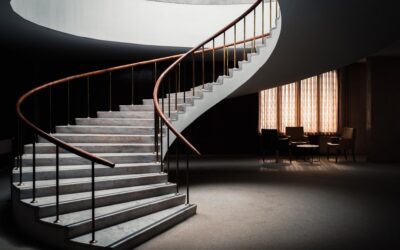
In most two-story homes, the staircase is the largest single piece of built-in furniture, and it sits right in the sightline from the front door. That is why modern staircase ideas have become one of the most requested remodel upgrades: replacing a carpeted, spindle-heavy stair with clean lines can change how the entire entry and living room feel. Modern design leans on a short list of ingredients, including thick treads, minimal railings, honest materials like steel and glass, and light. How you combine those ingredients, and how much structure you are willing to change, decides the budget.
Part of our Stairs & Stair Flooring guide — explore the full guide →
- What Defines Modern Staircase Ideas
- Floating and Cantilevered Stairs
- Mono and Double Steel Stringers
- Choosing Tread Materials
- Railings: Glass, Cable, and Flat Bar
- Lighting Built Into the Stair
- Updating an Existing Staircase to a Modern Look
- Coordinating Stairs With Surrounding Floors
- Code and Safety Considerations
- Frequently Asked Questions
- Final Thoughts
What Defines Modern Staircase Ideas
Modern stairs strip away ornament. Instead of turned balusters, curved volutes, and carved newel posts, you get square or flat profiles, fewer parts, and strong contrast between materials. The staircase reads as a sculptural object rather than a hallway. Four features show up again and again:
- Thick, square-edged treads, often 2 to 3-1/2 inches, with no bullnose overhang
- Open risers or risers set flush so the stair looks like a stack of solid blocks
- Minimal railings in glass, flat steel bar, cable, or a solid half-wall
- A limited palette, usually one wood tone plus black, white, or brushed metal
You do not need all four. Swapping carpet for square-nose white oak treads and black metal balusters gets you most of the look on an existing stair for a fraction of a full rebuild.
Floating and Cantilevered Stairs
The floating stair is the signature modern look. Each tread appears to project from the wall with no visible support, usually because a steel bracket or plate is anchored deep inside a reinforced wall. The effect is striking, and it lets light and sightlines pass through the entire flight.
True cantilevered stairs are engineered products. The supporting wall generally needs added blocking, a steel channel, or solid LVL framing, and the bracket design has to be approved by a structural engineer. Installed costs for a straight residential flight typically run $10,000 to $30,000. They also fall under the IRC 4-inch sphere rule for openings between treads when the total rise exceeds 30 inches, which designers handle with thin steel rods, a glass panel, or closely spaced treads.
Mono and Double Steel Stringers
A single central steel stringer (a mono stringer) with treads bolted on top gives a floating look at a lower price and without needing a special wall. The stringer is often a rectangular steel tube or a folded plate, powder-coated matte black or white. Double stringers in flat steel plate set at each side of the treads produce a crisp, industrial profile common in lofts and contemporary homes.
Custom steel stringer stairs usually run $6,000 to $15,000 for a straight flight, depending on steel thickness, finish, and tread material. Fabrication takes several weeks, so plan the lead time into your project schedule.
Choosing Tread Materials
White Oak
Rift and quartersawn white oak is the default modern choice because its straight grain looks calm and it takes clear or natural-look finishes well. Solid 1-3/4 inch treads cost about $120 to $250 each unfinished. A matte water-based polyurethane or hardwax oil keeps the pale color from ambering.
Walnut and Dark Woods
Walnut adds warmth and contrast against white walls, at roughly $180 to $350 per tread. It is softer than oak (about 1,010 on the Janka scale versus 1,360 for white oak), so expect visible wear in heavy traffic homes.
Concrete, Stone, and Metal
Precast or poured concrete stairs and porcelain slab cladding suit minimalist and industrial interiors. Perforated or checker-plate steel treads work in lofts but are loud underfoot. If you choose porcelain or stone, specify a textured or honed finish with a wet dynamic coefficient of friction of at least 0.42 for slip safety.
Railings: Glass, Cable, and Flat Bar
Railing choice has a large effect on both style and cost. Modern railings generally cost more per foot than wood balusters because the materials and hardware are specialized.
| Railing type | Look | Installed cost per linear ft |
|---|---|---|
| Square metal balusters | Clean, affordable update | $60 to $150 |
| Horizontal flat bar | Linear, architectural | $150 to $350 |
| Cable rail | Open, light | $150 to $300 |
| Frameless glass | Nearly invisible | $250 to $600 |
Horizontal rails and cables can create a climbable ladder effect, which some local codes restrict in homes with children. Glass must be tempered or laminated safety glass, typically 1/2 inch thick, set in a base shoe or on standoff clamps. Always confirm guardrail height (36 inches minimum under the IRC, higher in some jurisdictions) and handrail height between 34 and 38 inches.
Lighting Built Into the Stair
Integrated lighting is what makes a modern staircase look expensive at night. Common approaches include LED strip in a routed groove on the underside of each tread nosing, recessed step lights in the wall every second step, and a linear LED channel along the handrail. A warm 2700K to 3000K color temperature keeps the effect comfortable rather than clinical.
Plan lighting before the treads go in. Running wiring through a steel stringer or behind a finished wall later is expensive. A low-voltage driver hidden in a nearby closet or under-stair storage feeds all the fixtures, and a motion sensor or dimmer controls them.
Updating an Existing Staircase to a Modern Look
Most homeowners do not need a new structure. A traditional stair can be modernized in stages:
- Remove carpet and inspect the treads underneath. Builder-grade pine or particleboard treads get replaced.
- Install square-nose retrofit treads in oak, about $45 to $110 each, cut to fit over the existing stringers.
- Paint or clad the risers in white or a dark matte color for contrast.
- Swap balusters for square black metal, and replace a curved newel with a square box newel.
- Paint the handrail black or replace it with a simple square profile.
This approach usually lands between $3,000 and $8,000 for a typical 14-step stair professionally installed, or around $1,500 to $3,000 in materials for a capable DIYer.
Coordinating Stairs With Surrounding Floors
A modern staircase looks best when it relates to the floor at its base and top landing. The simplest approach is to match species and finish: if the main level is white oak engineered flooring, order solid white oak treads and have them finished with the same stain and sheen. Engineered planks cannot be used as stair treads on their own, but most manufacturers sell matching stair nosing or will recommend a compatible solid tread.
A deliberate contrast also works. Dark walnut treads against pale oak floors, or light oak treads over polished concrete, make the staircase a focal point. What rarely works is a near miss, where the tread color is almost, but not quite, the same as the floor. If exact matching is not possible, go clearly lighter or darker. Order a finished sample tread and view it in your own lighting at morning and evening before committing to the full set.
Landing transitions matter too. A flush stair nosing that sits level with the top floor looks cleaner than an overlap nosing, which leaves a visible lip. On a remodel, ask the installer to plan the landing nosing first so the top step lines up properly with the finished floor height.
Code and Safety Considerations
Modern design sometimes pushes against code. Treads without a nosing are allowed, but risers must still be 7-3/4 inches or less and treads at least 10 inches deep under the IRC. A minimum headroom of 6 feet 8 inches applies, and the handrail must be graspable, which rules out some wide flat rails unless a separate grip rail is added. Local building departments can be stricter than the IRC. Any work that changes stringers, walls, or the floor opening needs a permit, and floating stairs should be engineered.
Frequently Asked Questions
What is the most popular modern staircase style?
White oak treads with open or white risers and black metal or glass railings are the most common combination because they suit a wide range of interiors and resale buyers.
Are open riser stairs safe for kids and pets?
They can be when the gaps are small enough to block a 4-inch sphere. Many families add a clear acrylic riser insert or a thin steel rod in each opening to meet that rule.
How much does a modern staircase cost?
Refreshing an existing stair costs about $3,000 to $8,000, a steel stringer stair $6,000 to $15,000, and a fully floating stair with glass railing $15,000 to $30,000 or more.
Can I install a modern staircase myself?
Retrofit treads and new balusters are reasonable DIY projects. Structural stairs, steel stringers, and cantilevered treads need a fabricator, an engineer, and usually a permit.
Final Thoughts
The strongest modern staircase ideas start with one bold decision, like floating treads, a steel stringer, or a glass rail, and keep everything else quiet. Match the tread wood to nearby flooring or choose a deliberate contrast, plan the lighting early, and verify code dimensions before fabrication. The result is a staircase that works as the centerpiece of the house rather than a passage between floors.