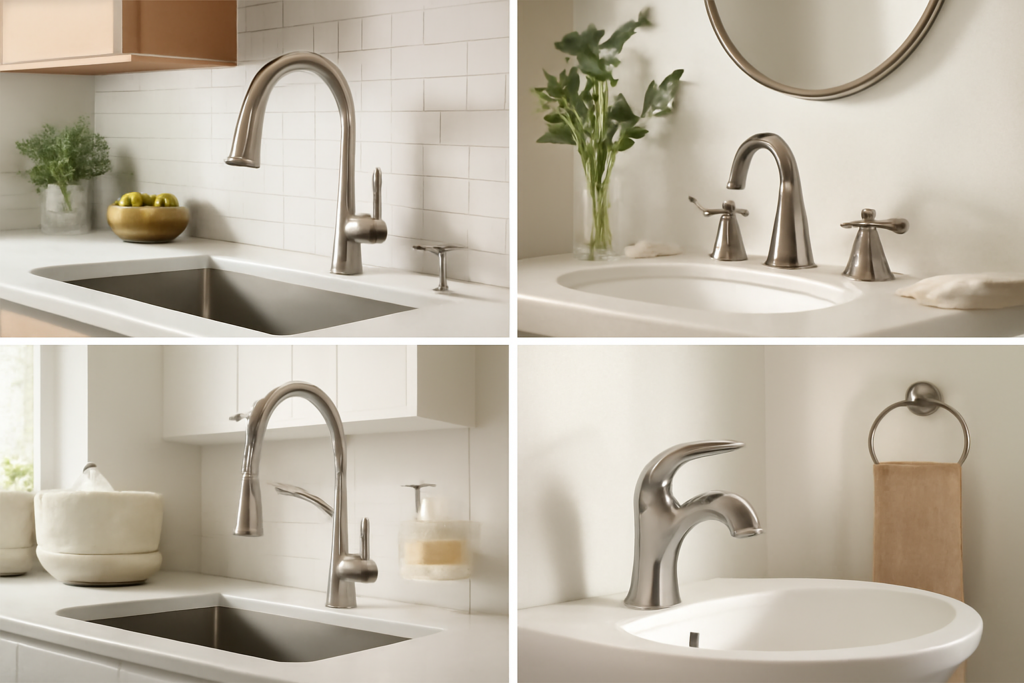
Every single-handle faucet in your house exists because a man named Al Moen scalded his hands at a two-handle sink in 1937 and decided to invent something better. The Moen faucet brand grew out of that single-handle mixing valve, first sold in 1947, and today Moen is the best-selling faucet name in North America — a Fortune Brands company headquartered in North Olmsted, Ohio, with fixtures in roughly one of every three American homes. This guide looks at Moen as a whole brand: the history, the technologies that run across its kitchen, bathroom, and shower lines, and how to decide whether the ecosystem deserves your remodel budget.
- From One Valve to a Full-House Brand
- The Technology Stack Across the Lines
- Kitchen, Bath, and Shower: How the Brand Divides
- Design Suites and Finish Matching
- Warranty and What It Is Really Like to Claim
- Reading a Moen Model Number Before You Buy
- Buying Channels and What Each Gets You
- Where Moen Falls Short
- Quick Answers to the Common Questions
- Verdict: The Safe Bet That Earns It
From One Valve to a Full-House Brand
Moen’s defining product was never a faucet shape — it was the cartridge. The company standardized its single-handle designs around a small number of replaceable cartridges, most famously the 1225 for kitchen and lavatory faucets and the 1222 for shower valves, and then kept those parts in production for decades. That decision quietly built the brand’s reputation: a Moen from 1995 can be restored to new working order today with a $20-$40 part hanging on a peg at any hardware store in the country. Competitors have excellent cartridges too, but none match the sheer availability of Moen service parts, and for a fixture expected to work for 20 years, that availability is worth as much as any feature.
The Technology Stack Across the Lines
Moen brands its features heavily, so here is what the names actually mean when you see them on a box:
- Power Boost: a kitchen spray-head button that increases flow for faster pot filling and rinsing
- Power Clean: a focused spray pattern claimed to deliver 50 percent more spray force with less splatter
- Reflex: the self-retracting pull-down hose system that docks the spray head reliably
- MotionSense Wave: hands-free activation via a sensor you wave a hand over — Moen’s answer to touch faucets
- Spot Resist: a brushed nickel or stainless finish treatment that hides fingerprints and water spots
- Duralock: push-to-connect supply fittings that install without tools
- Posi-Temp and TempIQ: pressure-balancing and thermostatic shower valve technologies that hold temperature when a toilet flushes
Not every feature appears on every model, and price tiers track the stack: an $89 Adler has none of it, a $250 Arbor has Reflex and Power Clean, and a $500 MotionSense model has nearly all of it.
Kitchen, Bath, and Shower: How the Brand Divides
In the kitchen, Moen’s core strength is the mid-market pull-down — durable, spray-forward designs in the $180-$400 range that dominate American sinks. Our Moen kitchen faucet guide breaks down the specific models and spray systems in depth, so treat this section as the aerial view: expect Reflex docking, Power Boost or Power Clean heads, and Spot Resist finishes as the recurring themes.
Bathroom fixtures span from $60 builder-grade centersets to $400 widespread sets, sharing the same cartridge serviceability and WaterSense 1.2 gallon-per-minute compliance across the range — the full model landscape is covered in our Moen bathroom faucet guide. On the shower side, Moen’s Posi-Temp pressure-balancing valve is arguably the most widely installed shower valve in the country, and the newer M-CORE platform lets you swap trim styles or upgrade from two-function to transfer valves without opening the wall. The smart-home tier adds Smart Faucet voice control and the Flo by Moen whole-house leak-detection shutoff, which some insurers now discount premiums for.
Design Suites and Finish Matching
Moen organizes design around suites — Genta, Eva, Voss, Align, Weymouth, Colinet — each spanning lavatory faucets, shower trim, towel bars, and accessories so a bathroom can match down to the paper holder. Finishes stay consistent across rooms: chrome, Spot Resist brushed nickel, matte black, brushed gold, and bronze tones, so a kitchen in brushed gold can echo a powder room without hunting across brands. That cross-room consistency is a genuine advantage of committing to one manufacturer for a whole-house remodel, and it simplifies future purchases because Moen rarely retires a core finish.
Warranty and What It Is Really Like to Claim
Moen’s limited lifetime warranty covers leaks, drips, and finish defects for the original consumer purchaser, and the practical experience is better than the legal language: call 1-800-BUY-MOEN with a model number, describe the drip, and the standard outcome is a free cartridge or spray head in the mail within a week — no receipt demanded for obviously-Moen products in most cases. Rental and commercial installations get shorter coverage (typically 5 years). This is a company whose support model assumes fixtures will be repaired rather than replaced, which aligns the warranty economics with your interests.
Reading a Moen Model Number Before You Buy
Moen’s numbering system rewards five minutes of literacy. The base number identifies the design (7594 is the Arbor pull-down, 6410 the Eva centerset lavatory), while suffix letters carry the substance: SRS means Spot Resist stainless, BL matte black, EW MotionSense Wave, and a leading “8” series generally flags commercial-grade fixtures. The trap for bargain hunters is the retail-channel variant — model numbers ending in different suffixes at big-box stores sometimes swap metal wands or braided hoses for plastic and vinyl versions of the same design. Compare the spec PDF on Moen’s site against the shelf box, and when two prices for the “same” faucet differ by $60, the internals usually explain it.
Serial-position matters on the used and clearance market too. Moen redesigned several long-running lines around 2015-2020, and cartridges differ across generations even when the outside looks identical. Photograph the underside of any existing Moen before ordering parts, or use the brand’s “Find Your Product” identifier tool, which narrows a mystery faucet from photos of the handle and spout in a few clicks.
Buying Channels and What Each Gets You
Where you buy a Moen changes what you take home. Big-box stores stock the value-tier versions and dominate on clearance pricing. Plumbing supply houses and showrooms carry the spec-book models with all-metal construction and the full finish range, typically 10-20 percent above retail but with genuinely better hardware. Online, Moen’s authorized-dealer list matters, because the warranty follows authorized purchases — a gray-market faucet from a marketplace seller can leave you buying your own cartridges. For rental properties, the commercial 8000-series lavatory faucets cost little more than consumer models and shrug off tenant abuse noticeably better.
Where Moen Falls Short
Honesty requires the other side. Moen’s design language is conservative — if you want fashion-forward knurled handles or two-tone luxury finishes, Brizo and Kohler push harder. Entry-level models sold through big-box stores use more plastic internals than the same-looking spec-book versions sold through plumbing suppliers, a distinction hidden in model number suffixes. And MotionSense, while reliable, trails Delta’s Touch2O in responsiveness for users who prefer tap activation over wave activation. None of these are dealbreakers; they define where the brand’s mid-market center of gravity sits.
Quick Answers to the Common Questions
Is Moen made in the USA? Partially — the company operates North American plants in Ohio and North Carolina alongside overseas manufacturing, with assembly and finishing split by product line. Are Moen and Delta cartridges interchangeable? No; every brand’s valve platform is proprietary, which is why identifying the brand before a repair matters. Does the lifetime warranty transfer when you sell the house? No — it covers the original purchaser, and subsequent owners get five years on most products. How do you tell a faucet is a Moen? Look for the logo stamped on the escutcheon or spout base, or the distinctive 1225/1222 cartridge once the handle is off.
Verdict: The Safe Bet That Earns It
Choosing a Moen faucet is the lowest-risk decision in plumbing fixtures — not because the brand is boring, but because every part of the ownership experience is engineered for the long haul: standardized cartridges, universal parts availability, a warranty that actually answers the phone, and finishes that match across every room in the house. Buy Moen when you value a fixture that will still be fixable in 2045. Look elsewhere when the faucet needs to be the jewelry of the room. For most American homes, the first case is the one that matters.