Ask any kitchen designer or cabinet shop what people actually order — not what magazines photograph — and the answer has barely moved in a decade. The most popular kitchen cabinet color in 2026 remains white and its off-white cousins, chosen for the same unglamorous reasons as always: it brightens small kitchens, photographs well for resale, and never clashes with the next owner’s taste. But the story under the headline is more interesting. Sage green, deep navy, and natural warm wood tones have climbed from accent choices to full-kitchen colors, and the stark builder-white of the 2010s is steadily giving ground to creamier, warmer versions. Here is what is genuinely trending, what holds value, and how to pick a color you will still like in year eight.
- White and Off-White: Still the Default, but Warmer
- Sage and Deep Greens: The Decade's Defining Riser
- Navy and Blue-Black: The Island Color That Went Full Kitchen
- Warm Wood Tones: The Un-Paint Movement
- Colors Cooling Off
- How to Choose: A Designer's Working Rules
- Hardware and Counter Pairings That Sell the Color
- The Bottom Line
White and Off-White: Still the Default, but Warmer
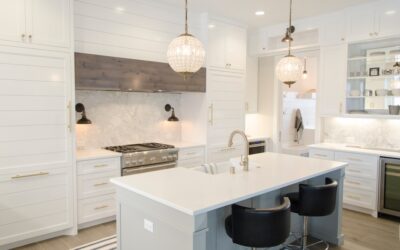
White leads every honest measure of popularity — cabinet manufacturer order data, designer surveys, and real-estate listing photos alike. What has shifted is the temperature. The cool, gallery-stark whites that defined the all-white-kitchen era are being passed over for warm whites, creams, and greige-tinted off-whites that read softer under LED lighting. Painter favorites in this zone include Benjamin Moore White Dove and Swiss Coffee, and Sherwin-Williams Alabaster — whites with enough warmth to avoid the operating-room effect.
The practical case for white has not changed. It reflects light in galley and north-facing kitchens, visually enlarges tight spaces, pairs with any countertop and backsplash, and is the safest resale play in nearly every US market. The honest downsides also have not changed: white shows grease film, fingerprints around hardware, and chips at the edges of doors, so a quality catalyzed or urethane-based finish matters more here than with forgiving mid-tones.
Sage and Deep Greens: The Decade’s Defining Riser
If white is the incumbent, green is the challenger with momentum. Sage — a gray-softened, herbal green — has become the go-to for homeowners who want color without commitment anxiety, because it behaves almost like a neutral: it flatters brass, black, and nickel hardware equally, and it sits comfortably beside both white quartz and butcher block. Deeper forest and olive greens show up on islands and lower cabinets in two-tone schemes. Designer staples include Sherwin-Williams Evergreen Fog and Clary Sage, and Benjamin Moore October Mist. Green kitchens photograph as current without screaming a date the way, say, 2015’s cool gray now does — though no color is truly trend-proof.
Navy and Blue-Black: The Island Color That Went Full Kitchen
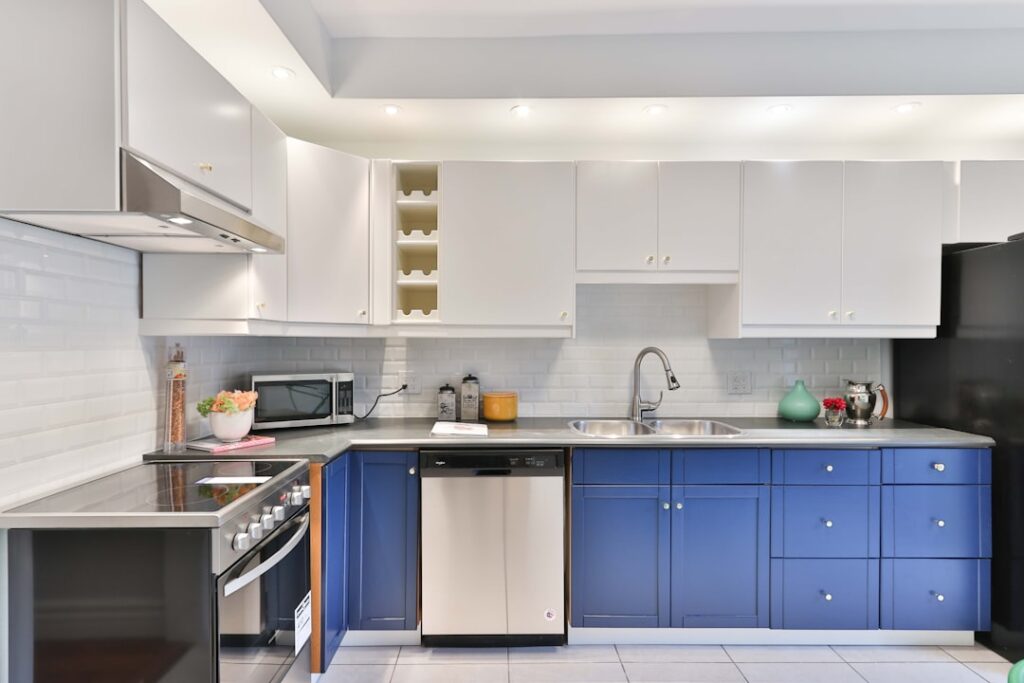
Navy earned its place as the classic island accent, and it increasingly wraps entire lower runs and even full kitchens in traditional and coastal homes. Deep blues ground a room, hide everyday smudges far better than white, and make brass hardware and white counters pop. Blue-blacks and charcoals (Benjamin Moore Hale Navy remains the reference navy; Sherwin-Williams Naval and Cyberspace are close cousins) serve homeowners who want drama with more forgiveness than true black. The caution with dark cabinets is light budget: in a kitchen with one small window, navy uppers can turn the room cave-like. The standard solution is the two-tone split — dark below, light above — which is itself one of the most requested looks of the past several years.
Warm Wood Tones: The Un-Paint Movement
The most notable shift of the mid-2020s is not a paint color at all. Natural white oak, walnut, and lighter stained finishes have surged as homeowners tire of painted everything and want texture back. Rift-cut white oak in a clear or lightly whitewashed finish — flat-slab doors in modern kitchens, shaker in transitional ones — has become the signature high-end look, often mixed with painted perimeter cabinets. Wood tones hide wear better than any paint, add warmth that all-white kitchens lack, and age gracefully. The cost is real, though: natural wood veneer and stain-grade doors typically run 15 to 30 percent above paint-grade equivalents, because stain hides nothing and demands better lumber.
Colors Cooling Off
Trend candor cuts both ways. Cool gray — the dominant color of roughly 2012 to 2020 — has slid noticeably; it is not “wrong,” but a freshly painted cool-gray kitchen now reads last-decade to buyers, and greige has absorbed most of its market. High-gloss red, burgundy, and the orange-toned honey oak of the 1990s remain firmly out of rotation, though early signals suggest richer burgundy-adjacent tones are creeping back on islands in design-forward projects. Stark black full kitchens, briefly fashionable, proved punishing to live with in homes with dust and hard water spots. If resale within five years is part of your plan, the safe list is short: warm white, cream, sage, navy on the island, or natural oak.
How to Choose: A Designer’s Working Rules
- Test at scale, in your light. Paint a 2×3-foot sample board (both sides of one door is better) and view it morning, noon, and under your actual bulbs. Every popular color shifts dramatically between north and south light.
- Pick the countertop first. Counters offer far fewer options than paint decks; matching paint to stone is easy, the reverse is not.
- Follow the 60-30-10 logic. Perimeter cabinets and walls as the dominant tone, island or lowers as the secondary, hardware and stools as the accent.
- Respect the house. Sage and cream suit farmhouse and cottage architecture; flat-slab oak and charcoal suit modern builds; navy and white flatter traditional and coastal homes.
- Budget for finish quality. A factory-baked or professionally sprayed 2K urethane finish outlasts brushed wall paint on doors by a decade. Repainting existing cabinets professionally runs roughly $3,000 to $7,000 for an average kitchen; new mid-range cabinets start around $150 to $400 per linear foot.
Hardware and Counter Pairings That Sell the Color
Color decisions land or miss based on what sits next to them. Warm whites want brushed brass or matte black pulls and quieter counters — a soft-veined quartz rather than a busy granite. Sage pairs naturally with unlacquered brass, butcher block accents, and cream backsplashes; nickel reads flat against it. Navy demands contrast: white or pale gray stone on top, brass or polished nickel on the doors, and lighter flooring below so the room does not bottom out visually. Natural white oak is the most forgiving of all — nearly any counter works — but black hardware and honed (not polished) surfaces keep it looking current rather than 1980s golden. When in doubt, borrow a door sample and a counter offcut and audition them together on site for a week.
The Bottom Line
The most popular kitchen cabinet color is still white — just a warmer, creamier white than the last decade’s — with sage green, navy, and natural white oak forming the strongest second tier in 2026. The smart play for longevity is to put trend colors where they are cheap to change (the island, the wall paint, the hardware) and keep the big perimeter investment in a warm neutral or timeless wood. Kitchens get repainted roughly every 8 to 15 years; choose a color you can imagine greeting you on an ordinary Tuesday in year ten, not just one that wins the reveal photo.