The single biggest barrier to a ductless mini-split has always been the installer: you legally cannot buy refrigerant or connect line sets without an EPA 608 certification, which meant paying a contractor $3,000 to $6,000 in labor on top of the equipment. The mrcool diy 5th gen 27k btu 3 zone mini split exists specifically to knock that barrier down, using pre-charged quick-connect line sets that a homeowner can hand-tighten without ever opening the refrigerant circuit or pulling a vacuum. After installing and living with these systems, I can tell you the DIY claim is real, though there are caveats worth understanding before you buy. Here is a straight look at what this 27,000 BTU three-zone system does well and where it falls short.
What You Get in the Box
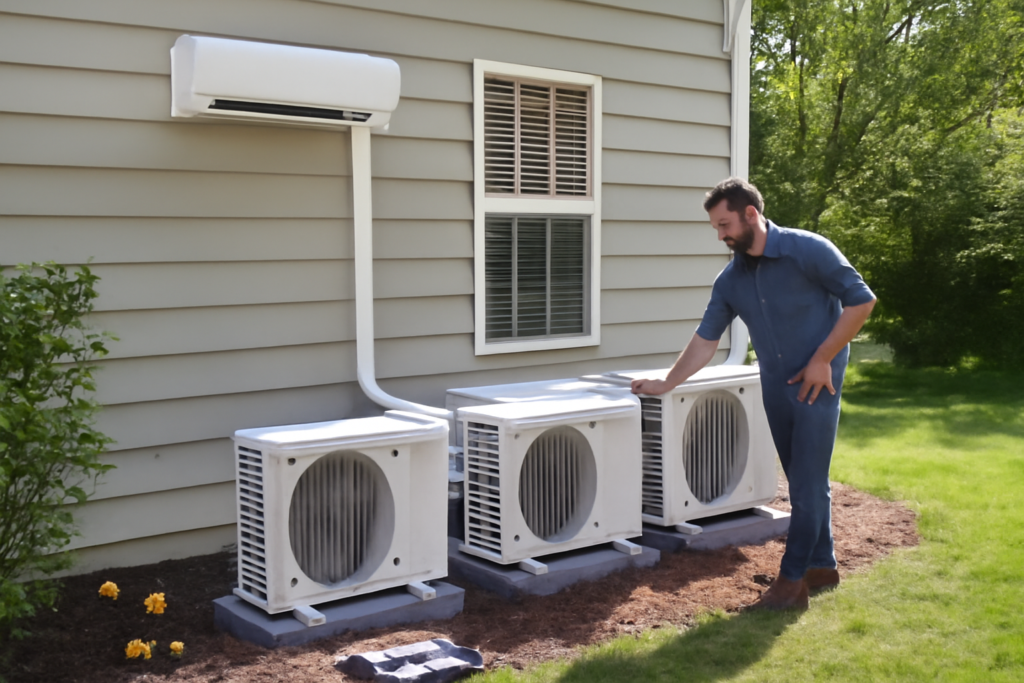
The system centers on a single outdoor condenser rated at 27,000 BTU, roughly 2.25 tons of capacity, feeding three separate indoor air handlers. The kit ships with the condenser, three wall-mounted head units, three pre-charged line sets, and mounting hardware. The signature feature is MRCOOL’s proprietary quick-connect fittings: the line sets arrive already charged with R-410A refrigerant and sealed, so you route them, hand-start the flare nuts, then torque them to spec to release the charge into the system.
That single design choice is why this is a legitimate DIY product. You never need a vacuum pump, a manifold gauge set, or an EPA certification for the basic install. You do need a drill, a hole saw, a wrench, and the patience to route line sets neatly, but the specialized HVAC steps are engineered out.
The Numbers That Matter
Efficiency is where the 5th generation earns its keep. The updated line meets the current federal minimums and then some, which matters because older mini-splits sold before the 2023 standard update no longer qualify for rebates.
- Cooling capacity: 27,000 BTU total across three zones.
- Efficiency: high-SEER2 performance, commonly in the low-to-mid 20s SEER2 on these hyper-heat condensers, well above the 14.3 SEER2 federal floor.
- Heating: HSPF2 ratings that qualify many units for heat-pump incentives, with hyper-heat operation rated down toward -5°F on the cold-climate models.
- Zone heads: typically an even split such as three 9,000 BTU heads, matching common bedroom and living-space loads.
The inverter-driven compressor modulates rather than cycling on and off, so it sips power at partial load and holds room temperature within a degree or so, which is a noticeable comfort upgrade over a window unit or a single-stage central system.
Sizing the Three Zones
Twenty-seven thousand BTU across three heads is well matched to a small home, an addition, a finished basement, or a set of rooms a central system struggles to reach. A common configuration is three 9,000 BTU heads, each sized for a room in the 250 to 400 square foot range depending on insulation, ceiling height, and climate.
Resist the temptation to oversize. A head that is too large short-cycles, never runs long enough to dehumidify, and leaves rooms clammy. Do a rough Manual J load or use the 20 to 30 BTU per square foot rule of thumb, adjusting up for sun-blasted rooms with lots of glass and down for shaded, well-insulated spaces. The whole point of a multi-zone system is matching capacity to each room, so plan the head placement before you buy.
The Install, Realistically
A capable DIYer can install this system in a weekend. The workflow is consistent for each zone: mount the indoor head’s backing plate level on the wall, bore a 3-inch pass-through hole with a slight downward slope for the condensate drain, feed the line set and drain outside, and hang the head. Outside, you set the condenser on a pad or wall bracket, connect each pre-charged line set to the correct port, and torque the quick-connect fittings.
The details separate a clean install from a leaky one. Support the condensate line with continuous downward pitch or water backs up into the head. Do not overbend the line sets past their minimum radius, and do not overtighten the electrical whip. The most common homeowner mistake is cross-threading or under-torquing the quick-connect fittings, which lets refrigerant seep out over months. Use a torque wrench and follow MRCOOL’s spec exactly.
Cost and Rebates
Expect to pay roughly $3,500 to $5,000 for the 27K three-zone kit itself, plus a few hundred dollars in a disconnect box, wire, line-set covers, and a pad. Because you supply your own labor, the all-in cost often lands near what a contractor would charge for equipment alone on a comparable branded system.
Federal and state incentives can shave that further. The 5th generation’s efficiency ratings make many configurations eligible for the 25C energy-efficient home improvement tax credit, worth up to $2,000 on qualifying heat pumps, and some utilities stack rebates on top. Verify the specific model’s AHRI certificate and CEE tier before you count on a credit, since eligibility hinges on the exact SEER2 and HSPF2 figures.
The Honest Downsides
No product is perfect. The pre-charged line sets come in fixed lengths, commonly 16 or 25 feet, and while you can buy longer ones, you cannot cut them to length, so you will coil the excess neatly somewhere. Wall-mounted heads are visible and not to everyone’s taste; there is no ducted-look option in the basic DIY kit.
The self-install also affects warranty and support. You are the installer, so a mistake is on you, and some homeowners find MRCOOL’s technical support stretched during peak season. Finally, if your electrical panel lacks capacity for a dedicated 20 or 30-amp 240V circuit, you will still need an electrician, which is one job most homeowners should not DIY.
Who Should Buy It
The mrcool diy 5th gen 27k btu 3 zone mini split is an excellent fit for a hands-on homeowner heating and cooling a small home, an ADU, a garage conversion, or a cluster of rooms that a central system cannot reach. If you are comfortable with a drill and a torque wrench and you want to save several thousand dollars in labor while landing an efficient, rebate-eligible heat pump, it delivers.
Skip it if you are uneasy working at height, cannot supply a proper dedicated circuit, or want an invisible ducted system. For everyone else, this is one of the few genuinely DIY-friendly ways into modern ductless comfort, and after the install it disappears into the background exactly as good HVAC should.
Electrical Requirements You Cannot Skip
The one part of this project that is not truly DIY for most people is the power feed. A 27,000 BTU condenser typically needs a dedicated 240-volt circuit, commonly a 20 or 30-amp breaker depending on the exact model, run in appropriately sized wire to a weatherproof disconnect box mounted near the outdoor unit. Check the unit’s minimum circuit ampacity and maximum overcurrent protection on the data plate and size the breaker and wire to match exactly.
If your panel has a spare double-pole slot and capacity, an experienced DIYer with permits may handle it, but many homeowners should hire a licensed electrician for this step, both for safety and to satisfy the inspection. Pulling a permit for the electrical work also protects you at resale and keeps your homeowners insurance valid. Do not undersize the wire or share the circuit; a mini-split compressor draws a real inrush current on startup and needs its own dedicated feed.
Living With the System Day to Day
Once running, the system is refreshingly low-maintenance, but a few habits keep it efficient. Wash the indoor head filters every month during heavy use; they slide out in seconds and a quick rinse restores airflow that dust steadily chokes off. Keep the outdoor condenser clear of leaves, grass clippings, and snow drifts, maintaining a couple of feet of clearance so it can breathe.
Each head runs independently, so you can set the unused rooms warmer or cooler and only condition the zones you occupy, which is where the real energy savings live. The included handheld remotes and the optional smart controller let you schedule setbacks, and because the inverter modulates rather than cycling, holding a steady setpoint uses less power than big swings. In shoulder seasons, running just one or two heads at low output keeps the whole home comfortable for pennies, which is the quiet payoff of a well-zoned ductless system.