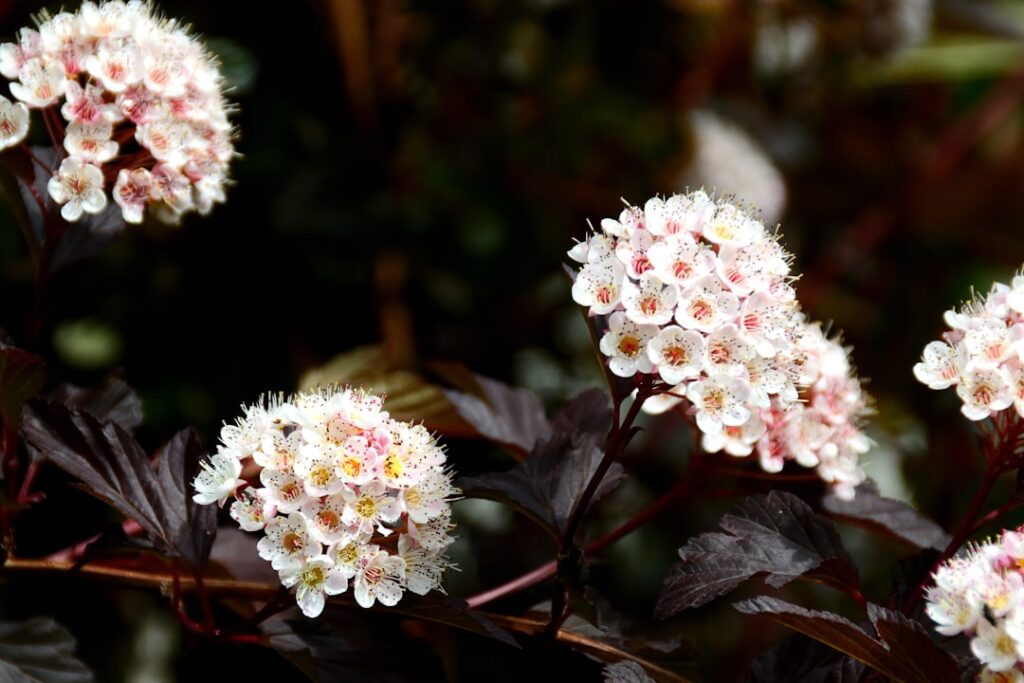
If you want a tough, native, four-season shrub that survives almost anything a North American yard can throw at it, the ninebark shrub deserves a hard look. Physocarpus opulifolius earned its odd name from the way its mature bark peels in thin layers, supposedly nine of them. What sells it today is not the bark but the foliage: modern cultivars come in deep burgundy, glowing copper, and bright gold, backed by clusters of spring flowers and red fall fruit. It is native, cold-hardy, and nearly indestructible.
Why Gardeners Choose Ninebark
Ninebark is a deciduous shrub native to eastern and central North America, which makes it well adapted to our soils, pollinators, and winters. The straight species is a large, somewhat coarse plant, but breeders have transformed it into a landscape staple. ‘Diabolo’ has dark purple, almost black foliage and reaches 8 to 10 feet. ‘Coppertina’ and ‘Amber Jubilee’ emerge coppery-orange and shift through the season. ‘Summer Wine’ is a more compact burgundy form around 5 to 6 feet, and dwarf selections like ‘Tiny Wine’ and ‘Little Devil’ stay 3 to 4 feet for smaller spaces.
Across the seasons it earns its keep. Clusters of small pink or white flowers appear in late spring, followed by reddish seed capsules that persist into fall. The colorful leaves hold their tint all summer in full sun, and after the leaves drop the peeling, exfoliating bark gives winter interest.
Hardiness, Sun, and Soil
Few shrubs are hardier. Ninebark thrives across USDA zones 3 through 8, shrugging off winter lows to minus 40 degrees Fahrenheit, which makes it a mainstay of northern gardens where choices are limited. It grows in full sun to part shade, but the colored-leaf cultivars need at least six hours of direct sun to develop and hold their best color. In shade, purple and gold forms fade toward green and grow leggy.
It is genuinely unfussy about soil, tolerating clay, sand, rocky ground, wet spots, dry spots, and a wide pH range from acidic to slightly alkaline. Once established it handles drought and even occasional flooding. This adaptability is why you see ninebark planted in tough roadside and commercial settings where pampered shrubs would fail.
Planting and Spacing
Plant in spring or fall. Dig a hole twice as wide as the root ball and no deeper, set the crown at grade, backfill with native soil, and water deeply.
- Space large cultivars like ‘Diabolo’ 6 to 8 feet apart, or 3 to 4 feet for a hedge.
- Space compact forms such as ‘Summer Wine’ 4 to 5 feet apart.
- Space dwarf types like ‘Little Devil’ 2 to 3 feet apart.
- Water weekly through the first growing season; after that it is drought tolerant.
Match the cultivar to the space. Planting an 8-foot ‘Diabolo’ under a window guarantees years of over-pruning, while a dwarf form fits a foundation bed without a fight.
Watering and Feeding
New plants need regular water, about an inch a week, until roots establish over the first season. After that, ninebark is drought tolerant and needs supplemental water only during extended dry spells. It is a light feeder and rarely needs fertilizer in average soil. If growth is weak, a single application of a balanced slow-release fertilizer in early spring is plenty. Overfeeding produces soft, floppy growth that is more prone to disease, so err on the side of less.
Pruning for Shape and Color
Ninebark blooms on old wood, so if you care about the flowers, prune right after they finish in late spring. In practice, many gardeners grow it mainly for foliage and prune in late winter, accepting the loss of some bloom for a cleaner shape. Either way, the plant tolerates hard pruning remarkably well.
For routine shaping, remove dead, damaged, or crossing branches and cut back overlong stems to a bud. To rejuvenate an old, overgrown, or bare-bottomed shrub, use renewal pruning: each year cut about a third of the oldest, thickest stems all the way to the ground, and within three years you will have replaced the whole plant with fresh, well-colored growth. For a drastic reset, you can cut the entire shrub back to 6 to 12 inches in late winter, and it will regrow vigorously with especially vivid new foliage. That responsiveness to hard pruning is one of ninebark’s best traits.
Pests and Diseases
Ninebark is largely trouble-free, but the one issue to watch is powdery mildew, a white coating on the leaves that is most common in humid weather and on plants in shade or with poor air circulation. Some cultivars, especially older purple ones, are more susceptible. Choose mildew-resistant selections such as ‘Tiny Wine’ or ‘Amber Jubilee’, give plants full sun and space for airflow, and avoid overhead watering. Where mildew appears, thinning the shrub by pruning usually solves it without spraying. Occasional aphids may cluster on new growth and can be knocked off with a hose or treated with insecticidal soap, but they rarely cause lasting harm.
Design Uses and Companions
The bold foliage colors make ninebark a workhorse in the landscape. Use a dark ‘Diabolo’ as a backdrop that makes lighter flowers pop, plant a row of compact forms as a low informal hedge, or set a gold ‘Amber Jubilee’ where it can brighten a shady corner. The peeling winter bark adds interest in the off-season. It pairs beautifully with plants that contrast its color: gold ninebark against blue spruce or blue-flowered perennials, purple ninebark against chartreuse foliage or yellow flowers like coreopsis and rudbeckia. As a native, it also supports pollinators and birds, which feed on the flowers and fruit. Plant the right-sized cultivar in full sun, prune it hard when it needs a reset, and the ninebark shrub will give you decades of nearly maintenance-free color.
Native Value and Wildlife Benefits
One reason to choose ninebark over an exotic shrub of similar looks is what it does for the local ecosystem. As a plant native across much of eastern and central North America, it has co-evolved with regional insects and birds and supports them in ways non-native ornamentals cannot. The late-spring flower clusters draw bees, butterflies, and other pollinators, providing an early-season nectar source, and the plant serves as a host for the larvae of certain native moths and butterflies. The reddish seed capsules that follow the flowers persist into fall and winter and feed birds when other food is scarce. The dense, twiggy structure also offers nesting cover and shelter. Planting natives like ninebark in place of some of the standard nursery shrubs is one of the simplest ways to make a residential yard more useful to wildlife without sacrificing looks.
Propagation and Long-Term Care
Ninebark is easy to propagate if you want more plants for a hedge or to share. Take softwood cuttings in early summer, dip the cut ends in rooting hormone, and stick them in a moist, well-drained medium; they root readily within a few weeks. You can also layer a low branch by pinning it to the soil until it roots, then severing it from the parent. Over the long term, the main maintenance beyond the annual renewal pruning is simply keeping an eye on size, since even compact cultivars grow steadily and can outgrow a tight spot in five or six years. When a plant gets too large or bare at the base, do not be timid about the hard rejuvenation cut to 6 to 12 inches in late winter; ninebark’s vigorous response to that treatment is one of its best features and produces the most intensely colored new foliage of the year. With that occasional reset and almost no other input, a single ninebark easily performs for 20 years or more in the landscape.
One more practical note on siting for the long haul: give even a compact cultivar a foot or two more room than its listed mature width suggests, because these shrubs grow vigorously and a crowded planting invites the powdery mildew that thrives in still, humid air. A little breathing space between plants, combined with full sun, does more to keep ninebark healthy over two decades than any spray or treatment. Plant it right, prune it hard when it asks for it, and this tough native will reward the minimal effort with color in every season.