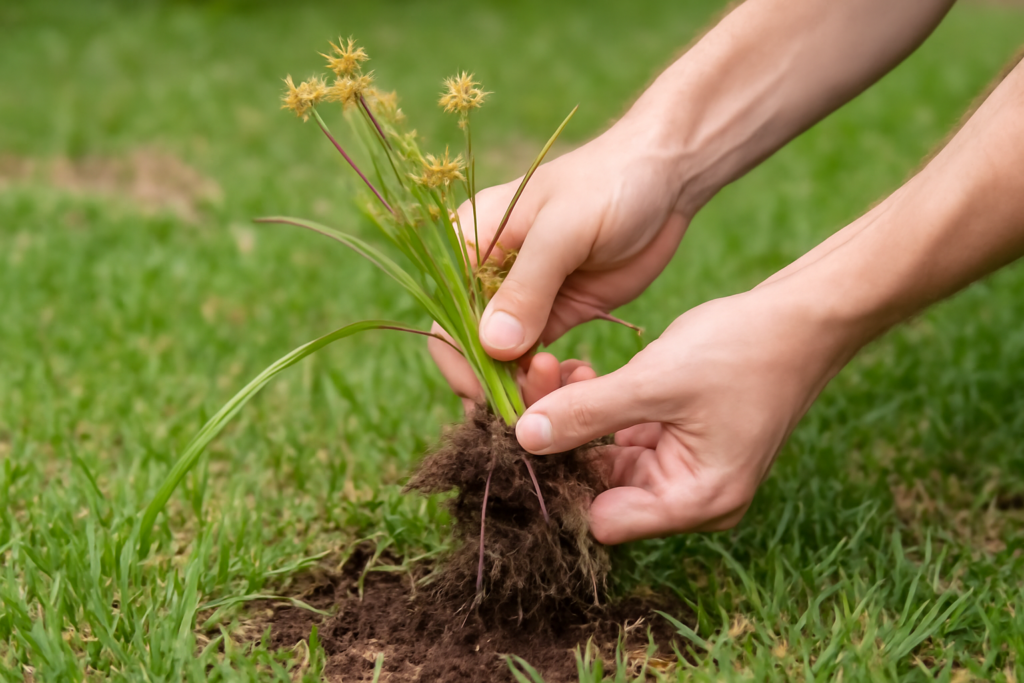
If you have ever yanked a spiky green blade out of your lawn only to watch three more shoot up in its place a week later, you have met nutgrass. Despite the name, nutgrass is not a grass at all. It is a sedge, and that single fact explains why the weed-and-feed you bought at the box store did almost nothing to it. I have fought this plant in vegetable rows, along walkways, and across half-acre lawns, and I can tell you it rewards patience and the right chemistry more than brute force.
What Nutgrass Actually Is
Botanists call it nutsedge, and you will usually be dealing with one of two species: yellow nutsedge (Cyperus esculentus) or purple nutsedge (Cyperus rotundus). Yellow is more common across the northern two-thirds of the country, while purple dominates the hot, humid South and struggles once soil temperatures drop below about 55 degrees Fahrenheit. Both spread through underground tubers, and that is the heart of the problem. A single yellow nutsedge plant can produce several hundred tubers in one growing season, and each tuber can sit dormant in the soil for three to four years before it decides to sprout.
The old saying among growers is that you are never fighting the plant you see. You are fighting the network of tubers eight inches down that you cannot see. Knowing this changes your whole approach, because it means you cannot win by pulling tops alone.
How to Identify Nutgrass
Before you spend a dime on control, confirm what you have. Three features give a sedge away every time, and they take about ten seconds to check.
- Triangular stems. Roll a stem between your thumb and finger. Grass stems are round or flat, but sedge stems have three distinct edges. The old rhyme “sedges have edges” is genuinely the fastest field test there is.
- Fast, waxy, upright growth. Nutsedge grows noticeably faster than turf, so within a few days of mowing you will see it standing an inch or two above the lawn surface. The leaves have a glossy, almost plastic sheen and a stiff V-shaped crease down the middle.
- Color of the seedhead. Yellow nutsedge throws a straw-yellow to golden seedhead, while purple nutsedge shows a reddish-brown to purple one. If it has flowered, this tells you which species and which chemistry to reach for.
Dig one plant up with a trowel and follow the roots down. You will find small, round, hard tubers, often the size of a popcorn kernel, strung along the roots. Those are the nutlets that give the plant its name and its staying power.
Why Hand-Pulling Usually Fails
You can pull nutgrass, but you have to do it correctly and relentlessly. When you tug a mature plant, the stem snaps off at the soil line and leaves the tubers behind, and the plant re-sprouts from those tubers within a week or two. Every time it re-sprouts, it draws down stored energy, so in theory repeated pulling starves the plant. In practice, that takes an enormous amount of consistency.
If you are going to pull, do it while the plant is young, before it has more than five or six leaves, because at that stage it has not yet formed its own new tubers. Dig with a hand trowel or a narrow spade and go down a full 8 to 10 inches to lift the tuber chain intact. Pull once a week without fail through the whole growing season. Miss two weeks in July and you have handed the colony a fresh generation of nutlets.
The Herbicides That Actually Work
Selective sedge herbicides are what finally turned the tide on the worst infestations I have handled. These products move down into the tubers, which is exactly what pulling cannot do. Two active ingredients do the heavy lifting.
Halosulfuron
Halosulfuron-based products are my first choice for lawns and landscape beds. The typical rate is about 0.9 ounces of product per acre, which for a homeowner works out to roughly 0.5 to 0.9 grams per gallon of water treating 1,000 square feet. Always add a nonionic surfactant at 2 teaspoons per gallon, because without it the chemical beads up and rolls off the waxy leaf. Expect the sedge to yellow within 7 to 10 days and collapse over 2 to 3 weeks. A second application 14 to 21 days later catches the tubers that sprout after the first pass.
Sulfentrazone
Sulfentrazone works faster on contact and is often blended with other actives in ready-to-use lawn sedge sprays. It is especially useful on purple nutsedge, which shrugs off some other chemistries. Follow the label rate for your product, usually in the range of 6 to 12 fluid ounces per acre. Sulfentrazone can nip cool-season grasses if you overdo it, so measure carefully rather than eyeballing.
Spray when the sedge is actively growing and daytime temperatures sit between 70 and 90 degrees Fahrenheit. Do not mow for 2 to 3 days before or after treatment, because the plant needs full leaf area to absorb the chemical and move it down to the tubers.
Timing Your Attack
Season matters more with nutgrass than with almost any other weed. Your goal is to hit the plant before it builds a new crop of tubers, which for most regions means late spring through early summer, roughly mid-May through late June. A plant treated at the six-leaf stage has not yet invested in new nutlets, so the herbicide starves a smaller bank.
Once you get into August, the plant shifts energy underground and treatment gives you far less bang for the buck. You can still spray to knock back tops, but plan on a full follow-up program the next spring. Realistically, clearing an established stand takes two to three seasons of disciplined treatment, not one heroic weekend.
Cultural Controls That Tip the Odds
Nutsedge thrives in wet, compacted, poorly drained soil, so fixing your growing conditions quietly weakens it over time. If a low spot in the lawn stays soggy for days after rain, that is prime sedge habitat. Aerate compacted areas, correct grades so water drains within a day, and check for leaking irrigation heads that keep one patch perpetually damp.
- Mow cool-season lawns at 3 to 3.5 inches. A dense, tall stand of turf shades the soil and slows sedge emergence.
- Water deeply and infrequently, about 1 inch per week, rather than a light daily sprinkle that keeps the surface wet.
- In garden beds, lay a 3-inch layer of mulch, but know that mature nutsedge will punch straight through mulch and even through landscape fabric, so pair mulch with spot spraying.
A Realistic Battle Plan
Here is the sequence I hand to anyone starting from a heavy infestation. Confirm the triangular stem first so you are not wasting product on a real grass. In late spring, spray a halosulfuron product with surfactant across the whole affected area, then follow up 3 weeks later. Hand-pull any young escapes at the 8-to-10-inch tuber depth through summer. Fix drainage and mowing height so the site stops favoring the weed. Then repeat the spring program the following year, and probably the year after that.
Nutgrass is beatable, but it is a marathon opponent. If you treat it like an annual weed and expect one spray to end it, you will be frustrated. Treat it like the tuber-driven perennial sedge it truly is, hit it at the right stage with the right chemistry, and keep your conditions unfavorable, and you will watch those triangular spikes finally thin out and disappear.
Common Mistakes That Feed the Colony
Over the years I have watched homeowners work harder than they need to and still lose ground, almost always because of one of a handful of avoidable errors. Rototilling a bed full of nutsedge is the worst of them. Every pass of the tiller chops the tuber chains into dozens of fragments, and each fragment is a fresh plant waiting to sprout. You do not clear the bed; you propagate it across the whole plot. If you must break ground where sedge lives, hand-dig and lift the tubers out rather than shredding them.
Reaching for a standard broadleaf weed-and-feed is another dead end. Products built around 2,4-D and dicamba are formulated for broadleaf weeds, and nutsedge is neither a broadleaf nor a true grass, so those chemistries roll right off it. You spend money, wait two weeks, and see no change. Match the herbicide to the plant, which means a sedge-specific active like halosulfuron or sulfentrazone, and nothing else.
The third mistake is quitting too early. People treat once in June, see the tops brown, and assume victory, then panic when new shoots appear in July from tubers that were dormant during the first spray. That regrowth is not a failure of the product; it is the tuber bank doing exactly what it does. Budget for the follow-up passes from the start.
Keeping It From Coming Back
Once you have knocked a stand down, your job shifts to guarding the ground so a new colony cannot establish. Nutsedge often arrives in fill dirt, in nursery container soil, or on the tines of shared equipment, so inspect any imported topsoil and reject loads that show those glossy triangular blades. Clean the soil off tools and mower decks before moving between beds.
- Scout the lawn every couple of weeks through the growing season and spot-treat the first few shoots while they are young, rather than waiting for a full patch.
- Keep turf dense and thick, because bare, thin, or compacted ground is exactly the opening a new sedge seedling or stray tuber needs to take hold.
- Log where you find outbreaks. Sedge tends to return to the same soggy, compacted low spots, so fixing drainage in those specific areas pays off year after year.
Stay on top of those small habits and the few stragglers that surface each spring never get the chance to rebuild the underground network that made the original infestation so miserable.