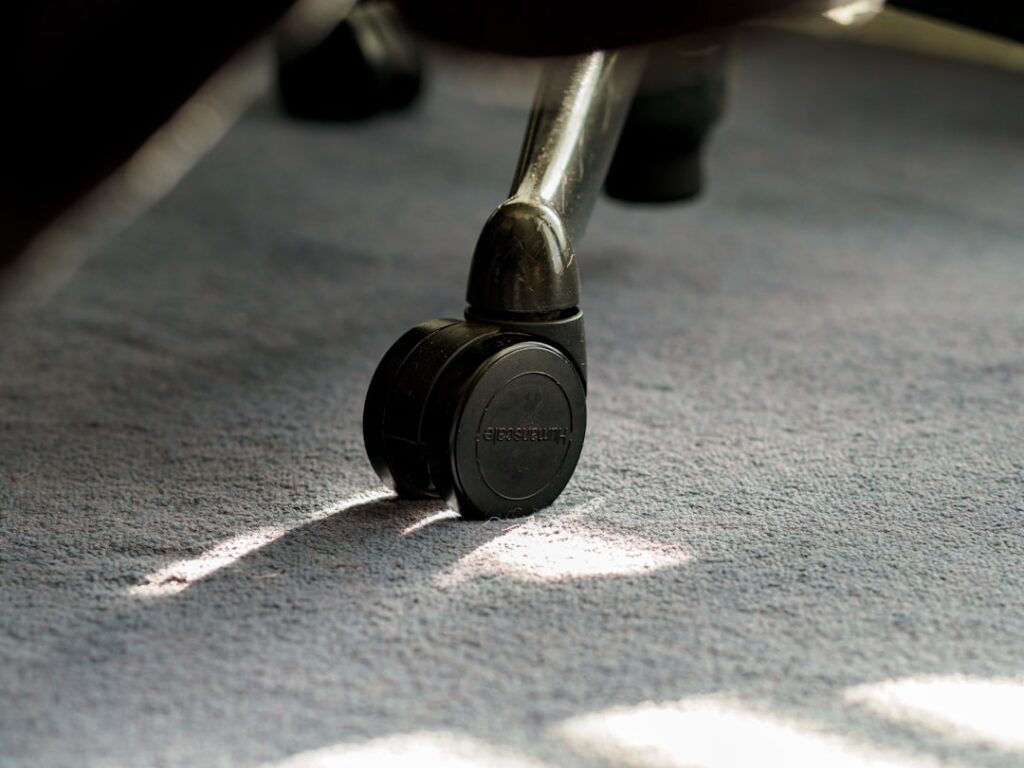
Most chair mats fail on plush carpet for one simple reason: they were built for low-pile commercial loop, not the soft three-quarter-inch shag in a home office. An office chair mat for thick carpet has to grip through that cushion and stay anchored, or it slides, buckles, and curls at the corners within a week. If you have ever chased a wandering mat across the floor while trying to roll back to your desk, you already know the standard hardware-store mat is not the answer. Picking the right one comes down to three measurable things: cleat depth, mat rigidity, and overall thickness.
Why Thin Mats Fail on Plush Carpet
Carpet is rated by pile height, the distance from the backing to the top of the fibers. Anything over half an inch counts as thick or plush, and most cut-pile residential carpet with a thick pad underneath lands between 0.5 and 0.75 inches. Budget mats ship with cleats, the little gripper spikes on the underside, that measure only an eighth of an inch. On a soft floor those teeth never reach the backing, so the mat floats on the fibers and skates with every push of your chair.
The fix is a deeper bite. Mats labeled for thick or high-pile carpet use cleats in the 0.25 to 0.4 inch range, sometimes called “long stem” or “extra grip” cleats. Those anchor down into the pile and hold the mat flat. As a rule of thumb, match your cleat depth to roughly half your pile height and you will get a mat that stays put.
Measure Your Pile Before You Buy
Skip the guesswork. Press a ruler straight down into the carpet until it hits the hard backing, then read the height where the fibers stop. Do this in a few spots, since pile compresses near walls and high-traffic lanes. Write down the number and use these tiers:
- Low pile (under 0.25 in): standard cleats are fine
- Medium pile (0.25 to 0.5 in): look for “medium to high pile” rated mats
- Thick or plush pile (0.5 to 0.75 in): you need a dedicated thick-carpet mat with long cleats
- Shag or very plush (over 0.75 in): consider a rigid glass mat, which does not rely on cleats at all
Material Matters: PVC, Polycarbonate, and Glass
Three materials dominate the market, and the difference shows up the moment you sit down. Standard PVC vinyl is the cheapest, usually $30 to $60, but it is also the floppiest. On thick carpet a soft PVC mat sinks and flexes, which makes your chair feel like it is rolling uphill.
Polycarbonate is the upgrade most people should buy. It runs $70 to $130 and stays rigid even over plush pile, so your casters glide instead of bog down. It also resists the cracking that plagues cheap vinyl in cold rooms. At the top end, tempered glass mats cost $120 to $250 and never curl, dent, or yellow. Glass distributes weight across the whole panel, so it works on any pile height regardless of cleats, though it is heavy and unforgiving if you drop something on the edge.
Quick Material Comparison
- PVC vinyl: budget pick, flexes on plush carpet, may dent under heavy users
- Polycarbonate: best all-around value, rigid, long-lasting, clear
- Tempered glass: premium, indestructible surface, works on any pile, heavy
Get the Size and Shape Right
A mat that is too small forces your chair off the edge and back onto bare carpet, which defeats the purpose and chews up the carpet at the lip. For a standard desk, a 36 by 48 inch mat is the minimum. If you have an L-shaped or executive desk, step up to 46 by 60 inches so the wheels stay on the surface through a full range of motion.
Lipped mats, the ones with a tongue that extends under the desk, keep the chair from rolling off the back when you lean forward. Rectangular no-lip mats give you more usable rolling area and suit standing-desk setups where the chair moves more freely. Measure your roll zone, then add about six inches on each side.
Installation Tips That Save Headaches
Let the mat acclimate before you stress it. Lay it flat in the room for 24 to 48 hours, or unroll it in reverse and weight the corners with books overnight. PVC and polycarbonate ship rolled, and they hold that memory until they warm to room temperature, around 68 to 72°F.
Press the mat down hard once it is positioned. Stand on the corners and walk across it to drive the cleats fully into the backing. On very plush carpet, kneel and lean your weight into each quadrant. The mat should feel locked, not floaty. If it still slides, your cleats are too short for your pile and you bought the wrong tier.
Care and Longevity
Wipe the surface with a damp microfiber cloth and mild dish soap; skip ammonia and harsh solvents, which cloud polycarbonate and soften PVC. Rotate the mat 180 degrees every few months so the wear pattern from your casters spreads out evenly. A quality polycarbonate mat lasts five to seven years of daily use, while glass effectively lasts the life of the room.
Inspect the cleats once or twice a year. If they are crushed flat, the mat has been compressing the pile and may have lost its grip, a sign it is time to replace it or move up to glass. With the right material, the right cleat depth, and a size that covers your full roll zone, an office chair mat for thick carpet turns a frustrating, sticky workspace into one where your chair glides exactly the way it should.
The Bottom Line
Thick carpet does not have to mean a chair that drags or a mat that wanders. Measure your pile first, then match it to long-cleat polycarbonate for most setups or tempered glass for the plushest floors. Buy a mat big enough to cover your roll zone, let it acclimate, and seat the cleets firmly. Get those basics right and you will not think about your floor again for years.