
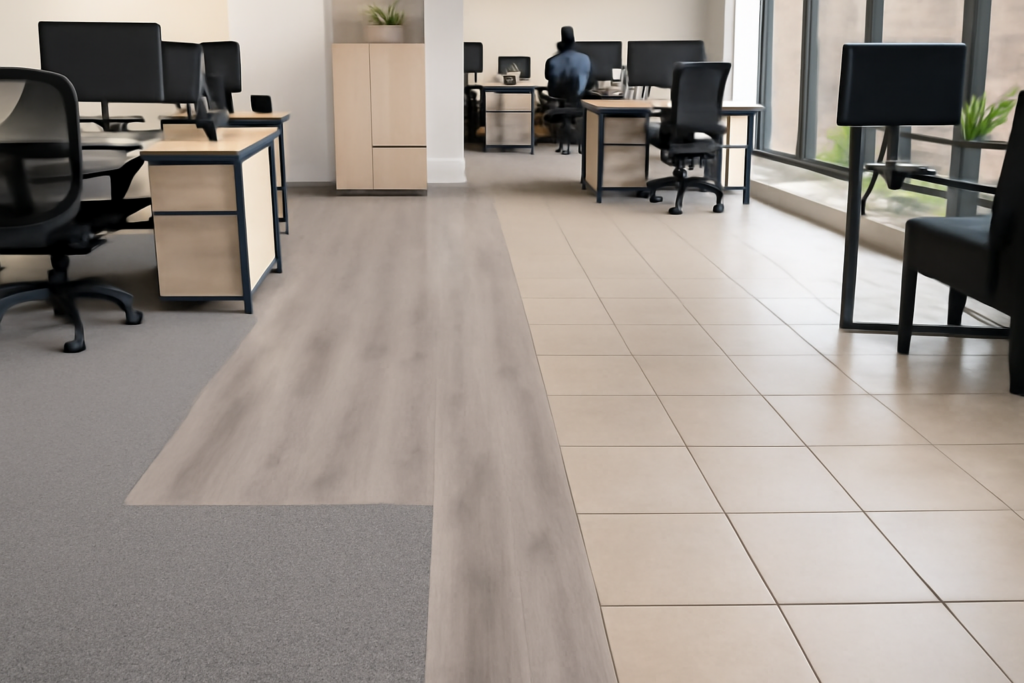
An office floor has to do more than look professional. It has to survive rolling chairs, heavy foot traffic, printer carts, and the occasional coffee spill, all while keeping noise down and staying easy to maintain on a facilities budget. Choosing among the many office flooring solutions means balancing durability, acoustics, comfort, and cost per square foot in a way that a residential floor never has to. Whether you’re outfitting a home office or a 10,000-square-foot suite, this guide breaks down the realistic options and where each one wins.
What Makes Office Flooring Different
Commercial and workplace flooring is engineered for abuse that home floors rarely see. Rolling casters concentrate weight and grind at the surface all day, foot traffic runs constant, and the floor often needs a sound-dampening quality that open-plan offices desperately need. On top of that, facilities managers care about maintenance cost and the ability to replace a damaged section without redoing the whole floor.
Those priorities push offices toward commercial-grade products with higher wear ratings than residential lines, even when the material looks the same. Always confirm you’re specifying the commercial version.
Budget planning for office flooring also works differently than for a home. Commercial projects factor in life-cycle cost, the total spend over 10 or 15 years including installation, maintenance, and eventual replacement, rather than just the sticker price per square foot. A cheaper floor that needs replacing in five years often costs more than a durable one that lasts fifteen. Downtime is part of the equation too, since a floor that installs quickly or repairs in modular sections keeps a business running with minimal disruption. And warranties matter: commercial flooring warranties spell out wear ratings and traffic ratings that residential products simply don’t guarantee. Weigh all of those factors, not just the upfront number, when you compare options for a workplace.
Carpet Tile
Modular carpet tile is the workhorse of office flooring, and for good reason. It cuts noise, feels comfortable underfoot, and, unlike broadloom, lets you swap out a single stained or worn tile instead of replacing the whole floor.
- Pros: excellent acoustics, easy spot replacement, wide design range, comfortable and warm.
- Cons: holds dust and stains more than hard surfaces, needs regular vacuuming and periodic extraction.
- Cost: roughly $3 to $8 per square foot installed for commercial-grade tile.
Look for solution-dyed nylon fiber and a heavy face weight for high-traffic zones. The modular format alone often justifies the choice for large offices.
Luxury Vinyl Tile and Plank
Commercial LVT has surged in popularity for offices that want a hard-surface, wood or stone look with real durability. It’s tough, water-resistant, and quieter than tile or laminate underfoot.
- Pros: highly durable wear layer, water-resistant, low maintenance, realistic wood and stone visuals.
- Cons: harder and louder than carpet, can dent under very heavy point loads.
- Cost: roughly $3 to $9 per square foot installed for commercial grades.
Specify a 20-mil or thicker wear layer for offices; the thin residential wear layers won’t survive years of chair casters and cart traffic.
Rubber Flooring
Rubber is the quiet overachiever of office floors, especially in gyms, break rooms, and high-traffic corridors. It’s slip-resistant, comfortable to stand on, and remarkably durable.
- Pros: excellent slip resistance and cushioning, very durable, good acoustics, low maintenance.
- Cons: higher upfront cost, limited high-end aesthetic, can have an initial odor.
- Cost: roughly $5 to $12 per square foot installed.
Polished Concrete
For a modern, industrial look, polished concrete is hard to beat on durability and lifetime cost. It’s essentially maintenance-free once sealed and handles the heaviest traffic without wearing.
- Pros: extremely durable, low lifetime maintenance, sleek modern look, no material to replace.
- Cons: hard and cold, poor acoustics, unforgiving on dropped items, slippery when wet without treatment.
- Cost: roughly $3 to $8 per square foot for basic polishing, more for decorative treatments.
Pair it with area rugs and acoustic panels to offset the noise and hardness in work areas where people stand.
Matching Flooring to the Space
Different zones within one office often call for different solutions. Zone your specification rather than defaulting to one material everywhere.
- Open workstations: carpet tile for noise control and comfort.
- Reception and lobbies: LVT or polished concrete for a durable, impressive first impression.
- Corridors and high-traffic paths: LVT or rubber for wear resistance.
- Break rooms and kitchens: water-resistant LVT or rubber for easy cleanup.
- Conference rooms: carpet tile or LVT with area rugs for acoustics.
Factors Beyond the Material
Before you sign off on any product, weigh the practical realities. Acoustics matter more in open offices than almost anywhere else, so factor in sound-dampening underlayment or carpet where noise is a problem. Consider maintenance staffing, since carpet needs regular extraction while hard floors need periodic buffing. Think about downtime, because modular products install and repair faster with less disruption. And check the total cost of ownership over 10 years, not just the install price, since a cheap floor that fails early costs more in the end.
Laminate and Engineered Wood
For offices that want a genuine wood look or a warm, professional feel, engineered hardwood and commercial laminate both have a place, though each comes with caveats in a workplace. Commercial-grade laminate rated AC4 or AC5 handles office traffic and resists scratches at a lower cost than most alternatives, but it’s noisier underfoot and vulnerable to moisture at the seams. Engineered wood delivers the real thing with more warmth and prestige, ideal for an executive suite or a boutique office, but it dents under chair casters and costs more to maintain.
- Commercial laminate pros: affordable, scratch-resistant, realistic wood look, easy to replace.
- Engineered wood pros: authentic appearance, warm and premium, can be refinished once or twice.
- Shared caution: both need chair mats under rolling chairs, and neither loves moisture, so keep them out of break rooms and entries.
- Cost: laminate roughly $3 to $6 and engineered wood roughly $6 to $14 per square foot installed.
Sustainability and Indoor Air Quality
Modern office specifications increasingly weigh environmental and health factors, and flooring plays a real role. Look for products certified low-VOC, such as those carrying FloorScore or Greenguard Gold certification, which limit the off-gassing that can affect indoor air quality in a sealed office. Carpet tile and resilient flooring both offer certified low-emission lines, and many carpet tiles now use recycled content in the backing. If your project is chasing a green building certification like LEED or WELL, coordinate your flooring choice with those requirements early, since documentation and certified products matter for the credits. Beyond compliance, low-VOC flooring simply makes for a healthier workplace, which is worth prioritizing in any space where people spend forty hours a week.
The Bottom Line
The best office flooring solution is rarely a single product. Carpet tile handles workstations and acoustics, commercial LVT covers corridors and lobbies with a durable hard surface, rubber shines in break rooms and gyms, and polished concrete delivers a low-maintenance modern look where noise is manageable. Specify commercial grades, zone your materials to how each space is used, and evaluate cost over the full lifespan. Get that mix right and you’ll have floors that look sharp, stay quiet where it counts, and hold up for a decade of daily traffic.
Prefer to explore on your own?
See how new flooring looks in your actual room in seconds — free, no signup.
Try the free Floor Studio →

