
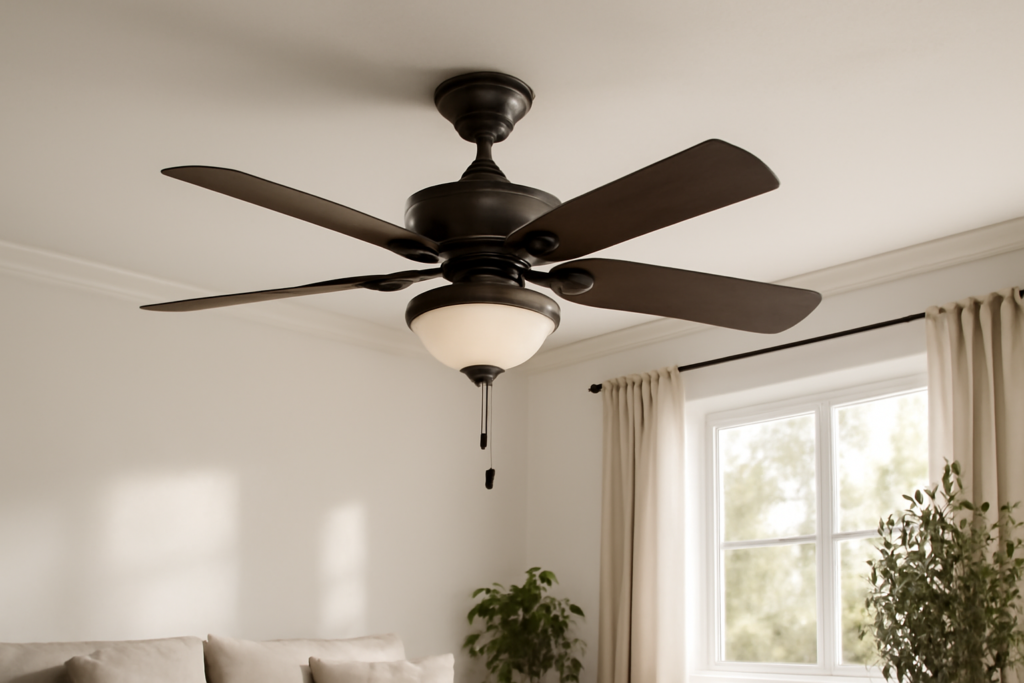
Matte black is everywhere and brushed nickel is safe — but neither has the depth of a dark bronze with copper light catching its edges. An oil rubbed bronze ceiling fan brings warmth to a category dominated by cool metallics, and it remains the default choice for traditional, rustic, Mediterranean, and craftsman rooms where black reads too stark and nickel too contemporary. The finish carries some fine print (what “living finish” means on a fan, and how not to overmatch a room full of ORB hardware), so here is the complete style guide: the finish itself, the rooms it suits, blade pairings, model picks at every budget, and care.
What Oil Rubbed Bronze Actually Is
Traditional oil-rubbed bronze was exactly that: solid bronze or brass chemically darkened, then rubbed with oil so high spots wore lighter over years of handling — a living finish that patinas and changes. On faucets and door hardware, some premium lines still work that way. Ceiling fans are different, and helpfully so: fan bodies are painted/powder-coated steel with an ORB-effect finish — a deep brown-black base with subtle copper, gold, or red undertones, often lightly relieved on cast details to mimic wear. Because nobody’s hands touch a fan, the living-finish question is mostly moot: your fan’s finish is stable and will look in year ten as it does out of the box. The practical consequence is variation between brands — Hunter’s “onyx bengal,” Minka’s “oil rubbed bronze,” and Kichler’s “olde bronze” all sit at slightly different points between black-brown and coppery — so when matching across fixtures, compare in person or order from one brand family.
Rooms and Styles Where ORB Wins
ORB’s warmth is its function — the finish absorbs light where nickel reflects it, which is why it grounds a room rather than sparkling in it. It anchors:
- Traditional and transitional living rooms — with wood tones, warm whites, and classic trim, ORB reads intentional where chrome reads clinical.
- Rustic, farmhouse, and lodge spaces — pairs naturally with reclaimed wood, leather, iron, and stone; a five-blade ORB fan with walnut blades is the genre’s signature.
- Mediterranean, Tuscan, and Spanish revival — the copper undertone echoes terracotta, wrought iron, and warm plaster; scrolled-detail ORB fans exist specifically for these rooms.
- Craftsman and mission interiors — with quarter-sawn oak and amber glass, ORB is the period-correct metal.
- Warm-palette bedrooms and offices — beige, cream, terracotta, olive, and warm gray walls all flatter it.
Where it struggles: cool-gray contemporary rooms, stark white minimalist spaces, and Scandinavian palettes — there, matte black or nickel serves better. Against a dark ceiling, note that ORB nearly disappears; that is either the goal (unobtrusive) or a loss (detail vanishes), so decide which you want.
Pairing With ORB Hardware Without Overmatching
The classic mistake is the total-match room: ORB fan, ORB door levers, ORB faucet, ORB cabinet pulls, ORB frames — which flattens into heaviness. Designers’ working rules:
- Match by zone, not by house. The fan should agree with the room’s dominant fixed metal (typically lighting and door hardware). It does not need to match the kitchen faucet two rooms away.
- Two metals per room, one dominant. ORB pairs beautifully with warm brass/antique gold accents, copper, and even black iron; keep the second metal to roughly a third of the metal moments.
- Exact-match only what sits close together. A ceiling fan and its same-room chandelier should be the same or clearly different — near-miss bronzes side by side look like an error. Buying fan and lighting from one brand’s ORB solves this.
- Let wood carry the warmth too. If the room already has abundant dark wood, an ORB fan with lighter blades keeps it from going muddy.
Blade Color Combinations
Most ORB fans ship with reversible blades, and the choice changes the room:
- Walnut or medium cherry blades — the classic pairing; warm, traditional, matches most wood floors.
- Dark espresso/burnished blades — monochrome and heavier; elegant in tall rooms, oppressive under 8-foot ceilings.
- Weathered gray or driftwood blades — the farmhouse-coastal update, softens ORB for transitional rooms.
- Cream/distressed white blades — cottage and Mediterranean move that lightens the fan against dark beams.
Rule of thumb: contrast blades with the ceiling for presence, match them to it to disappear. Under 8-foot ceilings, lighter blades on an ORB hugger keep the fan from looming.
Model Picks Across Budgets
- Budget ($60-$130): Harbor Breeze Mazon 44″ flush-mount and Hampton Bay Rockport 52″ — honest basic fans in convincing ORB for bedrooms and rentals.
- Mainstream ($130-$250): Hunter Builder Deluxe 52″ and Hunter Dempsey 44″/52″ (LED, low-profile option) — Hunter’s bronze finishes are among the best-calibrated; Westinghouse Comet 52″ with reversible blades.
- Upper-mid ($250-$450): Minka-Aire Contractor Plus and traditional five-blade lines with DC motors; Kichler Basics Pro; Craftmade Outdoor Pro damp-rated ORB for porches.
- Premium ($450-$900+): Minka-Aire Great Room Traditional 72″ for big spaces; Casablanca Fellini/Heritage-style ORB fans with cast detailing for period rooms; Fanimation Islander in bronze for tropical-Mediterranean spaces.
Shopping tip: ORB is often the cheapest premium finish because it is the volume seller in traditional lines — the same fan frequently costs $10-$30 less in bronze than in matte black or brass. Check open-box and last-generation listings too; because the finish does not date the way trend metals do, a discontinued ORB model loses nothing stylistically.
Outdoor note: for porches and patios, buy a damp- or wet-rated ORB fan specifically — the coastal air that patinas real bronze beautifully just corrodes a dry-rated painted fan.
Light Kits, Glass, and Bulb Temperature
Lighting choices make or break an ORB fan because the finish is dark and warm — the glass and bulb have to agree with it. Amber, tea-stain, and seeded glass shades are the natural partners, throwing warm light that flatters the bronze; bright white opal glass reads mismatched on traditional ORB fans, though it works on transitional models. Bulb color temperature matters more than most buyers expect: 2700K warm white is the correct answer for nearly every ORB fan, since 4000K+ cool bulbs turn the copper undertones muddy gray and make amber glass look dingy. On integrated-LED models, look for selectable CCT and set it warm. If the fan will be the room’s primary light, check delivered lumens — 800 is a supplement, 1,500+ can carry a bedroom — and confirm the light kit dims by a method your wall switch supports. Uplight-style kits bouncing off the ceiling are an underused trick with dark fans: they light the room without glare while leaving the silhouette dramatic.
Care and Keeping the Finish Right
Sizing follows the same rules as any fan, restated briefly because dark fans visually enlarge: 44 inches for rooms to about 10×10 feet, 52 inches to roughly 12×15, 60 inches and up beyond that, with blades at least 7 feet above the floor and 18 inches off walls. In small rooms, a dark 52-inch fan can overwhelm where a nickel one would not — dropping one size, or choosing lighter blades, restores the proportion.
Painted ORB is low-maintenance: dust monthly with a microfiber cloth or blade duster (a pillowcase slipped over each blade catches the dust instead of raining it), and wipe the housing with a barely damp cloth. Never use ammonia or abrasive cleaners, which dull the undertone highlights, and skip furniture polish on the motor housing — it builds a film that grabs dust. If a ceiling-brush scuff exposes primer, ORB touch-up paint pens ($8-$12, or the fan brand’s touch-up kit) blend well on the low-sheen finish. Check blade screws annually; warm-finish fans tend to live in rooms with fireplaces and their seasonal temperature swings loosen hardware. Treated that gently, the finish outlasts the motor — and unlike this year’s trending metal, an oil rubbed bronze ceiling fan will still look correct over the same room in twenty years, which is the quiet argument for choosing it in the first place.


