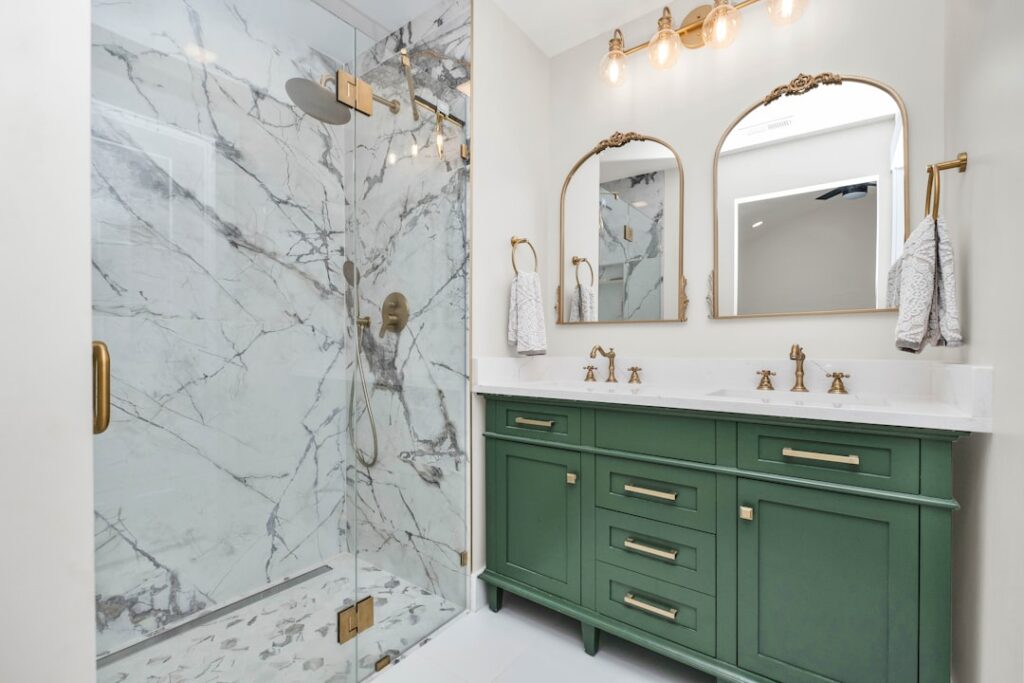
Walk into any renovated primary bathroom built in the last five years and you will probably see one, often in place of a tub. An open shower, also called a walk-in or doorless shower, eliminates the glass enclosure, curtain, and often the curb itself in favor of a flush, spa-like wet area. The look is hotel-grade, the cleaning is easier, and the accessibility benefits are real, but the engineering has to be right or you will be mopping water off the bedroom carpet.
What Defines an Open Shower
At its most literal, an open shower has no door. That covers three distinct design approaches. A curbless shower drops the floor plane entirely so the bathroom tile runs continuously into the shower. A walk-in with a half wall uses a partial glass or tile partition to block splash while keeping the entrance open. A wet room waterproofs the entire bathroom floor so the shower boundaries become purely visual.
Each approach has different drainage, waterproofing, and heating requirements, and mixing them up in the design phase leads to expensive fixes later.
Pros That Drive the Trend
- Visual space gain of 15 to 25 percent in small bathrooms
- Wheelchair and walker accessibility without retrofits
- No door tracks, hinges, or glass panels to clean
- Continuous floor tile pattern increases perceived room size
- Easier to renovate for aging-in-place
- Premium resale appeal in most US housing markets
Honest Drawbacks
Open showers lose more heat than enclosed ones, so the rest of the bathroom can feel chilly mid-shower unless you have in-floor radiant heat or a ceiling heat lamp. Water containment requires careful design, and even well-built showers occasionally need a squeegee pass to keep neighboring surfaces dry. Privacy is reduced if the shower sits in the line of sight from the bedroom or toilet area.
Cost is the other catch. Going curbless adds $2,000 to $6,000 versus a conventional tile shower because the subfloor usually needs to be dropped to create slope and clearance for the linear drain.
Minimum Size Requirements
Code and comfort diverge here. The International Residential Code allows showers as small as 30 by 30 inches, but an open shower needs more room to keep water contained. Aim for 42 by 60 inches minimum, with a preferred 48 by 72 inches. The extra length creates a splash zone that keeps water off the main bathroom floor.
If the shower head is wall-mounted opposite the entry, locate it on the farthest wall. If you use a rainhead, point it away from the opening at a slight angle. A hand shower on a slide bar should mount on the wall farthest from the entrance too.
Waterproofing Systems
Traditional mortar pan-liner systems do not belong in an open shower. Modern builds use a bonded membrane system such as Schluter Kerdi, Laticrete Hydro Ban, or Wedi Board. These sheet or trowel-applied membranes create a continuous waterproof layer under the tile that tolerates the flush transitions an open shower demands.
Expect to pay $4 to $8 per square foot in waterproofing material, plus labor. Any installer bidding on a curbless shower without specifying which system they use is a red flag.
Drain Selection
A single point drain in the center works for small showers, but large open showers almost always use a linear drain along one wall. Linear drains allow the floor to slope in a single plane, which accommodates large-format tile (12 by 24 inches or bigger) without awkward miter cuts. Budget $250 to $800 for a quality stainless linear drain like the Schluter Kerdi-Line or the ACO HygienicBox.
Slope needs to run 1/4 inch per foot toward the drain, and the bathroom floor outside the shower should slope 1/16 inch per foot away from the opening to keep stray water from escaping.
Heating and Ventilation
In-floor radiant heat under a tile wet room is the single best upgrade you can make. A 110-volt electric mat like the WarmlyYours TempZone runs $8 to $14 per square foot and keeps tile at 80 to 85 degrees Fahrenheit. Pair it with a programmable thermostat that warms the floor 30 minutes before your morning shower.
Upgrade your bath fan to 110 CFM minimum, or 150 CFM for bathrooms over 100 square feet. A Panasonic WhisperGreen fan at $180 moves the moisture out before it condenses on the rest of the room.
Design Details That Elevate the Space
Use large-format porcelain tile (24 by 48 inches is trending) to minimize grout lines and reinforce the continuous-floor illusion. A wall-hung niche instead of a curbed one keeps shampoo bottles off the floor. Hidden LED strip lighting behind a half-wall or under a floating bench adds drama without obvious fixtures.
Consider a trough-style shelf along one wall, a built-in teak bench for seating, and matte black or brushed nickel hardware that hides water spots. A single glass splash panel (36 to 60 inches wide) blocks the worst of the spray while preserving the open feel.
Typical Costs
A basic curbless open shower retrofit runs $8,000 to $15,000 in most US markets, covering demo, subfloor modification, waterproofing, new tile, fixtures, and a linear drain. New construction versions start closer to $6,000 because the slab can be formed at the correct elevation from day one. High-end wet rooms with radiant heat, stone slab walls, and premium fixtures commonly reach $25,000 or more.
Done right, the investment lifts the entire bathroom into a spa category and commands a strong return at resale. Done wrong, it delivers water damage and a callback for the contractor. Hire a remodeler who has built at least five open showers and can show you photos of the linear drain transition, and the finished space will look and feel as good as the magazines promise.
Fixture Selection That Matters
Thermostatic mixing valves are essential in open showers. Without an enclosure trapping warm air, the temperature swings from a flushing toilet or running sink across the house become much more noticeable. A Grohe Grohtherm or Hansgrohe ShowerSelect valve ($350 to $700) holds water within 1 degree Fahrenheit of the set point. Pair with a high-output rain head (8 to 12 inches) and a separate hand shower on a slide bar for the most flexible daily use.