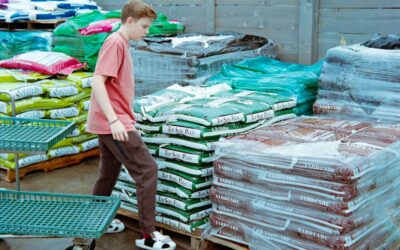
A big garden project burns through compost faster than most people expect. A single raised bed can swallow ten bags, and topdressing a lawn can take dozens. Buying a pallet of compost is the usual next step, but it is not always the cheapest way to get material onto the ground. For large jobs, loose compost delivered by the cubic yard often costs half as much per unit of volume.
Here is the quick version. A typical pallet holds roughly 50 to 80 bags, which works out to about 2 to 4 cubic yards depending on bag size. One cubic yard covers about 324 square feet at 1 inch deep, 162 square feet at 2 inches, and 108 square feet at 3 inches. Once a project needs more than about 3 cubic yards and you have somewhere for a truck to dump it, bulk delivery usually wins on price. Bagged compost wins on convenience, cleanliness and access to tight spots.
- How Many Bags Are on a Pallet of Compost
- Converting Cubic Feet to Cubic Yards
- Coverage Math: How Far a Pallet Spreads
- Bulk vs Bagged Compost: Cost Comparison
- What to Check Before You Buy
- Spreading Tips for Big Jobs
- Troubleshooting Common Ordering Mistakes
- When to Hire a Landscaper
- Frequently Asked Questions
How Many Bags Are on a Pallet of Compost
Pallet counts vary by supplier, bag size and how heavy the product is, so treat these as typical numbers rather than fixed rules. Compost is dense when moist, and pallets are limited by weight as much as by space.
- 1 cubic foot bags (often 35 to 50 pounds each): typically 60 to 100 bags per pallet, or about 2.2 to 3.7 cubic yards.
- 1.5 cubic foot bags: typically 50 to 70 bags, or about 2.8 to 3.9 cubic yards.
- 2 cubic foot bags: typically 40 to 60 bags, or about 3 to 4.4 cubic yards.
- Bags sold by weight (for example 40 pound bags with no volume listed): usually about 0.75 to 1 cubic foot each, depending on moisture.
A full pallet commonly weighs 2,000 to 3,000 pounds. That matters for delivery: a liftgate truck or forklift drop is needed, and the pallet should sit on a driveway or firm, level ground rather than on a lawn that could rut. Always ask the supplier for the exact bag count and bag volume before you order, because those two numbers drive every calculation that follows.
Converting Cubic Feet to Cubic Yards
Bags are sold in cubic feet, and bulk compost is sold in cubic yards. The conversion is simple: 27 cubic feet equals 1 cubic yard (3 feet by 3 feet by 3 feet).
- Multiply the number of bags by the cubic feet per bag to get total cubic feet.
- Divide total cubic feet by 27 to get cubic yards.
For example, 75 bags of 1.5 cubic feet equals 112.5 cubic feet. Divide by 27 and you get about 4.2 cubic yards. If 75 bags of 1 cubic foot come on a pallet, that is 75 cubic feet, or about 2.8 cubic yards. Writing the math down before you shop makes it easy to compare a pallet price against a per-yard bulk price.
Coverage Math: How Far a Pallet Spreads
To estimate how much compost you need, measure the area and choose a depth. Then use this formula:
Square feet × depth in inches ÷ 324 = cubic yards needed.
Common depths for different jobs:
- Lawn topdressing: 1/4 to 1/2 inch, raked into the grass after aeration.
- Annual vegetable or flower bed amendment: 1 to 2 inches worked into the top 6 to 8 inches of soil.
- New planting beds on poor soil: 2 to 3 inches tilled or forked into the top 8 to 12 inches.
- Mulching around shrubs with fine compost: 1 to 2 inches, kept a few inches away from stems.
Here is a worked example. A 20 by 30 foot vegetable garden is 600 square feet. At 2 inches deep: 600 × 2 ÷ 324 = about 3.7 cubic yards. A pallet of 1 cubic foot bags holding 80 bags (about 3 cubic yards) would fall short, so you would need a second partial pallet or a bulk load. For lawn topdressing at 1/4 inch, the same 3.7 cubic yards would cover about 4,800 square feet.
Raised beds work the same way. A 4 by 8 foot bed filled 12 inches deep holds 32 cubic feet, or about 1.2 cubic yards. If you blend one third compost with two thirds topsoil, each bed needs roughly 11 cubic feet of compost, which is about 11 one-cubic-foot bags. A full pallet could supply compost for five to eight beds that size.
Bulk vs Bagged Compost: Cost Comparison
Prices swing widely by region, product and season, so these figures are typical ranges for planning, not quotes.
- Bagged compost: typically 4 to 10 dollars per cubic foot bag at retail. That equals roughly 110 to 270 dollars per cubic yard of material.
- A full pallet of bagged compost: often 250 to 700 dollars before delivery, with some retailers discounting 10 to 20 percent for full-pallet orders.
- Bulk organic compost: typically 30 to 70 dollars per cubic yard at a landscape yard, with premium blends and certified organic products running higher.
- Delivery: commonly 50 to 150 dollars per trip within a local radius, often with a minimum order of 2 to 3 cubic yards.
Run the numbers on that 3.7 cubic yard garden. Bagged, it might cost 400 to 1,000 dollars. Bulk, it might cost 110 to 260 dollars of material plus around 100 dollars of delivery. For a single raised bed, though, a handful of bags is easier and the savings from bulk disappear once a delivery fee is added.
Many municipal yard waste programs also sell or give away compost made from leaves and grass clippings, sometimes for a few dollars a yard if you load it yourself. Quality varies, so ask whether it is screened and how long it was cured.
When bulk delivery is the better choice
- You need more than about 3 cubic yards.
- You have a driveway or tarp-covered area where a truck can dump a pile.
- The beds are close to the drop spot, or you have a wheelbarrow and time.
- You want a specific blend, such as mushroom compost bulk loads or a compost and topsoil mix.
When a pallet of bagged compost makes more sense
- You need 1 to 3 cubic yards spread over several small beds or containers.
- There is no room for a dump pile, or a homeowner association restricts it.
- Access is through a gate, side yard or stairs where carrying bags is easier than wheelbarrowing loose material.
- You want to use the compost gradually over a season and store it neatly.
What to Check Before You Buy
Compost quality varies more than price. A cheap yard of half-finished material can set a garden back. Before ordering, ask or check for:
- Finished, cured product: it should be dark, crumbly and smell earthy, not sour or like ammonia.
- Screening size: 3/8 to 1/2 inch screened compost spreads easily for topdressing; coarser material is fine for tilling into beds.
- Feedstock: yard waste, manure, food waste and mushroom compost each behave differently. Mushroom compost and some manure blends are higher in salts and lime, which suits vegetables but not acid-loving plants.
- Lab testing: larger producers often share results for pH, salts and organic matter.
- Contaminants: look for bits of plastic, glass or treated wood in a sample before a full load arrives.
Spreading Tips for Big Jobs
- Lay a heavy tarp where the bulk load will be dumped to protect the driveway and make cleanup easy.
- Mark bed areas and calculate depth before the delivery, so you know how many wheelbarrow loads go where. A standard 6 cubic foot wheelbarrow holds about 1/4 cubic yard when heaped.
- Spread with a shovel and level with a bow rake. For lawns, use the back of a leaf rake or a drag mat to work compost into the turf.
- Water lightly after spreading so the compost settles and does not blow away.
- Cover any leftover pile with a tarp to keep weeds from seeding into it and rain from leaching nutrients.
Lift bags with your legs, not your back, and use a hand truck to move several at a time. A pallet of 40 pound bags adds up to more than a ton of lifting, so split the work over a couple of sessions if you are moving it by hand.
Troubleshooting Common Ordering Mistakes
Ran out halfway through. Most people underestimate depth. Measure in square feet, pick a depth, and add 10 percent for settling and uneven ground.
Too much left over. Extra compost stores well under a tarp and can be used next season for topdressing or potting mixes.
Compost is hot or smells sour. It was not fully cured. Spread it thinly away from plant roots or let it sit a few weeks, turning it once or twice.
Plants yellowed after amending. Some blends are high in salts. Water deeply to flush the root zone and blend future applications with topsoil.
When to Hire a Landscaper
For very large areas, steep slopes or jobs that need a skid steer, a landscaping crew can spread several yards in an afternoon. Expect labor charges by the hour or by the yard spread on top of material costs. A pro also makes sense when compost is one part of a larger job, such as regrading a yard or building new beds, where the crew can source bulk material at contractor pricing.
Frequently Asked Questions
How many cubic yards are in a pallet of compost?
Most pallets hold about 2 to 4 cubic yards, depending on bag size and count. Multiply the number of bags by cubic feet per bag, then divide by 27 to get the exact figure.
How much area does one cubic yard of compost cover?
One cubic yard covers about 324 square feet at 1 inch deep, 162 square feet at 2 inches and 108 square feet at 3 inches. For lawn topdressing at 1/4 inch, it covers roughly 1,300 square feet.
Is bulk compost cheaper than bagged compost?
Usually, yes. Bulk organic compost typically costs a fraction of bagged compost per cubic yard, but delivery fees and minimum orders mean bagged compost is often cheaper for small jobs under about 2 cubic yards.
How much does a pallet of compost weigh?
A full pallet commonly weighs 2,000 to 3,000 pounds. Plan for a firm, level drop spot such as a driveway, since a loaded pallet can rut a lawn.
Can I store a pallet of compost for next season?
Yes. Keep bags out of direct sun and off bare soil, and cover the pallet with a tarp. Bagged compost stays usable for a year or more, though it may dry out and need watering before use.