Most homeowners spend hours scrolling Pinterest looking for flooring inspiration and end up with a clear vision but no idea how the materials actually perform in each room. Looking at pictures of different flooring in different rooms is a great starting point, but the real question is which material survives kids in the kitchen, water in the bath, and pets in the entry. This guide pairs the visual choices with hard performance data and 2026 pricing so you can plan a whole-house specification that works.
Why Mixing Flooring Across Rooms Works
Designers increasingly mix materials room by room because no single product nails every requirement. Tile beats hardwood in wet zones. Carpet beats LVP in bedrooms for sound and warmth. Hardwood beats tile in main living areas for warmth underfoot and resale value. The trick is choosing materials that share undertones and pair through clean transitions.
Real-estate data from 2025 also shows that buyers prefer one consistent floor across the public areas (living, dining, kitchen, entry) with different floors in bedrooms and baths.
Living Rooms and Family Rooms
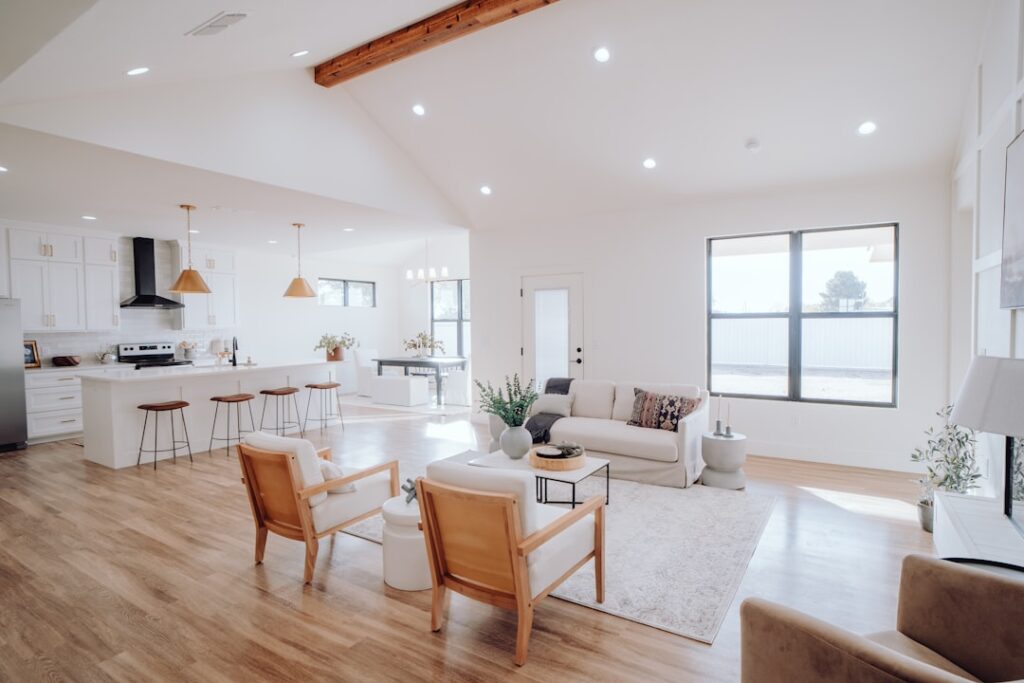
Hardwood dominates living-room photography for good reason. 5 to 7 inch white oak engineered planks cost $5.50 to $8 per sq ft installed and deliver the warm, neutral palette that flatters every furniture style from modern to traditional. Wide-plank visuals make small rooms feel larger and large rooms feel grander.
If hardwood is over budget, premium LVP with a 22 mil wear layer mimics the look at $3.50 to $5 per sq ft. Pick a brand like COREtec Originals or Mohawk SolidTech that uses real wood texture rather than glossy print films.
Kitchens
Kitchens demand waterproof or near-waterproof floors because dishwashers leak, sinks splash, and ice makers fail on schedule once every 8 to 12 years. The best modern picks are large-format porcelain tile (24 by 48 inches running $5 to $9 per sq ft) and SPC luxury vinyl plank ($3.50 to $5.50 per sq ft).
Hardwood works in kitchens if you accept the moisture risk. Use a factory-finished engineered product with a urethane topcoat, and add felt pads to every chair and stool. Avoid solid hardwood directly adjacent to dishwashers.
Bathrooms
Porcelain tile is the default for bathrooms because it handles standing water indefinitely. Mosaic patterns work for shower floors at 1 to 2 inch tile size, while 12 by 24 inch large-format planks suit main bathroom floors. Heated tile with electric in-floor systems like SunTouch costs $8 to $14 per sq ft installed including the heat layer.
LVP also works in bathrooms if you specify products with welded seams or apply silicone caulk at every perimeter and fixture penetration. Sheet vinyl remains the most water-tight resilient option at $2 to $4 per sq ft.
Bedrooms
Carpet still wins most bedroom photography because soft floors feel right under bare feet first thing in the morning. Modern nylon and polyester carpets cost $3 to $6 per sq ft installed and carry 10 to 25 year stain warranties. Pick a 1/2 inch 8 lb density pad to extend the carpet’s wear life by 40%.
If you prefer hard flooring in bedrooms, run the same product as the main living area to keep the visual flow. Add area rugs at the bedside and under accent furniture for warmth.
Entryways and Mudrooms
Entries take the worst abuse of any room: snow, sand, salt, wet shoes, dog paws, and dropped grocery bags. Porcelain tile or commercial-grade LVP with a 28 mil wear layer are the only finishes I confidently recommend. Pricing runs $5 to $10 per sq ft installed for tile, $4 to $6 for premium LVP.
Add a 3 by 5 foot heavy-duty mat at every exterior door. The cheapest insurance against scratch damage is a $40 mat that catches grit before it reaches the floor.
Basements
Below-grade rooms demand moisture tolerance. The big three are SPC luxury vinyl plank ($3 to $5 per sq ft), engineered tile over uncoupling membrane ($6 to $11 per sq ft), and sealed concrete ($2 to $5 per sq ft). Avoid solid hardwood and traditional laminate in basements without exception.
Pair any floating floor with a vapor-barrier underlayment rated for below-grade installation, especially in older foundations where slab moisture readings often exceed 75% RH.
Transition Strips and Color Coordination
- Choose flooring colors that share undertones, not exact shades. Cool gray LVP pairs with cool gray porcelain in adjacent rooms.
- Use T-molding transitions when both floors are the same height. Reducers handle height changes up to 1/2 inch.
- Plan transitions at doorway centerlines, not at room thresholds, for cleaner sightlines.
- Match grout color to the LVP undertone when tile meets vinyl to keep the line subtle.
- Document each material box label for warranty claims and future repairs.
Pros of Mixing Flooring by Room
The biggest advantage is right-tool-for-the-job performance. You get warm hardwood in living spaces, durable tile in wet zones, and soft carpet in bedrooms without compromise. Cost can also be optimized because you spend premium dollars only where they earn their keep.
Cons and Coordination Challenges
Mixed flooring requires more design effort. Coordinating undertones, plank widths, and transition strips across four or five rooms takes planning that single-material installs avoid. Resale-minded buyers may also worry about the patchwork look if rooms run too many different products.
Bottom Line on Whole-House Flooring
For a typical 2,200 sq ft US home, a smart specification might be hardwood or wide-plank LVP in the public areas, porcelain tile in baths and entry, and nylon carpet in the bedrooms. Total installed cost lands $14,000 to $24,000, with the mix paying back in performance every single day.
Prefer to explore on your own?
See how new flooring looks in your actual room in seconds — free, no signup.
Try the free Floor Studio →