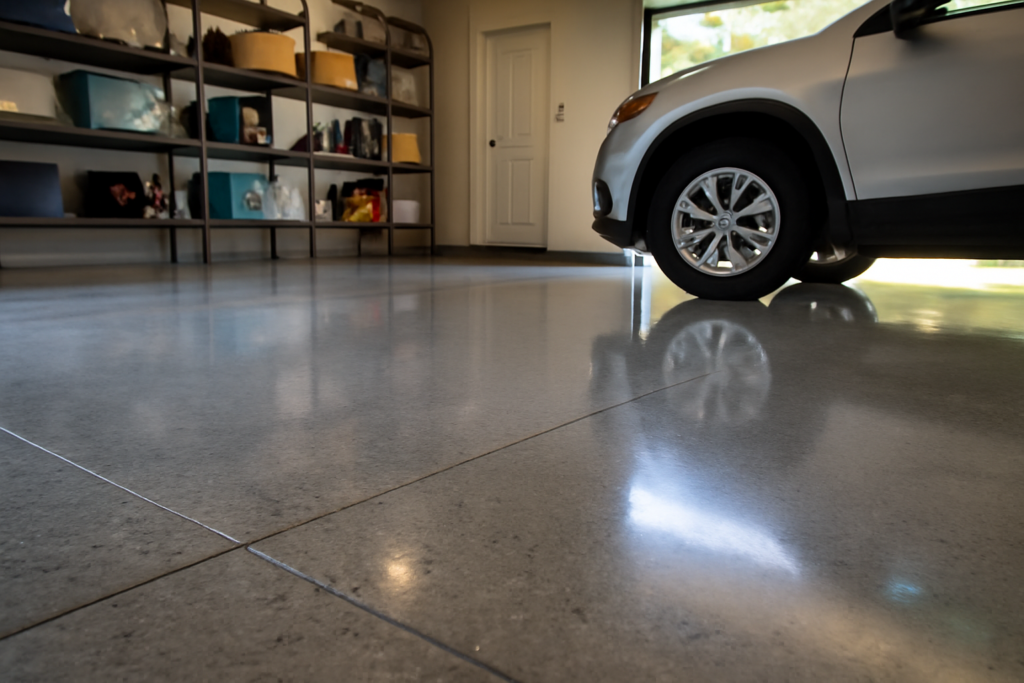
A polished concrete garage floor takes the raw slab you already own and grinds it into a smooth, dense, subtly glossy surface that resists stains, shrugs off traffic, and needs almost no maintenance. Unlike a coating that sits on top of the concrete, polishing works the concrete itself, so there’s nothing to peel, chip, or delaminate. That’s a big part of its appeal for people tired of epoxy failures.
I’ve polished plenty of garage slabs, and it’s a fantastic finish for the right situation. Here’s an honest breakdown of the process, cost, and trade-offs.
What Polished Concrete Actually Is
Polishing is a mechanical process, not a coating. Specialized machines fitted with progressively finer diamond abrasives grind the concrete surface smooth, much like sanding wood from coarse to fine grit. A chemical hardener called a densifier is applied during the process to react with the concrete and make the surface harder and more stain-resistant.
The result is a floor that’s part of the slab itself. Because there’s no film on top, there’s nothing to bond and fail. The finish level ranges from a satin, matte sheen to a high-gloss, near-mirror polish depending on how far you take the grit sequence.
If you’re running out of room even with a clean garage floor, a backyard shed takes the overflow — seasonal gear, tools, lawn equipment. And if you’re parking outside while the garage doubles as a workshop, a carport keeps your car covered without needing a second garage.
We may earn a commission when you purchase through our links.
The Big Advantages
Durability is the headline benefit, and it’s genuine. A properly polished floor holds up to vehicle traffic, dropped tools, and heavy loads for decades.
- No coating to peel, chip, or delaminate over time
- Extremely low maintenance, usually just dust mopping and occasional damp mopping
- Stain and abrasion resistance from the densified surface
- A bright, reflective surface that improves visibility in the garage
- No VOC-heavy coatings and no fumes once the job is done
The Honest Drawbacks
Polished concrete isn’t perfect, and I’d be doing you a disservice to pretend otherwise. The finish reveals the slab’s true character, cracks and all.
It won’t hide existing cracks, spalling, or discoloration; if anything, polishing highlights them. It’s also hard and cold underfoot, which matters if you spend long hours in the garage. And while the surface resists stains, it’s not fully impervious the way epoxy is, so oil left sitting can still leave a mark on lighter finishes. A good sealer or guard product mitigates this but adds maintenance.
Is Your Slab a Good Candidate?
Not every garage floor polishes well. The slab needs to be structurally sound and reasonably flat, without major cracks or heaving. Older slabs with significant surface damage may need repair or a different approach.
Structural cracks are a red flag. A hairline surface crack can often be filled and polished over, but wide, active, or heaving cracks signal a foundation or slab issue that a flooring contractor should not simply grind over. Have a pro evaluate any significant cracking before committing to polishing, because the finish is only as sound as the concrete beneath it.
Cost Expectations
Polishing is priced by the square foot and by the level of finish. Basic grind-and-seal or a lower-sheen polish sits at the affordable end, while a multi-step, high-gloss finish with dyes and multiple densifier passes costs more.
- Basic polish or grind-and-seal, roughly $3 to $6 per sq ft
- Mid-level polish with a higher sheen, roughly $5 to $8 per sq ft
- High-end polish with dyes and multiple grit passes, $8 to $15 or more per sq ft
For a typical two-car garage of around 400 to 500 sq ft, budget roughly $1,500 to $5,000 depending on finish level and slab condition. It’s competitive with a quality professional epoxy floor and often lasts longer.
Polished Concrete Versus Epoxy
This is the comparison that decides most garages. Epoxy gives you color, a fully sealed impervious surface, and a lower up-front cost for DIY kits, but it’s a coating that can peel and eventually needs recoating. Polished concrete costs more up front and offers fewer color options, but it never peels and needs far less long-term upkeep.
If you want a colorful, fully sealed, oil-proof floor and don’t mind eventual maintenance, epoxy makes sense. If you want a permanent, ultra-low-maintenance surface and like the industrial look, polishing wins. Some people even combine approaches, using a stain and guard on polished concrete for the best of both.
Is It Worth It?
A polished concrete garage floor is an excellent long-term choice for a sound slab when you value durability and near-zero maintenance over color options and softness underfoot. The finish is permanent, never peels, and looks clean and modern for decades. Just have any real cracks evaluated by a pro first, and be honest with yourself about the hard, cold surface. For the right garage, it’s one of the best flooring investments you can make.
Maintenance and Durability
One of the biggest draws of a polished concrete garage floor is how little it asks of you. There is no coating to peel, no grout to scrub, and no wax to strip. Day-to-day care is a dust mop and the occasional damp mop with a pH-neutral cleaner. Because the surface is densified and sealed, oil drips and road salt wipe up rather than soaking in, though blotting spills promptly still keeps the sheen looking its best.
Expect to reapply a guard or burnish the finish every few years in a working garage to maintain the gloss, which is minor upkeep compared to recoating epoxy.
Is It Right for a Garage?
Polished concrete shines in a garage that already has a sound, level slab. It resists hot tire pickup that plagues some coatings, handles heavy vehicle loads without denting, and never yellows in sunlight. The trade-offs are real, though: the surface is hard and unforgiving to dropped tools and can be slippery when wet, so an anti-slip additive in the final guard coat is wise. If your slab is cracked, pitted, or stained from years of use, budget for grinding and repair first, because polishing reveals every existing flaw rather than hiding it the way an opaque coating would.
Cost and What to Expect
Polished concrete for a garage typically runs a few dollars per square foot for a basic grind-and-seal up to considerably more for a high-gloss, multi-step mechanical polish, still often competitive with a quality epoxy system over the long run given how little maintenance it needs. The finish level is a choice: a satin honed look hides wear and dust, while a high-gloss polish maximizes light reflection and that showroom shine. Whatever you choose, a sound slab is the prerequisite, so budget for any needed crack repair or grinding before the polishing begins.