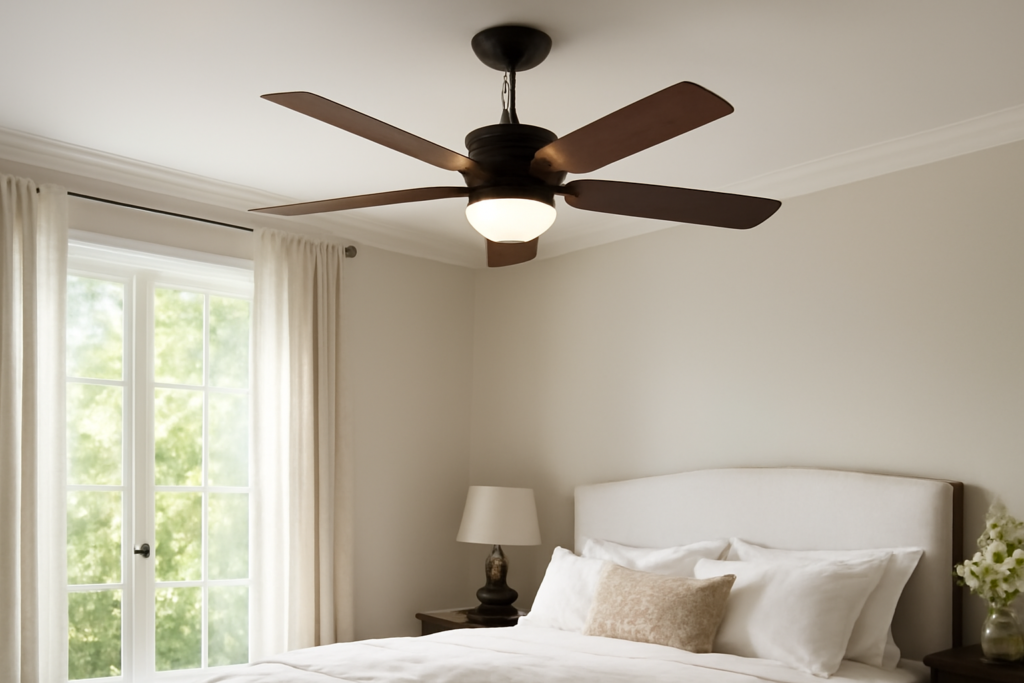
Here’s the detail most shoppers miss: a Pottery Barn ceiling fan isn’t actually built by Pottery Barn. The retailer partners with established fan manufacturers — most notably Monte Carlo (now part of Visual Comfort Fan Collection) — to produce co-branded designs that match its farmhouse and coastal aesthetic. That’s good news, because it means the motors, warranties, and replacement parts come from a company that has built fans for decades, while the styling gets Pottery Barn’s design polish. This review breaks down what’s in the collection, what you’ll pay, how the fans perform, and when you’re better off buying the equivalent Monte Carlo model directly.
Who Actually Makes Pottery Barn Fans
Pottery Barn’s fan lineup has historically been a curated selection of Monte Carlo designs, sometimes exclusive colorways of existing models and sometimes co-developed pieces. Monte Carlo has manufactured ceiling fans since 1996 and was folded into Visual Comfort & Co., a serious lighting house. The practical upshot: the motor architecture, remote receivers, and mounting hardware in a Pottery Barn fan are the same components you’d find in a $400-plus specification-grade fan sold through lighting showrooms.
That partnership also explains the warranty structure. Fans purchased through Pottery Barn carry the manufacturer’s limited lifetime motor warranty, with parts support handled through Visual Comfort Fan’s customer service rather than Pottery Barn’s furniture channels. Keep your order confirmation — the model cross-reference (for example, a PB-exclusive finish of the Monte Carlo Maverick) is what parts support will ask for when you need a new remote receiver in year six.
The Signature Look: What Defines the Collection
Pottery Barn’s fan curation leans hard into three looks. First is the windmill-inspired natural wood fan — long, thin solid-wood blades in weathered oak or driftwood gray, usually 52 to 70 inches, built around the Maverick platform. Second is the modern farmhouse fan: matte black or aged pewter housings, three to five flat blades, often with an integrated LED and a caged or exposed-bulb light kit. Third is the coastal category — whitewashed or rattan-look blades meant for beach houses and covered porches, most of them damp-rated.
What you won’t find is anything ornate. No Tuscan scrollwork, no brass-and-glass 1990s styling. If your interior runs traditional-formal, the collection will feel thin; if it runs farmhouse, transitional, or coastal, nearly everything fits together because the finishes are coordinated across the catalog with Pottery Barn’s lighting and hardware lines.
Pricing and How It Compares
Expect $350 to $800 for most models, with large-format windmill fans reaching $900 to $1,100. That’s a $50 to $150 premium over buying the equivalent Monte Carlo model at a lighting retailer — you’re paying for the exclusive finish and the one-stop design coordination. A few reference points from recent seasons:
- Maverick-platform wood-blade fans: $500 to $750 depending on span (52″, 60″, 70″)
- Matte black farmhouse fans with LED kits: $400 to $600
- Damp-rated coastal/porch fans: $450 to $700
- Compact 44-inch bedroom models: $350 to $450
Watch Pottery Barn’s sale cycles. Fans routinely drop 20 to 25 percent during Presidents Day, Memorial Day, and Labor Day promotions, which erases most of the brand premium. Stack a trade or design program discount and the co-branded fan can actually undercut the open-market Monte Carlo price.
Performance: DC Motors and Real Airflow Numbers
The better models in the collection run DC motors, and it shows in the numbers. The Maverick platform posts roughly 6,600 CFM on high while drawing about 30 watts — a five-blade builder-grade fan from a big-box store typically moves 4,000 to 5,000 CFM at twice the wattage. DC motors also give you six speeds instead of three, near-silent operation, and a true reverse function on the remote rather than a hub slider you have to reach on a ladder.
Two performance caveats. Handheld remotes are the primary control on most models; if you want wall control, budget another $60 to $100 for the compatible wall station, and never put a DC fan on a standard dimmer — it will destroy the receiver. Second, the rattan and open-weave decorative blades on some coastal models cost 15 to 20 percent in airflow versus solid blades of the same span. In a hot climate where the fan does real cooling work, choose solid wood or ABS blades and get the look elsewhere in the room.
Sizing and Placement
Use blade span to match room size: 44 inches for rooms under 150 sq ft, 52 to 54 inches for 150 to 250 sq ft, and 60 to 70 inches for great rooms above 250 sq ft. The oversized windmill fans need breathing room — keep blade tips at least 24 inches from walls or sloped-ceiling surfaces, and 30 inches looks better. Blades must clear the floor by 7 feet minimum; on 8-foot ceilings pick the flush-mount version of the model, and on 9- and 10-foot ceilings use the included 4- to 6-inch downrod. For vaulted ceilings, most Pottery Barn/Monte Carlo canopies accept slopes up to about 30 degrees out of the box, with an angled-ceiling adapter available for steeper pitches.
Porch installations need the damp rating listed on the product page — a dry-rated wood-blade fan on a humid screened porch will warp and wobble within two summers. None of the standard collection is wet-rated, so keep them out of open pergolas where rain reaches the blades.
Installation: What to Expect
Installation follows standard practice: fan-rated box, canopy bracket, downrod-and-motor assembly, then blades and light kit. Budget an hour if you’re replacing an existing fan, and note two model-specific details. The wood-blade Maverick-style fans arrive with blades individually wrapped and weight-matched — install them in the hub positions indicated, because mixing positions can introduce wobble that the balancing kit then has to chase. And the remote receiver tucks into the canopy; leave slack in the wiring so the receiver isn’t pinched against the mounting bracket, the most common cause of intermittent remote response.
Hiring it out runs $100 to $200 for a like-for-like swap. If there’s no existing fixture, an electrician will charge $300 to $500 to fish a switch leg and set a fan-rated brace box, and the big 70-inch models justify the pro install — the motor assemblies weigh 20-plus pounds and are clumsy on a ladder.
Pottery Barn vs. Buying Monte Carlo Direct
If the finish you want exists in the open Monte Carlo/Visual Comfort catalog, buying direct through a lighting retailer usually saves money and widens your choice of spans and control options. Buy through Pottery Barn when you want one of the exclusive finishes, when a sale brings the price under the open-market equivalent, or when you’re coordinating an entire room from their catalog and the matched finishes matter. Either way you end up with the same motor and the same parts pipeline — which is exactly why this collection is safe to buy.
Common Questions Before Buying
Can you use these fans with existing wall dimmers? No — the DC-motor models require either the included handheld remote or the manufacturer’s dedicated wall control, and a standard triac dimmer on the line will burn out the receiver. Have the electrician cap the dimmer or swap it for a plain toggle. Do the light kits take standard bulbs? Most current models use integrated LED arrays rated around 15 to 18 watts (roughly 1,100 lumens) with dimming through the remote; a few older designs accept E26 bulbs, so check the spec tab if smart-bulb compatibility matters to you.
What about sloped ceilings and downrod lengths? The stock canopy handles common vaults, and downrods are available in 12- to 72-inch lengths in matching finishes for tall foyers — size the rod so blades hang 8 to 9 feet off the floor. Returns are the last wrinkle: fans ship freight-heavy, and Pottery Barn’s return window applies, but opened electrical items can be slow to process. Confirm the room size and finish carefully up front, because reboxing a 70-inch fan is nobody’s idea of a weekend.
Verdict
The Pottery Barn ceiling fan collection is a well-curated front end on genuinely good hardware. The DC-motor wood-blade models are the standouts — quiet, efficient, and distinctive — and the damp-rated coastal fans solve the screened-porch problem cleanly. Pay attention to sale timing, skip the airflow-sacrificing decorative blades in hot climates, and keep your model cross-reference for warranty service. Do that and you get showroom-grade equipment wearing very good clothes.