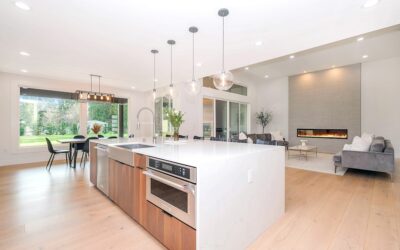
Engineered quartz overtook granite as the most-installed countertop in US kitchens around 2018 and has not looked back. The reason is simple — quartz countertop material delivers stone-like aesthetics with non-porous, low-maintenance behavior that natural stones cannot match. But “quartz” is a category, not a product, and the quality gap between top-tier Cambria and entry-level imports is enormous. Here is what every homeowner needs to know about composition, brands, pricing, and the specs that actually matter.
- What Engineered Quartz Actually Is
- Brand Spotlight: The Top Tier
- Mid-Range and Value Brands
- The Specs That Actually Matter
- Heat Resistance: The Real Weakness
- UV Sensitivity: Indoor Only
- Edge Profiles and Fabrication
- Installation Pricing Breakdown
- Maintenance Is Genuinely Minimal
- Quartz vs Quartzite: Not the Same Material
- Resale and Buyer Expectations
What Engineered Quartz Actually Is
True quartz countertop material is roughly 90 to 94 percent ground natural quartz crystals bound with 6 to 10 percent polymer resins (typically polyester or acrylic) plus pigments. The mix is compressed under vacuum at high pressure and cured, then cut into slabs typically 2 cm or 3 cm thick. The Italian Breton process patented in 1963 remains the dominant manufacturing method.
Because the binder seals the surface, quartz is non-porous, never needs sealing, and resists staining from coffee, red wine, oil, and acidic foods. Bacterial growth is negligible compared to granite or marble — NSF 51 certification on most quartz brands confirms food-safety performance.
Brand Spotlight: The Top Tier
The premium quartz tier is built on consistency, design depth, and warranty backing:
- Cambria (American-made): $75 to $150 per sq ft installed. Lifetime residential warranty, over 175 design patterns. The only US-manufactured premium quartz
- Caesarstone (Israeli): $65 to $120 per sq ft installed. Pioneered engineered quartz in 1987. Strong veined collections like Statuario Maximus and Calacatta Nuvo
- Silestone (Cosentino, Spanish): $60 to $130 per sq ft installed. N-Boost technology adds easier-clean surface treatment. HybriQ+ line uses 99 percent recycled water in production
- LG Viatera: $50 to $100 per sq ft installed. Strong color range, 15-year residential warranty, often slightly cheaper than the big three for similar quality
Mid-Range and Value Brands
Strong options for tighter budgets:
- MSI Q Quartz: $40 to $80 per sq ft installed. Massive pattern library, available at most slab yards
- Hanstone: $50 to $95 per sq ft installed. Korean-made, used widely in production homes
- Pental Quartz: $45 to $85 per sq ft installed. Strong Pacific Northwest distribution
- Vicostone: $45 to $90 per sq ft installed. Vietnamese-made, growing US presence
- IKEA Kasker: $60 to $80 per sq ft installed. Limited patterns but solid quality with template-and-install service
Avoid no-name “quartz” sold below $30 per sq ft installed. These often run 70 to 80 percent quartz content with cheaper binders that yellow under UV and crack at edges.
The Specs That Actually Matter
When comparing slabs, look past the pretty veining to the performance data:
- Quartz content: 93 percent or higher signals premium tier; below 90 percent typically indicates a budget product
- Mohs hardness: Quartz rates 7 (harder than granite at 6 to 7). Scratch resistance is genuinely strong
- Water absorption: Below 0.05 percent — essentially zero. This is what makes sealing unnecessary
- Flexural strength: 6,000 to 8,500 psi on quality slabs
- Slab thickness: 2 cm (3/4 inch) for backsplashes and walls, 3 cm (1-1/4 inch) for countertops without buildup
- Warranty: Lifetime (Cambria, Caesarstone) signals manufacturer confidence; 10 or 15 years is typical for mid-tier
Heat Resistance: The Real Weakness
The one place quartz loses to granite is heat. Natural quartz handles 1,000+ degrees F, but the polymer resin in engineered quartz starts to degrade above 300 degrees F. A cast iron skillet straight from a 400-degree oven can discolor or crack quartz. Always use trivets.
Quartz manufacturers do not warranty heat damage, and refinishing is not possible — you would need a full replacement of the affected section. For cooks who frequently sear, granite or porcelain slabs are more forgiving.
UV Sensitivity: Indoor Only
Quartz countertop material is not recommended for outdoor kitchens or sunrooms with direct UV. The pigments and binders fade and yellow under prolonged sunlight, and most warranties exclude UV damage. For outdoor or heavily sunlit applications, consider Dekton or Lapitec sintered stone slabs, which handle full sun exposure.
Edge Profiles and Fabrication
Standard edge profiles included in most installed quotes:
- Eased (straight): Cleanest modern look, lowest fabrication cost
- Quarter round: Soft and traditional
- Half bullnose: Family-friendly, no sharp edges
- Mitered waterfall: 3 cm slab folded vertically at the island end — adds $400 to $1,200 for a single waterfall edge
Premium edges (ogee, dupont, double bullnose) add $8 to $15 per linear foot.
Installation Pricing Breakdown
A typical 40-square-foot quartz install runs:
- Material: $30 to $90 per sq ft slab
- Fabrication and installation: $30 to $60 per sq ft
- Tear-out of existing counter: $200 to $600
- Sink cutouts: $100 to $300 each
- Cooktop cutout: $150 to $400
Get three quotes from local slab yards, not just the showroom. The same Cambria color can vary $1,500 between fabricators on a single kitchen.
Maintenance Is Genuinely Minimal
Daily care is a damp microfiber and mild dish soap. For stuck-on residue, a paste of baking soda and water cleans without etching. Avoid bleach (degrades the surface treatment), abrasive scrubbers (dulls polish), and high-alkaline cleaners like oven spray. Wipe up turmeric, beet juice, and red wine within an hour or so — even non-porous surfaces can hold trace pigment if left overnight.
Quartz vs Quartzite: Not the Same Material
Engineered quartz and natural quartzite get confused at slab yards constantly. Quartzite is a natural metamorphic rock formed from sandstone over millions of years. It is harder than granite (Mohs 7), needs sealing twice a year, and runs $80 to $200 per sq ft installed. Engineered quartz is manmade as described above. Quartzite has natural veining that varies slab to slab; engineered quartz has consistent veining intentionally designed. Always confirm which product you are buying — fabricators occasionally mislabel quartzite as “natural quartz.”
Resale and Buyer Expectations
The 2025 NAR Remodeling Cost vs Value report puts quartz countertop installs at a 65 to 80 percent return at resale in most US markets. Buyers in the $400,000-plus price tier now expect quartz or granite as the baseline kitchen counter — laminate signals “needs renovation” and reduces offer prices. In condos and lower-priced homes, mid-tier quartz from MSI or LG Viatera delivers buyer appeal without overspending on premium brands. Save Cambria and Caesarstone for high-end neighborhoods where the design matters as much as the material.