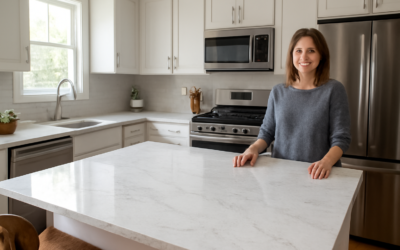
Quartz has been the best-selling countertop material in America for most of a decade, and its pricing is easier to predict than granite’s because the slabs are factory-made rather than quarried. The average cost of quartz countertops installed runs $50 to $150 per square foot, with most kitchens landing between $70 and $100 per square foot once fabrication and installation are included. For a typical kitchen with 40 to 55 sq ft of counter space, that means a total project cost of roughly $3,000 to $5,500 at mid-range grades. The spread comes from brand tier, pattern complexity, edge and cutout choices, and local fabrication rates, and each of those is negotiable once you understand it. This guide breaks the price into its components and shows where the real savings hide.
The Quick Numbers
- Budget tier: $50 to $70 per sq ft installed. Builder-grade lines, simple solid colors and subtle speckles, standard eased edge. Common at big-box programs and value fabricators.
- Mid tier: $70 to $100 per sq ft installed. Popular marble-look patterns from mainstream brands (Silestone, Cambria, Caesarstone, MSI Q, LG Viatera and peers), more color depth and veining.
- Premium tier: $100 to $150+ per sq ft installed. Dramatic full-slab veining, translucent and specialty finishes, thick mitered edges, waterfall panels.
Whole-project reality checks: a 30 sq ft galley kitchen runs $2,000 to $3,500 mid-grade; a 50 sq ft kitchen with an island, $3,500 to $6,500; a large 70 sq ft kitchen with a waterfall island can pass $10,000. Bathroom vanities price higher per square foot in percentage terms because minimum fabrication charges ($400 to $800) dominate small jobs.
What Is Actually in the Price
An installed quartz price has three layers. The slab material itself wholesales at roughly $15 to $60 per sq ft depending on brand and pattern. Fabrication, cutting the slab, polishing edges, machining sink and faucet cutouts, is the largest chunk, typically $30 to $50 per sq ft of shop labor built into the quote. Installation day, templating, transport, seaming, leveling, and attachment, accounts for the rest. This is why two quotes on the same slab can differ by 30 percent: you are mostly comparing fabricators, not stone. Standard inclusions to confirm in writing: digital templating, one undermount sink cutout, standard edge profile, seam placement plan, and haul-away of old tops. Cooktop cutouts ($100 to $250), faucet and soap-dispenser holes ($25 to $75 each), and outlet notches on backsplash-height quartz are commonly billed as extras.
The Options That Move the Number
Thickness
Standard is 3 cm (1 1/4 inch). Thinner 2 cm material saves 10 to 20 percent on material but often needs plywood substrate and edge lamination, eating the savings. Chunky looks come from mitered edges that wrap 3 cm material into a 6 cm apron, adding $40 to $100 per linear foot.
Edges
Eased, quarter-round, and bevel edges are usually free. Ogee and other decorative profiles add $10 to $30 per linear foot; mitered waterfalls on an island add $1,000 to $2,500 per side including the vertical panel.
Pattern Matching
Bookmatched veining, veined edges, and full-height quartz backsplashes each add material and shop hours. A veined-slab backsplash behind a range typically adds $800 to $2,000 versus tile.
Seams and Layout
Slabs run about 120 by 55 inches (jumbo sizes larger). Kitchens needing three slabs instead of two, or seam-free islands over 55 inches deep, jump in price. A good fabricator’s layout drawing shows exactly where your money goes.
Quartz vs. the Competition on Price
Installed, granite runs $40 to $100 per sq ft for common colors, overlapping quartz’s budget and mid tiers, with exotic granites climbing past $150. Marble lands at $60 to $150 but etches and stains in real kitchens. Solid surface (Corian-type) runs $45 to $85; butcher block $35 to $75 plus maintenance; laminate $20 to $45 and unashamedly budget. Porcelain slab, quartz’s newest rival, prices similarly at $60 to $120 installed. Quartz holds its market share because it is nonporous (no sealing, ever), consistent from sample to slab, and covered by 10-to-lifetime residential warranties from major brands, which granite, a natural product, cannot match. Its weakness is heat: trivets are mandatory, since resin binders can scorch above roughly 300°F.
Where to Save Real Money
The honest saving strategies, in order of impact. First, shop fabricators, not just brands: get three itemized quotes on the same or equivalent slab, because shop rates vary more than material costs. Second, choose high-volume patterns; every brand has a handful of best-sellers priced aggressively, and MSI-class value brands make convincing versions of famous looks for 30 to 40 percent less than the design-brand original. Third, simplify the layout: standard edges, one seam in a low-visibility spot, tile backsplash instead of slab, and no waterfall. Fourth, watch remnants for bathrooms; a vanity top cut from a fabricator’s leftover slab often costs half of quoted retail. Finally, time it: countertop shops discount in January and February in most markets. Do not save by skipping the licensed fabricator; DIY quartz is a two-person-minimum, 600-pound-slab trade with real cracking risk, and cracked slabs are not returnable.
Budgeting Checklist Before You Sign
- Measure counters yourself (length times depth in inches, divided by 144) so square-footage quotes pass a sanity check
- Confirm what happens to the sink: undermounts must be on site at templating, and plumbing reconnection ($150 to $400) is usually not included
- Ask where seams will fall and how veining will flow across them
- Verify the warranty is registered to you and covers seam separation, not just slab defects
- Hold final payment until leveling, seam fill, and caulk lines pass your inspection in daylight
Long-Term Value and Maintenance Costs
Part of what you are buying with quartz is the absence of future line items. Granite wants resealing every one to three years; quartz never needs sealing, and daily care is dish soap and a soft cloth, so the ten-year maintenance budget is effectively zero. Repairs are the exception: a chipped edge costs $150 to $400 for a professional resin fill, and deep scorch marks usually cannot be buffed out the way they can on solid surface, which is why the trivet habit matters. At resale, updated quartz counters consistently rank among the kitchen features buyers flag in listings, and remodeling surveys typically credit midrange kitchen updates with recouping a meaningful share of their cost. Spread over a 20-to-30-year service life, a $4,500 quartz kitchen works out to under $20 per month of ownership.
Bottom Line
Plan around $70 to $100 per square foot installed for a mid-range quartz kitchen, get three fabricator quotes on identical material, and put your upgrade dollars into layout and seam quality before exotic patterns. The material is engineered to be predictable; with an itemized quote in hand, the price can be too.