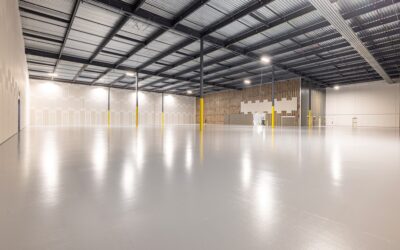
QuestMark is the industrial and commercial flooring division of Centimark, the largest commercial roofing contractor in North America. QuestMark flooring handles everything from $30,000 warehouse epoxy floors to $500,000 multi-system installations across hospitals, food plants, and aviation hangars. With more than 300,000 systems installed since 1996, they are one of a small group of contractors who can self-perform work in all 50 states. After spec’ing QuestMark for three industrial clients between 2021 and 2025, here is what buyers and facility managers should know.
- What QuestMark Actually Installs
- Product Lines and Where They Fit
- Pros That Justify Working With QuestMark
- Cons and Real Limitations
- Real Cost Ranges by System Type
- Installation Process and Timeline
- QuestMark Versus Regional Competitors
- Maintenance and Long-Term Performance
- Frequently Asked Questions
What QuestMark Actually Installs
QuestMark installs resinous flooring systems, not retail-grade products. Their core offerings include epoxy mortar systems for heavy traffic, urethane cement for food and beverage facilities, decorative quartz and flake epoxy for showrooms and public spaces, and ESD (electrostatic dissipative) systems for electronics and pharmaceutical manufacturing.
Each system is engineered for the specific facility based on chemical exposure, traffic load, temperature extremes, and slip-resistance requirements. The company does not sell DIY products or lower-end consumer epoxy kits.
Product Lines and Where They Fit
- QuestMark Epoxy Mortar: heavy industrial traffic, forklift use, 1/4 inch thick
- Urethane Cement: USDA-compliant food plants, thermal shock zones, 1/4 to 3/8 inch
- Decorative Quartz: lobbies, showrooms, education facilities, 3/16 inch broadcast
- Vinyl Flake Systems: garages, mechanical rooms, locker rooms, 1/8 inch
- ESD Systems: data centers, electronics assembly, controlled discharge
- Methyl Methacrylate (MMA): rapid-cure repair, 1 hour return to service
System selection is critical. The wrong epoxy in a wash-down dairy plant fails within months from steam and lactic acid, while the right urethane cement holds up for 15 to 20 years.
Pros That Justify Working With QuestMark
Self-perform crews across all 50 states is the headline advantage. National retail chains, manufacturers with multiple plants, and government agencies value a single contractor with consistent quality control rather than coordinating dozens of regional installers.
Their warranty program covers materials, labor, and surface preparation under one umbrella, which eliminates finger-pointing when problems arise. Standard warranties run 5 to 10 years depending on system, with extended options available.
Engineering support during specification is included. A QuestMark project manager visits the site, reviews drawings, identifies moisture and substrate issues, and recommends the appropriate system before quoting. This catches problems that DIY installers and smaller regional contractors regularly miss.
Cons and Real Limitations
Pricing is at the top of the market. QuestMark systems run 25 to 50 percent above small regional epoxy contractors. The premium buys engineering, project management, and the national warranty, but cost-sensitive single-site buyers often find better value locally.
Minimum project size is real. While not officially published, projects under about 3,000 square feet rarely make economic sense for QuestMark to mobilize. Garage floor installs and small retail spaces are better served by regional specialists.
Lead times for non-emergency work run 6 to 14 weeks during peak construction season. Emergency repairs through their MMA quick-cure systems can be scheduled faster but at premium pricing.
Real Cost Ranges by System Type
Pricing varies by site conditions and quantity, but here are ballpark 2026 ranges for QuestMark installations.
- Vinyl flake garage or warehouse floor: $5 to $9 per sq ft
- Decorative quartz lobby or showroom: $8 to $14 per sq ft
- Urethane cement food plant: $10 to $18 per sq ft
- Epoxy mortar industrial floor: $9 to $16 per sq ft
- ESD system for electronics: $12 to $22 per sq ft
- Surface prep and shot-blasting: $1 to $3 per sq ft included in most bids
Demolition and removal of failed existing coatings adds $2 to $6 per square foot. Moisture mitigation under the new system, often required for slabs without vapor barriers, adds another $2 to $5 per square foot.
Installation Process and Timeline
QuestMark projects follow a defined sequence: site assessment, system specification, written proposal, scheduling, mobilization, surface preparation (typically shot-blasting), priming, base coat, broadcast or color application, topcoat, and cure. Total facility downtime ranges from 24 hours for fast-cure MMA systems to 72 hours for thicker epoxy mortars.
Crews work in coordinated phases to minimize facility disruption. For 24/7 operations like hospitals and data centers, work is sequenced at night or in isolated zones with temporary barriers. The project manager remains on site daily for jobs over 10,000 square feet.
QuestMark Versus Regional Competitors
Compared to Stonhard, the other major national resinous flooring contractor, QuestMark and Stonhard are roughly equivalent in quality and pricing. Stonhard tends to lead in pharmaceutical and lab cleanrooms, while QuestMark has stronger food and beverage plant credentials.
Versus regional epoxy contractors, QuestMark wins on consistency and engineering but loses on price for single-site projects. A solid local contractor with 10-plus years of experience often delivers comparable quality on a 5,000 square foot warehouse for 30 percent less money.
Maintenance and Long-Term Performance
Properly installed QuestMark systems last 10 to 25 years with appropriate maintenance. Daily auto-scrubbing with neutral pH cleaner is standard for industrial floors. Avoid harsh acids and solvents not approved for the specific resin chemistry.
Annual inspections by the QuestMark service team catch wear-through, joint failures, and chemical staining before they require full system replacement. Topcoat refresh every 5 to 8 years extends life significantly. With proper care, QuestMark flooring systems pay back the premium investment through decades of service.
Frequently Asked Questions
Does QuestMark install residential garage floors?
Generally no. Residential garage epoxy projects are too small for their economic model. They will refer homeowners to Centimark’s network of qualified residential contractors or recommend regional specialists.
How long does a typical industrial install take?
A 10,000 square foot urethane cement food plant install runs 4 to 7 days from shot-blasting through final cure. Larger projects scale linearly. Phased installs in occupied facilities take longer due to coordination with operations.
What surface prep is required before installation?
Shot-blasting to a CSP-3 to CSP-5 profile is the industry standard for resinous flooring. QuestMark performs prep in-house using their own equipment. Acid etching is not used since it leaves residue that compromises adhesion.
Can existing failed epoxy be coated over?
Sometimes. If the existing coating is well-bonded and chemically compatible, a new topcoat can be applied after light shot-blasting. Most failed systems require complete removal back to bare concrete, which is more cost effective long-term.
Prefer to explore on your own?
See how new flooring looks in your actual room in seconds — free, no signup.
Try the free Floor Studio →