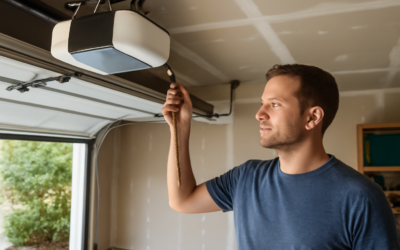
If a bedroom, home office, or nursery sits above or beside your garage, the difference between a rattling chain and a smooth belt is the difference between a peaceful morning and a jarring wake-up. A quiet garage door opener uses a rubber belt drive, a DC motor, and vibration-isolating hardware to bring operating noise down to a soft whir instead of a metallic clatter. For attached garages, it is one of the highest-value upgrades you can make for under $300.
Part of our Garage Doors guide — explore the full guide →
Not all “quiet” openers are equal, though, and part of the noise comes from the door and springs rather than the motor. This guide covers the quietest drive types, the specific models worth buying, and the simple fixes that cut noise even further.
- Why Some Openers Are So Loud
- Belt Drive vs. Chain Drive vs. Screw Drive
- Best Quiet Garage Door Openers
- Features That Reduce Noise
- The Door Itself Matters as Much as the Opener
- Simple Ways to Quiet an Existing Opener
- Installation Considerations
- Making the Right Choice
- Understanding Decibel Ratings
- Smart Features Worth Having
- Matching the Opener to Your Door Weight
Why Some Openers Are So Loud
Traditional chain-drive openers pull the trolley with a metal chain riding on a metal rail. That metal-on-metal contact, plus the vibration transmitted through the ceiling joists, is what you hear as clatter and hum in the room above. Older AC motors also start and stop abruptly, slamming the door into its travel limits.
Quiet openers attack the problem on three fronts: a reinforced rubber belt replaces the chain, a DC motor with soft-start and soft-stop eases the door into motion, and isolation mounts keep vibration from telegraphing into the structure. Together these can drop perceived noise dramatically.
Belt Drive vs. Chain Drive vs. Screw Drive
Understanding the drive type is the single most important decision. Here is how the three main systems compare for noise:
- Belt drive: The quietest option by a wide margin. A steel-reinforced rubber belt runs nearly silent and is ideal for living space above the garage.
- Chain drive: The loudest but cheapest and most durable. Fine for detached garages where noise is a non-issue.
- Screw drive: A threaded steel rod turns the trolley. Middle-of-the-road on noise and sensitive to temperature swings, though newer sealed versions run smoother.
- Wall-mount (jackshaft): Mounts beside the door instead of overhead, so no motor vibrates through the ceiling. Among the quietest setups available.
Best Quiet Garage Door Openers
These models consistently deliver low-noise operation and reliable smart features. Expect to pay roughly $200 to $400 depending on horsepower and connectivity.
- Chamberlain B1381 / B970: A belt-drive workhorse with 1.25 HP equivalent, built-in Wi-Fi via myQ, and battery backup. A strong value for heavy insulated doors.
- LiftMaster 8550W: A premium belt drive with battery backup, integrated Wi-Fi, and a wall-mount trolley design. Extremely smooth and durable.
- LiftMaster 8500W wall-mount (jackshaft): Frees up ceiling space and eliminates overhead vibration entirely. Excellent for rooms directly above the garage.
- Genie SilentMax 1200: A budget-friendly belt drive with a DC motor and soft start, often found near $230.
- Chamberlain RJO70 / RYO7 secure-key models: Belt drive with strong smart integration for those who want app and voice control.
Features That Reduce Noise
Beyond the belt, a few features make a real audible difference. A DC motor with soft-start and soft-stop prevents the jolt that shakes the whole assembly at the beginning and end of travel. Higher horsepower, ironically, can run quieter on heavy doors because the motor is not straining.
Look also for these when you shop:
- Vibration-isolation mounting brackets included in the box.
- A one-piece or steel-reinforced rail rather than a multi-section rail that can rattle.
- Battery backup, which keeps the door working during outages without added noise.
- Smart controls so you avoid the loud override of a jammed door.
The Door Itself Matters as Much as the Opener
Here is what many homeowners miss: a new belt opener bolted to a neglected door will still be loud. Worn rollers, dry hinges, and loose hardware create most of the racket. Before you blame the motor, inspect the mechanical parts.
Swapping standard steel rollers for nylon rollers with sealed bearings is a cheap, transformative fix, typically $30 to $50 for a set of ten. Nylon glides where steel grinds, and it never needs greasing on the track.
Simple Ways to Quiet an Existing Opener
You do not always need a full replacement. If your current opener is only a few years old, try these steps first:
- Lubricate the springs, hinges, rollers, and the opener rail with a lithium-based garage door lubricant, never WD-40, every six months.
- Tighten every nut and bolt on the door and track with a socket wrench; vibration loosens them over time.
- Replace steel rollers with nylon rollers for an instant drop in rolling noise.
- Add anti-vibration isolator pads or rubber grommets where the opener mounts to the ceiling joists.
- Check that the door is balanced; a door that is spring-heavy forces the motor to work harder and louder.
Installation Considerations
Most belt-drive openers install in three to four hours for a confident DIYer, though the rail assembly and travel-limit programming demand patience. If you are replacing an old unit, reuse the existing wall button and safety sensor wiring where compatible to save time. Set the force limits carefully so the door reverses on contact, a critical safety function.
For wall-mount jackshaft models, the door needs torsion springs and adequate side clearance, so verify your setup or bring in an installer. A professional install runs roughly $150 to $300 in labor on top of the opener.
Making the Right Choice
For living space above the garage, prioritize a belt drive or a wall-mount jackshaft, add nylon rollers, and keep everything lubricated. For a detached garage, a chain drive still makes sense and saves money. Battery backup and smart controls are worth the modest premium for the convenience and security they add.
Understanding Decibel Ratings
Manufacturers rarely publish a clean decibel figure, but real-world numbers help set expectations. A worn chain-drive opener can hit 70 to 80 decibels at the source, roughly the loudness of a vacuum cleaner, and the low-frequency vibration it sends through joists is what actually wakes people upstairs. A quality belt drive typically runs in the 50 to 60 decibel range, closer to normal conversation.
Keep in mind that the opener is only one noise source. The door’s rollers, hinges, and springs contribute their own clatter, and even a whisper-quiet motor cannot mask a dry, poorly maintained door. That is why the quietest results always come from pairing a good opener with a well-tuned door.
Smart Features Worth Having
Modern quiet openers bundle connectivity that adds real convenience. Built-in Wi-Fi with an app like Chamberlain and LiftMaster’s myQ lets you check whether the door is closed, open it for a delivery, and get alerts if it is left open. Many integrate with Amazon Alexa, Google Assistant, and in-car systems.
- Battery backup: Federally required on new residential openers in some states and simply smart everywhere, it keeps the door working during outages.
- Auto-close timers: Shut the door automatically after a set period.
- Motion-activated lighting: Brighter LED panels that trigger as you enter.
- Security 2.0 rolling codes: A fresh code on every use to prevent code theft.
Matching the Opener to Your Door Weight
Horsepower matters more than many buyers realize, and it interacts with noise. A double-wide insulated steel door can weigh well over 150 pounds, and a motor that strains against that weight runs louder and wears out faster. For heavy or insulated doors, choose at least a 1.25 HP-equivalent belt drive rather than a base 1/2 HP model.
A properly sized motor lifts the door smoothly with the soft-start and soft-stop engaged, which keeps operation quiet and extends the life of both the opener and the door hardware. If you are unsure of your door’s weight, disconnect the opener and lift the door by hand; a heavy or unbalanced door signals you need more horsepower and possibly a spring adjustment.
A well-chosen quiet garage door opener, paired with a tuned-up door, transforms a daily annoyance into something you barely notice. Spend a little on the belt, a little on nylon rollers, and a few minutes on lubrication, and the mornings above your garage will finally stay peaceful.