Getting rain on concrete after 2 hours feels like a disaster while it’s happening — water pooling on your brand-new driveway, the finish you paid for dissolving into gray soup. Here’s the perspective from someone who’s poured through more surprise showers than I can count: rain on concrete after 2 hours is almost always a surface problem, not a structural one. By the two-hour mark, the chemistry below the top fraction of an inch is doing its job regardless of the weather. What happens in the next 30 minutes of triage, though, decides whether you end up with an invisible save, a cosmetic blemish, or a chalky surface that needs resurfacing. Let’s walk through the reality.
What’s Actually Happening in the Slab at Hour Two
Concrete doesn’t dry; it hydrates — cement and water chemically bond, and that reaction started the moment the truck’s drum turned. On a typical 70°F day with standard 4,000 psi mix, initial set arrives somewhere between 2 and 4 hours after batching. At the two-hour mark, your slab is usually in late plastic or early initial set: firm enough that a thumb pressed in leaves a shallow dent, way past the soupy stage, with the internal water-cement ratio locked in everywhere except the top 1/8 to 1/4 inch.
That’s why the damage ceiling is low. Rain physically cannot penetrate a consolidated slab and change the mix design 3 inches down. What it can do is attack the surface paste — the thin, cement-rich cream the finisher floated to the top. Extra water there raises the local water-cement ratio, and a high w/c surface cures out weak: dusty, chalky, prone to scaling in the first freeze season. The battle is entirely in that top quarter inch.
The Severity Scale: Light Sprinkle to Downpour
- Light rain or drizzle at 2 hours: Usually harmless. The surface may show slight texture or “bird bath” dimpling. If the slab was already edged and floated, often nothing visible survives to the next morning.
- Steady rain, 15 to 30 minutes: Expect some surface marring — rain pocks, a washed look where paste moved, possible weakening of the top skin. Fixable during the pour window; cosmetic afterward.
- Hard downpour on a fresh broom finish: The finish itself can wash away, exposing sand and fine aggregate in streaks. Structurally still fine; cosmetically it may need grinding or a thin resurfacing overlay later.
- Downpour at 30 to 60 minutes instead of 2 hours: This is the genuinely bad timeline — much more paste is mobile. At 2 hours you dodged the worst window without knowing it.
Triage: The 30 Minutes That Matter
What the crew (or you) does while it rains determines the outcome more than the rain itself.
- Cover if you can do it cleanly. Plastic sheeting or tarps supported so they don’t drag across the surface. Weight the edges. Yes, plastic touching the slab can leave discoloration marks — accept them; they beat wash-out.
- Do not trowel water into the surface. This is the cardinal sin and the most common panic move. Working standing rainwater in with a float or trowel blends it into the paste, spiking the surface w/c ratio and guaranteeing a weak, dusting finish. Whatever you do, don’t “smooth it out” while water sits on top.
- Push standing water off, gently. Once rain stops, drag a garden hose across the surface like a squeegee, or use the edge of a float held nearly flat to shove puddles off the slab edge — moving water without stirring it in.
- Wait, then assess. Let the bleed/rain sheen evaporate. If the slab still takes a finish (thumbprint dents 1/4 inch), you can refloat and re-broom the marred areas and nobody will ever know. If it’s set past finishing, stop — grinding on set concrete makes things worse.
- Delay jointing if needed, but don’t skip it. Control joints still need cutting within 6 to 18 hours (sooner in hot weather) even after a rain event.
The Next Morning: How to Assess Real Damage
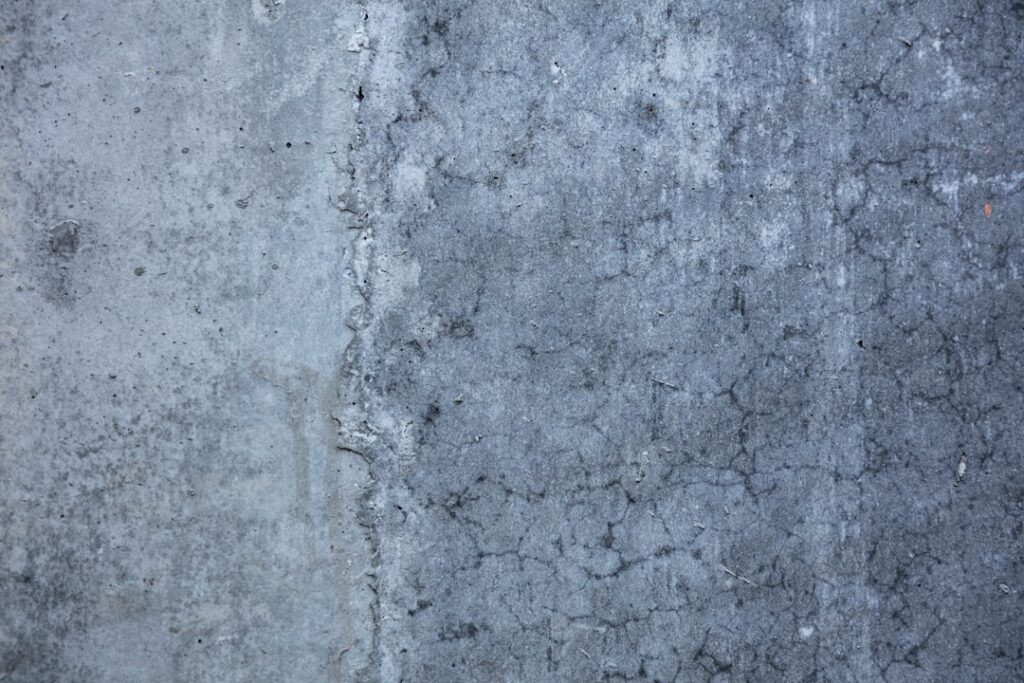
Wait for the slab to dry surface-white, then run three checks. First, the scratch test: drag a screwdriver tip firmly across the affected area. Sound concrete scratches faintly with effort; rain-weakened paste powders up like chalk under light pressure. Second, look at the finish uniformity — rain pocks and plastic-sheet marks are texture and color flaws only. Third, over the following weeks, watch for dusting (a persistent fine powder that regenerates after sweeping), which signals the surface paste cured weak.
Structural worry is almost never warranted for a 2-hour rain hit, but for peace of mind: the slab’s rated strength lives in its full depth. If you want numbers, a Schmidt hammer test or a $300 to $500 core test settles arguments with a contractor — and in twenty-plus years I’ve never seen a 2-hour rain event produce a core that failed spec.
Fix Options If the Surface Did Suffer
- Minor pocking or texture blemishes: Live with them; they weather uniform within a year or two of sun and tires. Cost: $0.
- Dusting surface: Apply a densifier — sodium or lithium silicate hardener ($0.30 to $0.50 per sq ft in materials) reacts with the weak paste and hardens it substantially. Often a complete fix.
- Washed or streaked broom finish: Grind lightly and apply a polymer-modified thin overlay or microtopping, $3 to $8 per sq ft done professionally. Restores appearance completely.
- Scaling that appears after the first winter: The delayed bill for troweled-in rainwater. Resurface affected areas with an overlay, then seal every 2 to 3 years.
On a contractor pour, document everything the day it happens — photos with timestamps, the pour ticket, the weather record. A reputable outfit will address a rain-marred finish; the scratch test and photos keep that conversation factual.
Temperature Changes the Timeline
The two-hour mark means different things in different weather, and it’s worth adjusting your worry accordingly. On a 90°F summer afternoon, set accelerates hard: initial set can arrive at 90 minutes, so rain at hour two hits a surface that’s already firm and often shrugs it off completely — hot-weather pours are the lucky ones in a surprise shower. At 50°F, everything stretches; initial set may not come until hour four or five, meaning rain at hour two lands on concrete that behaves more like a 45-minute-old pour and deserves the full triage response, tarps and all. Below 40°F, set times balloon and the surface stays vulnerable half the day.
Mix design shifts the window too. Accelerated mixes (calcium chloride or non-chloride accelerator, standard in cold-weather work) can be finish-hard at 2 hours. High fly-ash or slag mixes run slower. Air-entrained exterior mixes bleed less water, which ironically makes them more sensitive to rain-worked surfaces because there’s less natural bleed to evaporate off. If you have the batch ticket, the plant’s dispatcher can tell you in one phone call how your specific mix was tracking that day — concrete plants log ambient temperature with every load, and that record also becomes useful documentation if the finish conversation with your contractor ever gets formal.
When to Worry vs. When to Relax
Relax if: the rain arrived at 2-plus hours, the surface passes the scratch test dry, marring is visual only, and the slab is a driveway, patio, or walkway. That combination is cosmetic territory, full stop. Worry — meaning make calls and document — if: the rain hit inside the first hour of finishing, the surface powders under a fingernail a week later, aggregate is visibly exposed across large areas, or this is a garage or structural slab that will see loads and de-icing salts. Salt plus a weak surface is the combination that turns a cosmetic issue into annual spalling.
And for the next pour, cheap insurance: check the hourly radar before ordering, have 6-mil plastic and lumber for quick tenting on site (a $40 kit), and remember that a delayed pour costs a restocking fee while a rained-out finish costs a weekend of worry. Concrete has been rained on since the Romans; at the 2-hour mark, the slab is tougher than your nerves.