
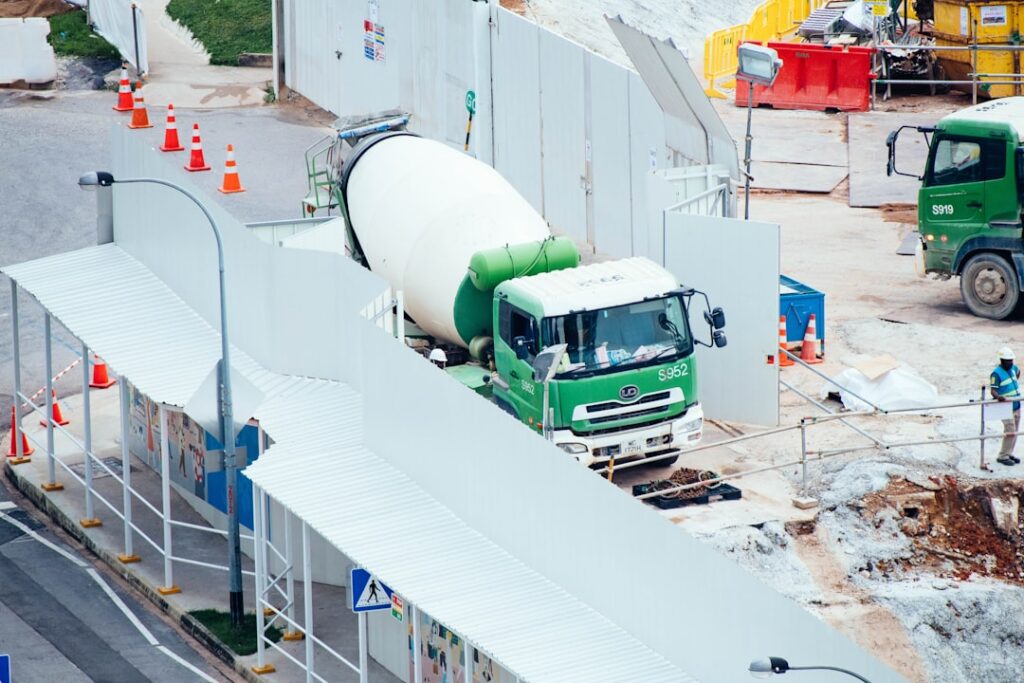
Somewhere around the 25-bag mark, mixing concrete by hand stops being thrifty and starts being a mistake. Ready mix concrete — batched at a plant to an exact recipe and delivered wet in a rotating drum truck — is how every driveway, garage slab, and patio of real size gets poured, and ordering it is easier than most homeowners expect. The parts that trip people up are the math, the fees, and the clock. Here’s how to calculate yardage, what a short load actually costs, and how to run pour day so the driver isn’t standing on the chute watching you find your boots.
How Ready Mix Is Sold
Concrete is sold by the cubic yard — 27 cubic feet, roughly 4,000 pounds of material. A full truck carries 8 to 10 yards. As of 2026, most US markets price standard 3,500 to 4,000 PSI mix between $150 and $200 per yard delivered, before fees; our concrete cost per yard guide breaks down regional pricing in detail. When you call the dispatcher, you’re ordering four specs: strength (PSI), slump (wetness, usually 4 to 5 inches for flatwork), aggregate size (3/4 inch standard), and air entrainment (5 to 7 percent anywhere with freezing winters). Tell them the application — “4-inch exterior driveway in Ohio” — and any decent plant will spec it correctly for you.
Calculating Yardage Without Coming Up Short
The formula is simple: length (ft) × width (ft) × thickness (ft) ÷ 27 = cubic yards. A 20 × 24-foot garage slab at 4 inches (0.333 ft) works out to 5.93 yards. Then add 5 to 10 percent for waste, uneven subgrade, and form deflection — order 6.5 yards, not 6. Running short is the cardinal sin of pour day: a second truck means a second delivery fee, a 60- to 90-minute wait, and a cold joint where the two pours meet.
Common quantities for reference:
- 10 × 10 patio, 4 in. — 1.3 yards (order 1.5)
- 12 × 24 driveway strip, 4 in. — 3.6 yards (order 4)
- 24 × 24 garage, 4 in. — 7.1 yards (order 7.5–8)
- Footings, 12 × 12 in. — 1 yard per 27 linear feet
Anything under about 1 yard, skip the truck entirely — bagged mix is cheaper at that scale, and our concrete bags guide covers how many bags equal a yard (45 of the 80-pound size, for the record).
Short-Load Fees: The Small-Pour Tax
Trucks make money hauling full loads, so plants charge a short-load fee when you order less than their minimum — typically anything under 4 or 5 yards. Expect $50 to $150 for loads a yard or two under the minimum, and up to $200+ for a 1-yard delivery, effectively doubling the material price on tiny pours. Some plants simply set a 3-yard minimum charge no matter what you take.
Ways around the tax: schedule your pour as an add-on to a nearby job (some dispatchers will tack your 2 yards onto a truck already headed your direction), split a truck with a neighbor pouring the same week, or use a U-cart — a tow-behind trailer holding 1 yard that many supply yards rent for $100 to $150 including the concrete. For 1 to 3 yards, a volumetric mixer service (mixes on-site, charges only for what you use) often beats the drum-truck math too.
Scheduling the Truck
Call the plant 2 to 7 days ahead — further out during spring and summer, when Friday and Saturday morning slots vanish first. Dispatchers will ask for quantity, mix spec, address, time window, and how you’re getting concrete from truck to forms. Book the first pour of the morning (6 to 8 a.m.) if you can: the truck arrives on time before the day’s delays stack up, and in summer you finish before the afternoon heat flash-sets your surface.
Weather is your call to make, not the plant’s. Rain within a few hours of finishing ruins a surface; temperatures below 40°F or above 90°F need precautions. Most plants let you cancel or push a residential order by 24 hours without penalty — ask about their policy when you book, along with two other numbers: unload time allowance and standby rate. Standard is 4 to 6 minutes per yard of free unload time (about 45 minutes for a full truck), after which standby runs $2 to $3 per minute.
Truck Access: The Question That Decides Everything
A loaded mixer weighs 60,000 to 70,000 pounds — it will crack a residential driveway, crush a septic tank, and sink to its axles in a soft lawn. Measure before you order. The truck needs roughly 10 feet of width, 14 feet of overhead clearance, and solid ground. Chutes reach 12 to 16 feet from the rear of the truck, and each added chute section drops the flow lower and slower.
If the pour sits farther than chute reach, your options are wheelbarrowing (brutal — a yard is 25 heaped wheelbarrow loads; line up three barrows and four strong people), a concrete buggy rental ($150 to $250 a day), or a pump. A towable line pump adds $600 to $900 but places concrete 150+ feet away through a hose, and for backyards with no access it’s usually money well spent.
Pour-Day Readiness Checklist
The truck’s arrival is the deadline, not the start. Everything below happens before it rolls up:
- Forms staked, level, and oiled; subgrade compacted and lightly dampened
- Rebar or wire mesh placed on chairs, not lying on the dirt
- Tools staged: screed board, bull float, edger, groover, mag float, finishing broom
- Minimum three able-bodied people for anything over 3 yards
- Plastic sheeting or curing compound on hand for after the finish
- A washout spot — a wheelbarrow or lined pit — since drivers can’t legally rinse the chute into the street or a storm drain
Talking to the Dispatcher: A Sample Order
First-timers freeze on the phone, so here’s the whole conversation. “I need 6.5 yards of 4,000 PSI exterior mix with air, 3/4-inch stone, 5-inch slump, for a driveway in ZIP 43081. Pouring Saturday morning, first load if you have it. Truck will park on the street and chute directly into forms.” That’s every spec they need, and the dispatcher will fill gaps or correct anything odd for your region. Two upgrades worth asking about while you’re on the line: fiber reinforcement (about $8 to $12 per yard, meaningfully reduces surface cracking on flatwork) and mid-range water reducer if your crew is inexperienced — it buys workability without the strength penalty of adding water on site.
On pour day, check the batch ticket the driver hands you before the first yard slides down the chute. It lists the mix design, batch time, and water added. Concrete should be placed within about 90 minutes of batching; if the ticket shows the truck was loaded two hours ago and sat at another job, you’re entitled to refuse it. And resist the urge to ask the driver to “add a little water” for easier spreading — every 10 gallons added to a full truck costs roughly 500 PSI of final strength.
Is Ready Mix Worth It?
One more cost line worth knowing before the invoice arrives: fuel surcharges and environmental fees. Most plants add $15 to $50 per delivery in fuel and washout fees that don’t appear in the quoted per-yard price, and winter orders may carry a hot-water heating charge of $5 to $10 per yard. None of these are negotiable, but knowing they exist keeps the final ticket from feeling like a bait-and-switch — ask for the all-in delivered total when you book, not just the yard rate.
Above 1 yard, almost always. Plant-batched concrete arrives with consistent water content, verified strength, proper air entrainment, and no 45-bag afternoon attached. The delivered premium over bags shrinks to nothing at 2+ yards once your time and a mixer rental enter the math. Order 10 percent over your calculation, book the morning slot, have help and tools staged, and ready mix turns the hardest part of a slab project into the easiest 45 minutes of it.


