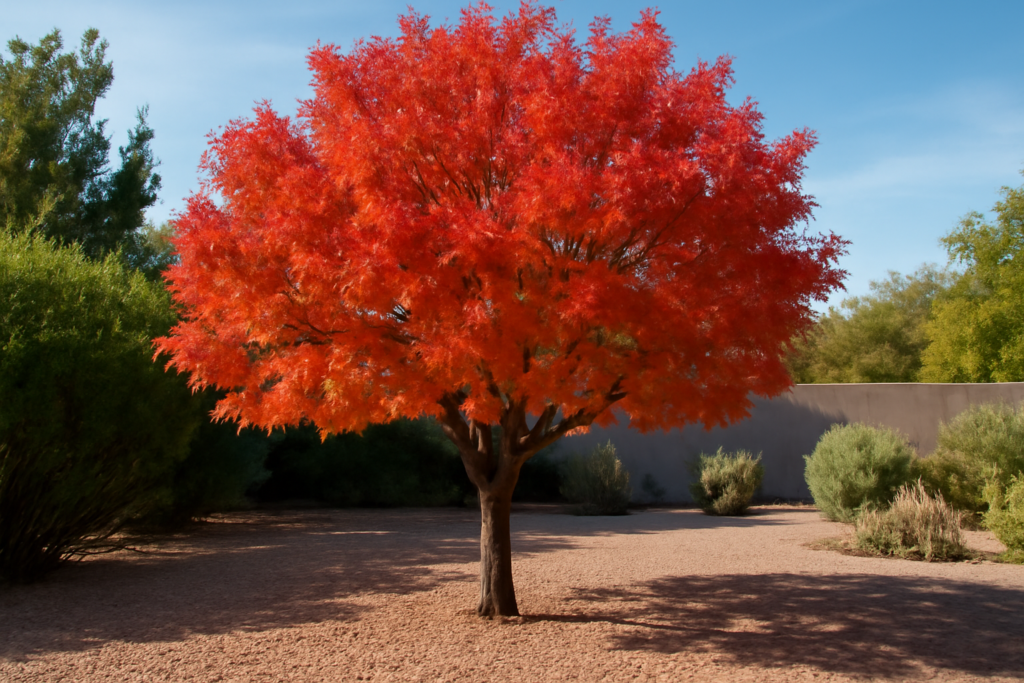
Few shade trees handle a west-facing yard in a hot, dry summer and still give you real fall color, but the red push pistache tree does both. It leafs out with red-tinged new growth in spring, settles into glossy green for summer and turns orange, red and scarlet in fall, even in regions where maples sulk. It also tolerates heat, wind, alkaline soil and long dry spells once established.
Red Push is a hybrid pistache, while Keith Davey is a selected male form of Chinese pistache. Both are fruitless or nearly fruitless, so they skip the messy berry drop of seedling trees. Expect moderate to fast growth to roughly 25 to 40 feet tall and wide, and plant at least 15 feet from patios, foundations and driveways. Here is how the two compare, how to choose between male and fruiting trees, and how to plant and care for one in a hot yard.
What Is a Red Push Pistache Tree?
The red push pistache tree is a hybrid of Chinese pistache and Atlas or Mount Atlas pistache, developed for landscapes in hot, dry climates. Its name comes from the burgundy-red new leaves that push out in spring. It is widely planted as a street and parking lot tree in the Southwest and California because it handles reflected heat from pavement better than many traditional shade trees.
Leaves are compound, with 10 to 16 narrow leaflets, giving the canopy a fine, feathery texture. The tree grows in a rounded to umbrella shape with age. It is deciduous, so it gives summer shade and lets winter sun through to warm the house, a useful trait for south and west exposures.
Red Push vs Keith Davey Chinese Pistache
Keith Davey Chinese pistache is the other name you will see most often at nurseries. It is a male clone of Chinese pistache selected for strong, reliable fall color and a symmetrical form. Here is how they compare in practice:
| Trait | Red Push | Keith Davey |
|---|---|---|
| Parentage | Hybrid pistache | Male Chinese pistache |
| Spring color | Red new growth | Green with slight bronze |
| Fall color | Orange to red | Bright red to orange |
| Fruit | Little to none | None (male) |
| Mature size | 25 to 40 ft | 30 to 40 ft |
Choose Red Push if you want color in two seasons and very high heat tolerance. Choose a Keith Davey pistache if fall color is the top priority and you want a dependable male tree with zero fruit. Both are tough, and in many yards the decision comes down to which one your local nursery stocks in good condition.
You may also see a tree sold as a Japanese pistache tree. In most cases this is a trade name for Chinese pistache, so ask whether it is a named male selection or a seedling before buying.
Male vs Fruiting Trees
Chinese pistache is dioecious, meaning individual trees are either male or female. Female trees produce clusters of small berries that ripen from red to blue. Birds like them, but the fruit stains patios and cars, and seedlings can sprout in beds and gravel. In some warm regions, seedlings from fruiting trees spread into wild areas.
That is why named selections matter. Keith Davey is male and fruitless. Red Push sets little to no fruit. A generic seedling Chinese pistache, often cheaper, can be either sex, and you will not know for years. For patios, pools and driveways, pay a little more for a named fruitless tree.
Growth Rate, Size and Spacing
With regular deep watering in its first few years, a chinese pistache red push tree typically grows 1.5 to 3 feet per year, slowing as it matures. Mature trees reach about 25 to 40 feet tall with a similar spread.
Use these spacing guidelines:
- From the house foundation: at least 15 to 20 feet
- From patios, walks and driveways: at least 10 to 15 feet to limit root lifting and leaf litter on hardscape
- From pools: 15 feet or more, since fall leaves and any fruit end up in the water
- Between trees in a row: 20 to 30 feet
- From power lines: plant far enough away that a 40 foot canopy will not reach them
Pistache roots are not as aggressive as some fast trees, but any shade tree can lift pavement if it is planted in a narrow strip. Give the roots room in open soil.
Climate and Site Needs
Red Push and Keith Davey pistache do best in full sun, at least 6 to 8 hours a day. They thrive in USDA zones roughly 6 or 7 through 9, depending on the selection, and like long, hot summers. Fall color is strongest when nights cool down in autumn while days stay sunny.
The trees tolerate clay, loam, sandy and alkaline soils as long as drainage is decent. The one thing they dislike is soggy ground. Avoid low spots where water stands after rain, and keep them away from lawn sprinklers that run every day. In very humid, rainy climates, pistache can struggle with root problems, so local nursery advice is helpful there.
Planting Steps
- Call before you dig. Contact 811 a few days ahead so underground utilities are marked.
- Dig wide, not deep. Make the hole 2 to 3 times as wide as the root ball and no deeper. The top of the root flare should sit at or slightly above grade.
- Loosen circling roots. Tease or cut any roots wrapping around the root ball so they grow outward.
- Backfill with native soil. Heavy amendment can create a bathtub effect in clay. Firm the soil gently to remove air pockets.
- Build a watering basin. Form a low berm around the root ball edge to hold water.
- Water deeply. Soak the root ball and surrounding soil right after planting.
- Mulch. Spread 2 to 3 inches of wood chips in a wide ring, keeping mulch a few inches away from the trunk.
- Stake only if needed. In windy sites, use two loose stakes and remove them after one growing season.
Watering and Ongoing Care
Drought tolerance comes after establishment, not before. For the first 2 to 3 summers, water deeply once or twice a week in hot weather, soaking the root zone 12 to 18 inches down. A tree watering bag is a simple way to deliver slow, deep moisture on a young trunk without running a hose for an hour. Once established, most trees need only occasional deep watering during long dry spells.
Fertilizer is rarely needed. Pistache grows well in lean soil, and heavy nitrogen pushes weak growth. A thin layer of compost under the mulch each spring is plenty.
Prune in late winter while the tree is dormant. Young pistache trees can grow lopsided or with a crooked leader, so early structural pruning pays off: pick one central leader, remove crossing branches and raise the lower limbs gradually over several years for clearance.
Troubleshooting
Weak fall color
Too much shade, overwatering and warm autumn nights all mute color. Full sun and a slight reduction in water in early fall usually help.
Leaves yellowing or dropping in summer
Soggy soil is the usual cause. Check drainage and reduce irrigation, especially if the tree sits in a lawn.
Wilting branches
Verticillium wilt can affect pistache in some soils. Prune out dead wood, keep the tree well watered during drought stress and ask a certified arborist to confirm the diagnosis.
Lopsided canopy
Young pistache trees often grow irregularly. Corrective pruning over the first five years shapes a balanced crown.
Cost and When to Call a Pro
Nursery prices vary with container size. Small 5 gallon trees are budget-friendly, 15 gallon trees cost more, and large box trees can run several times that, plus delivery and planting. Named selections like Red Push or Keith Davey usually cost more than seedlings, but they are worth it for predictable color and no fruit.
Hire a certified arborist for pruning once the tree is too tall to reach from the ground, for any work near power lines and for diagnosing disease. A landscape contractor can plant large box trees that need equipment to move safely.
Frequently Asked Questions
How fast does a red push pistache grow?
With regular deep watering when young, it typically grows about 1.5 to 3 feet per year, slowing as it approaches its mature height of 25 to 40 feet.
Does Red Push pistache produce fruit?
It sets little to no fruit, which makes it a cleaner choice than seedling Chinese pistache trees near patios, pools and driveways.
Is Keith Davey pistache better than Red Push?
Neither is better overall. Keith Davey is a fruitless male with strong fall color, while Red Push adds red spring growth and excellent heat tolerance.
How far from the house should I plant a pistache tree?
Plant at least 15 to 20 feet from the foundation and 10 to 15 feet from patios and driveways so the canopy and roots have room.
Are pistache trees drought tolerant?
Yes, once established. They need regular deep watering for the first 2 to 3 summers, then only occasional soaking during long dry spells.