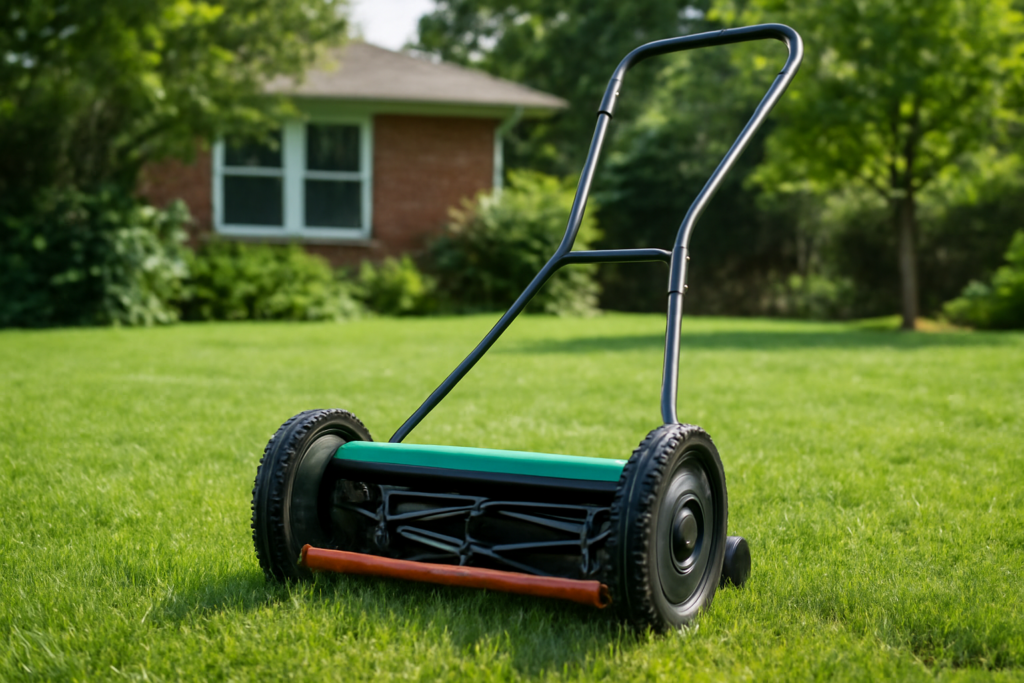
A reel lawn mower cuts grass the way sharp scissors cut paper, with a spinning cylinder of curved blades slicing each blade against a fixed bar. There is no engine, no gas, and no battery on a classic push model, which is exactly why the reel lawn mower has come roaring back for small suburban yards. If your lawn is under about 4,000 square feet and reasonably flat, this old-school machine can save you money, noise, and maintenance headaches.
- How a Reel Mower Actually Works
- Reel Count and Cut Quality
- What It Costs
- Best Grasses and Lawn Conditions
- Pushing Effort and the Terrain Reality
- Adjusting and Sharpening the Blades
- Reel vs. Battery vs. Gas at a Glance
- Top Picks Worth Considering
- The Environmental and Cost Case
- Mowing Technique for the Cleanest Cut
- Common Problems and How to Solve Them
- Is a Reel Mower Right for You?
How a Reel Mower Actually Works
Rotary mowers, the ones with a single horizontal blade spinning at 3,000 RPM, tear grass with brute speed. A reel mower does the opposite. As you push, the wheels drive a gear that spins a helical set of blades, typically 5 to 7 of them, past a stationary cutting bar called the bed knife. The grass gets sheared cleanly between the two edges.
That scissor action matters. A clean cut heals faster, loses less moisture, and browns less at the tips than the ragged tear a dull rotary leaves behind. Golf courses and premium sports fields still use powered reel units for exactly this reason.
Reel Count and Cut Quality
Blade count is the spec people fixate on, and it does matter, but not the way you might think. More blades mean more cuts per foot traveled, which produces a finer, more even finish at low heights.
- 5-blade reels are the standard for typical home lawns cutting at 1.5 to 2.5 inches. Great for fescue, ryegrass, and Kentucky bluegrass.
- 7-blade reels shine on grasses you keep short, like bermuda or zoysia cut at 0.5 to 1.5 inches.
- Below that, dedicated putting-green reels run 8 to 11 blades, but those are overkill for a backyard.
Cutting width usually runs 16 to 20 inches. A 20-inch deck covers ground faster but is heavier to push and harder to maneuver around beds.
What It Costs
Push reel mowers are refreshingly affordable. Entry models like the Great States 415-16 run about $90 to $110. The popular Fiskars StaySharp Max, with an inertia-drive system that lets it power through taller grass, sits around $220 to $260. The Scotts 2000-20 lands near $130 to $150 for a 20-inch cut.
Compare that to $250-plus for a decent gas mower plus ongoing costs of gas, oil, filters, and spark plugs, and the math favors the reel for small lots. There is no fuel to store and nothing to winterize.
Best Grasses and Lawn Conditions
Reel mowers reward good habits and punish neglect. They cut standing grass beautifully but struggle with tall, laid-over growth, thick weeds, and woody stems. The sweet spot is a lawn you mow often, before the grass gets long.
Cool-season grasses like fescue and bluegrass do well at 2 to 3 inches, near the upper limit of most reel mowers. Warm-season bermuda and zoysia are ideal because you keep them short anyway. Avoid a reel on St. Augustine, which grows on thick runners that can jam the reel, and skip it on lawns full of dandelion stalks or crabgrass seed heads.
Pushing Effort and the Terrain Reality
Modern reel mowers are far easier to push than the rusty units your grandparents fought with, but they are not effortless. Expect real work on slopes, in damp grass, or when the lawn gets ahead of you. Weight ranges from about 25 to 40 pounds. Ball-bearing wheels and a properly adjusted reel make a huge difference.
If your yard is over 5,000 square feet, hilly, or you travel and let the grass grow long between cuts, a battery mower will serve you better. Match the tool to how you actually mow.
Adjusting and Sharpening the Blades
Because there is no engine, maintenance is refreshingly simple, and there are still a few safety basics to respect since the blades are sharp. The two jobs that keep a reel cutting well are contact adjustment and sharpening.
Contact adjustment sets the gap between the reel blades and the bed knife. It should be close enough to shear a strip of newspaper cleanly along the whole width, but not so tight that it binds or wears fast. Most mowers adjust with two small screws at the ends of the bed knife.
Sharpening uses a process called backlapping. You apply a gritty lapping compound to the blades and spin the reel backward, usually with a hand crank or a drill adapter, to hone the mating edges. A backlapping kit costs about $15 to $25 and restores a paper-cutting edge in 20 minutes. Do this once a season for most lawns.
Before you reach into the reel to clean out clippings or adjust anything, make sure the mower is stopped and stable, and keep your fingers clear of the cutting edges. Wear gloves when you handle the blades or lapping compound.
Reel vs. Battery vs. Gas at a Glance
- Reel: quietest, zero emissions, cheapest to own, needs frequent mowing and flat-ish terrain. Best for small lawns.
- Battery: quiet, low maintenance, handles taller grass and slopes, higher upfront cost, run time limited by battery. Best for medium lawns.
- Gas: most power for tall or rough grass, handles big lots, but noisy, needs fuel and tune-ups. Best for large or neglected yards.
Top Picks Worth Considering
The Fiskars StaySharp Max is the crowd favorite. Its inertia drive and staggered wheels help it plow through slightly overgrown grass without stalling, and the blades never touch the bed knife, so backlapping is rare. At roughly $240 it is the premium choice.
The Scotts 2000-20 gives you a 20-inch cut and a comfortable price near $140, a solid pick for a flat, well-kept lawn. The Great States 415-16 is the budget workhorse at about $100 with a 16-inch reel, ideal for tiny yards and tight budgets.
The Environmental and Cost Case
Gas mowers are surprisingly dirty. A single hour of running an older gas push mower can emit as much smog-forming pollution as driving a car dozens of miles, and California has moved to phase out new gas-powered lawn equipment for exactly this reason. A reel mower emits nothing at the point of use, needs no oil that can leak or spill, and burns no fuel you have to buy and store. Over five years, a $100 reel mower with occasional $20 backlapping kits can cost less than the gas alone for a comparable powered machine.
There’s a health angle too. Because you’re the engine, mowing a small lawn with a reel gives you a legitimate walking workout, and you can do it at 7 a.m. without waking a single neighbor. That silence is a real quality-of-life benefit that owners mention constantly.
Mowing Technique for the Cleanest Cut
Getting a great result from a reel mower is partly about how you use it. A few habits make a big difference in cut quality and effort.
- Mow frequently. Cut before the grass gets tall, ideally removing no more than a third of the blade height at a time. Overgrown grass lays over and slips past the reel.
- Mow dry grass. Wet grass clumps, bends, and bogs down the reel. Wait until the dew burns off.
- Walk at a steady pace. The reel spins faster and cuts cleaner the faster you push, within reason, so a brisk, consistent walk beats a slow shuffle.
- Overlap your passes slightly so you don’t leave uncut strips between rows.
- Tackle tall spots twice from different directions rather than forcing the mower through in one slow pass.
Common Problems and How to Solve Them
If your reel mower stops cutting cleanly, the usual culprit is a dull or misadjusted reel; run the newspaper test and backlap or re-set the contact. If the mower is hard to push, check for grass wound around the reel shaft, low or dragging wheels, and whether the contact adjustment is too tight. Leaving uncut streaks usually means the grass got ahead of you, so mow more often. Rust from wet storage is the enemy of any reel mower, so wipe the blades dry and store the machine indoors or under cover.
Is a Reel Mower Right for You?
Choose a reel lawn mower if you have a small, level lawn of a grass type you keep short, you mow at least weekly in the growing season, and you value silence and simplicity over raw power. You will get a genuinely healthier, more even cut and a machine that costs almost nothing to run.
Skip it if your lawn is large, steep, weedy, or you let it grow long. In that case a battery or gas mower will save you frustration. For the right yard, though, a well-tuned reel mower is one of the most satisfying and low-cost tools in the shed.