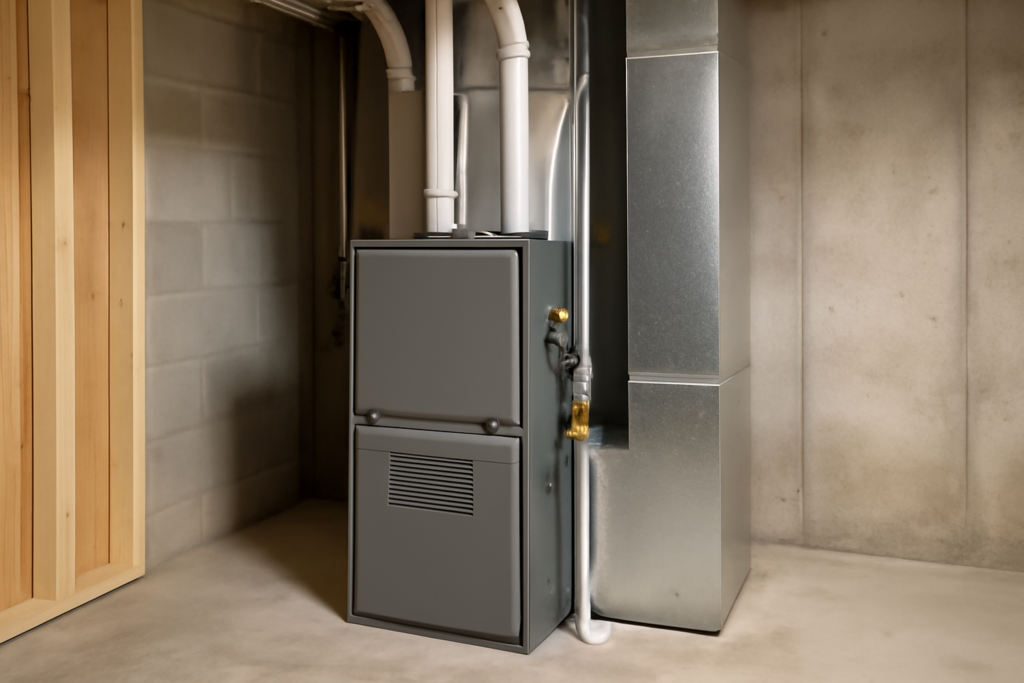
A furnace almost never dies in July when you have time to shop; it quits on the coldest night of the year, and panic buying leads to an oversized, overpriced unit installed badly. Planning a residential furnace replacement before the old one fails lets you size it correctly, compare efficiency, and hire the right contractor instead of whoever can come at 10 p.m. This guide covers when to replace, how to size, what efficiency to buy, and what a proper installation actually includes.
A residential furnace replacement typically runs $3,500 to $8,500 installed depending on fuel, efficiency, size, and whether ductwork or venting needs work. The right choice balances up-front cost against decades of energy bills, so it pays to understand the variables before a salesperson is standing in your basement.
- Signs You Need a Residential Furnace Replacement
- Sizing the New Furnace Correctly
- Understanding AFUE and Efficiency Tiers
- Single-Stage, Two-Stage, and Modulating
- Gas, Electric, and Considering a Heat Pump
- What a Proper Installation Includes
- Ductwork, Thermostat, and Air Quality Add-Ons
- Safety: Carbon Monoxide and Combustion Air
- Budgeting and Timing the Job
Signs You Need a Residential Furnace Replacement
Age is the first flag. Most gas furnaces last 15 to 20 years, and once yours is past 15, repairs get harder to justify. Watch for these warning signs that replacement beats another repair:
- Rising heating bills despite no change in usage, a sign of falling efficiency.
- Frequent repairs, especially costing more than about half the price of a new unit.
- Uneven heating, rooms that never warm up while others cook.
- Yellow or flickering burner flame instead of steady blue, which can signal incomplete combustion.
- A cracked heat exchanger, a safety hazard that almost always means replacement.
- Persistent short-cycling or loud banging, rattling, and squealing.
The most serious of these is a cracked heat exchanger, because it can leak carbon monoxide. If a technician reports one, stop using the furnace and replace it; never patch it.
Sizing the New Furnace Correctly
Bigger is not better. An oversized furnace short-cycles, wears out faster, and leaves rooms unevenly heated, while an undersized one runs constantly and never quite keeps up. The only correct method is a Manual J load calculation that accounts for your square footage, insulation, windows, ceiling height, and climate zone.
Furnace output is measured in BTUs per hour. As a rough sanity check, cold northern climates need about 40 to 60 BTU per square foot and mild southern climates about 30 to 40, so a 2,000-square-foot home might need 60,000 to 100,000 BTU depending on region. Do not let a contractor simply match the old unit’s size; the old one may have been wrong, and your home’s insulation may have changed.
Understanding AFUE and Efficiency Tiers
Furnace efficiency is rated by AFUE, Annual Fuel Utilization Efficiency, the percentage of fuel converted to usable heat. A 95 percent AFUE furnace turns 95 cents of every fuel dollar into heat; the rest goes up the flue. Current federal minimums sit around 80 percent, with high-efficiency condensing units reaching 95 to 98 percent.
Standard 80 percent units cost less up front and vent through a metal flue. Condensing 90-plus percent units capture extra heat from exhaust gases, vent through PVC pipe, and produce condensate that needs a drain, but they can cut fuel use noticeably. In cold climates with long heating seasons, the higher AFUE usually pays for itself; in mild climates with short winters, the payback stretches out and an 80 percent unit may make more sense.
Single-Stage, Two-Stage, and Modulating
Beyond AFUE, furnaces differ in how they modulate output. This affects comfort and efficiency:
- Single-stage: Full blast or off. Cheapest, but temperature swings more and it is less efficient at part load.
- Two-stage: A low and a high setting, so it runs gently most of the time and ramps up in deep cold. Steadier temperatures and quieter.
- Modulating with variable-speed blower: Adjusts output in fine increments and runs long, low cycles for the most even, efficient, and quiet heat. The premium tier.
A variable-speed blower also improves air filtration and pairs well with air conditioning in summer. If comfort and quiet matter to you and you plan to stay in the home, the upgrade is often worth it.
Gas, Electric, and Considering a Heat Pump
Most replacements are like-for-like gas furnaces, but it is worth pausing to consider alternatives. Electric furnaces cost less to install and have no combustion risk, but electric-resistance heat is expensive to run in cold climates. Where electricity is cheap or gas is unavailable, they make sense.
Increasingly, homeowners replace a failing furnace with a heat pump, or a dual-fuel system pairing a heat pump with a gas furnace for backup. Federal and utility incentives can offset the higher equipment cost, and the efficiency of a heat pump often beats a furnace on operating cost. If your air conditioner is also aging, replacing both with a heat pump can be the smarter long-term move, so ask your contractor to price that option too.
What a Proper Installation Includes
The install quality matters as much as the equipment. A thorough job includes:
- A load calculation to confirm size, not a guess based on the old unit.
- Inspection and, if needed, sealing of accessible ductwork; leaky ducts waste 20 to 30 percent of output.
- Correct venting, metal flue for 80 percent units, PVC and a condensate drain for condensing units, plus proper combustion-air supply.
- A new thermostat and, where applicable, a matched blower and coil.
- A combustion analysis and airflow check to verify the furnace runs within spec.
- A permit and inspection, which most jurisdictions require.
Get at least three itemized bids, confirm the contractor is licensed and insured, and make sure the quote lists the exact model, AFUE, size in BTU, and warranty terms. A typical changeout takes four to eight hours.
Ductwork, Thermostat, and Air Quality Add-Ons
A furnace swap is the ideal moment to address the parts of the system you never see. Have the installer inspect the ductwork for leaks, disconnected joints, and crushed sections; sealing accessible ducts with mastic and adding insulation to runs in unconditioned attics or crawl spaces can recover 10 to 20 percent of lost efficiency. Undersized return-air ducts are a common hidden problem that starves airflow and shortens equipment life, so ask whether returns are adequate for the new blower.
Consider bundling a few upgrades while the system is open. A programmable or smart thermostat like an Ecobee or Nest can trim heating costs 8 to 12 percent through setbacks. A high-MERV media filter cabinet, a whole-home humidifier for dry winter air, or a fresh-air ventilator all install most cheaply during a changeout rather than as separate visits later. Prioritize duct sealing and a good filter first, since they affect comfort and equipment longevity the most.
Safety: Carbon Monoxide and Combustion Air
Any gas furnace demands respect for combustion safety. Make sure the installation includes working carbon monoxide detectors on every level, especially near sleeping areas, and test them after the job. A properly installed furnace vents all exhaust outdoors, but a cracked heat exchanger, a blocked flue, or inadequate combustion air can push CO into living space, which is why a professional combustion analysis at startup is not optional.
Combustion air matters more in today’s tighter homes. A furnace burning gas needs a supply of fresh air to burn cleanly; in a sealed mechanical room or a very airtight house, the installer may need to add a dedicated combustion-air intake so the burner does not starve or backdraft. Never store paint, solvents, or other volatiles near the furnace, and keep the area around it clear so the burner draws clean air and a technician can service it safely.
Budgeting and Timing the Job
Plan the project for the shoulder seasons, spring or early fall, when HVAC companies are less swamped and sometimes offer promotions. Ask about manufacturer rebates, utility incentives, and financing, and register the warranty promptly since many require it within 60 to 90 days. Budget a small contingency for surprises like a rusted flue or an undersized gas line discovered during the swap.
Keep the paperwork organized after installation, because it matters more than people expect. File the permit and inspection sign-off, the equipment model and serial numbers, and the registered warranty together, and note the installer’s contact information. Schedule an annual tune-up each fall so a technician can clean the burners, check the heat exchanger, verify the flue draft, and confirm the safety controls before the heating season, cheap insurance that keeps the warranty valid and the furnace running safely.
Size it right, pick the efficiency and staging that fit your climate and how long you will stay, and insist on a careful install with a permit. Approach a residential furnace replacement that way, on your schedule rather than in a mid-winter emergency, and you will get years of reliable, even heat at a fair operating cost.