Contractors who have switched to it rarely go back, and homeowners who use it once for a soundproofing project usually find three more places to put it. Roxul insulation, now branded as Rockwool, is a stone-based mineral wool that competes with fiberglass batts but outperforms them on fire resistance, sound control, and moisture behavior. It costs more and is a bit denser to work with, but for specific jobs, from firestopping to quieting a media room, nothing off the shelf does the job better. Here is where it shines and where it is worth the premium.
What Roxul Is Made Of
Roxul, or Rockwool, is a type of mineral wool insulation spun from molten basalt rock and recycled slag, a byproduct of steel manufacturing. The material is heated to around 2,900 degrees Fahrenheit, spun into fibers like cotton candy, and formed into dense, semi-rigid batts and boards. Roxul was the well-known brand name in North America before the company rebranded to Rockwool, so the two names refer to the same product. It comes in batts for wall and ceiling cavities, in rigid boards such as Comfortboard for exterior continuous insulation, and in specialty products for pipes, fire safing, and industrial use.
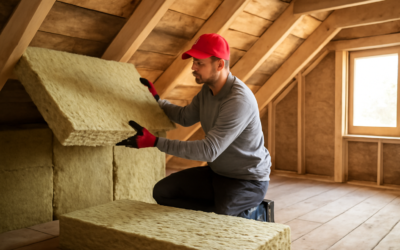
The batts are noticeably firmer and denser than fiberglass. They friction-fit into stud and joist bays and hold their shape, and you cut them with a serrated bread knife or a dedicated mineral wool blade rather than the utility knife you would use on foam.
R-Value and Thermal Performance
Roxul delivers a solid R-value of about R-4 to R-4.3 per inch, slightly higher than standard fiberglass batts at roughly R-3.1 to R-3.7 per inch. In practical terms, a Rockwool batt sized for a 2×4 wall provides about R-15, and a 2×6 batt provides about R-23, edging out comparable fiberglass. Because the batts are dense and hold their shape, they fill cavities completely without the gaps, sags, and compression that undermine sloppily installed fiberglass, so real-world performance is often better than the numbers alone suggest.
The Standout Benefits
Roxul’s real advantages go beyond R-value. Three properties set it apart from fiberglass and foam:
- Fire resistance: because it is made from stone, Roxul is noncombustible and withstands temperatures over 2,000 degrees Fahrenheit without melting. It does not burn or release significant smoke, which is why it is used as firestopping and in fire-rated assemblies. This is its single biggest selling point.
- Sound control: the dense fibers are excellent at absorbing sound, which makes Roxul the popular choice for insulating interior walls around bedrooms, bathrooms, home theaters, and laundry rooms. Rockwool Safe’n’Sound is a product made specifically for interior soundproofing.
- Water and moisture resistance: Roxul is hydrophobic, meaning it repels water rather than absorbing it, and it does not lose R-value when damp or support mold and mildew growth the way wet fiberglass can. It also dries out readily.
Add to those a high recycled content, resistance to pests and rot, and dimensional stability, and it is easy to see why it has taken market share from fiberglass.
Where to Use Roxul
The benefits map directly to the best applications. Reach for Roxul in these situations:
- Interior walls for soundproofing: around bedrooms, bathrooms, offices, and media rooms where you want quiet.
- Exterior walls and attics for thermal insulation, especially where fire safety is a priority.
- Basements and rim joists, where its moisture resistance is a real advantage over fiberglass in a below-grade, occasionally damp environment.
- Around chimneys, flues, and firestops, taking advantage of its noncombustibility (using the appropriate fire-rated safing product).
- Exterior continuous insulation using rigid Comfortboard over the sheathing to reduce thermal bridging.
- Garages and mechanical rooms, where fire separation matters.
Cost Compared to Fiberglass
The main trade-off is price. Roxul typically costs 25 to 50 percent more than equivalent fiberglass batts, running roughly $1.00 to $1.60 per square foot installed versus around $0.60 to $1.20 for fiberglass, depending on thickness and region. For a whole-house thermal job on a budget, fiberglass may still win on cost. But for targeted applications, soundproofing an interior wall, insulating a basement, firestopping around a chimney, or wherever moisture and fire are concerns, the modest upcharge buys real, measurable performance that fiberglass cannot match.
Working With It Safely
Installing Roxul is straightforward but calls for the right approach. The batts friction-fit snugly between studs on standard 16-inch and 24-inch centers, so they generally stay put without stapling. Cut them by compressing the batt with a straightedge and slicing with a serrated blade; a clean cut gives a tight fit with no gaps. As with any mineral fiber insulation, wear a dust mask or respirator, safety glasses, gloves, and long sleeves, since the fibers can irritate skin and lungs, and work in a ventilated space. The dense batts produce less airborne fiber than fiberglass, but protection is still smart.
For most homeowners, the decision is not Roxul versus fiberglass everywhere; it is knowing the handful of spots where Roxul insulation clearly earns its higher price. Use it where fire, sound, or moisture are on the line, and use standard batts for plain thermal fill, and you get the best of both worlds.
How Roxul Compares to Spray Foam and Rigid Foam
Roxul is not the only premium insulation, and it helps to know where it fits against the foam products. Spray foam, both open and closed cell, air-seals as it expands and can reach high R-values in a thin closed-cell layer, but it is expensive, requires a professional installer, is combustible and needs a fire barrier, and cannot be removed or adjusted once cured. Roxul, by contrast, is a batt you install yourself, is noncombustible, and can be pulled out and repositioned, though it does not air-seal a cavity the way foam does, so you still need separate air sealing at penetrations and top plates. Against rigid foam boards like polyiso and XPS, Roxul offers better fire resistance and sound absorption and does not off-gas, while foam boards give higher R-value per inch for continuous exterior insulation. Rockwool also makes a rigid mineral wool board, Comfortboard, that competes directly with foam for exterior continuous insulation while keeping the noncombustible and vapor-open advantages of mineral wool. The practical takeaway is to use Roxul batts in cavities where fire, sound, and moisture resistance matter, use spray foam where air-sealing an irregular space is the priority, and use rigid boards for continuous exterior layers.
Sizing and Buying the Right Product
Rockwool sells several distinct products, and choosing the right one matters. Comfortbatt is the thermal insulation batt for exterior walls, attics, and cavities, sized to friction-fit standard framing and rated at roughly R-15 for 2×4 walls and R-23 for 2×6 walls. Safe’n’Sound is a denser, unfaced batt engineered specifically for interior walls and floors where sound control and fire resistance are the goal rather than thermal value, and it is the product to buy for soundproofing a bedroom, bathroom, or media room. Comfortboard is the rigid board for continuous exterior insulation. When buying, match the batt width to your framing, 15 inches for studs on 16-inch centers and 23 inches for 24-inch centers, and match the thickness to your cavity depth, since compressing a thick batt into a shallow cavity wastes performance. Buy a little extra to allow for cutting around obstructions, and store the bundles dry until installation. Knowing which named product does which job prevents the common mistake of putting a thermal batt where a soundproofing batt belongs, or paying for the denser acoustic product where a standard thermal batt would do.
To estimate how much you need, measure the square footage of the wall, ceiling, or floor area you are insulating, subtract for large openings like windows and doors, and add about 10 percent for waste from cutting and fitting around obstructions. Each Rockwool bundle lists the square footage it covers on the packaging, so dividing your adjusted area by the coverage per bundle gives the number of bundles to buy. Buying a bundle extra is cheap insurance against running short mid-project, and unused batts store indefinitely as long as they stay dry. With the right product chosen and the right quantity on hand, Roxul insulation is a straightforward, do-it-yourself upgrade that pays back in comfort, quiet, and peace of mind for the life of the building.
Acoustic Performance in Real Numbers
The sound-control claim is easy to quantify, which helps when you are deciding whether the upcharge is worth it. A standard 2×4 interior wall with nothing in the cavity rates around STC 33 to 35, meaning loud speech and television come through clearly. Fill that same cavity with Safe’n’Sound mineral wool and the assembly typically climbs to roughly STC 45 to 52, a range where normal conversation becomes muffled and hard to follow through the wall. Pair the batts with a layer of 5/8-inch drywall and resilient channel or a second layer of drywall on green glue, and you can push a partition past STC 55, the point where even raised voices and bass-heavy audio are largely blocked. Those numbers are why media rooms, home offices, shared bedroom walls, and bathrooms are the classic places where mineral wool earns its price, since the same dollars spent on thicker fiberglass would gain only a few points by comparison.