Nearly every rug on the showroom floor is a rectangle, which makes shoppers assume rectangles are always the right answer. They are not. A rug 8×8 is a large square, 64 square feet of perfectly balanced footprint, and in the right room it does something a long rectangle simply cannot: it echoes the geometry of the space instead of fighting it. If your room reads square, your table is round or square, or your seating is arranged with symmetry in mind, a square rug is the shape that finally makes everything click.
- The Case for a Square Footprint
- When a Square Room Calls for a Square Rug
- Round and Square Tables Love a Square Rug
- Symmetrical Seating and Conversation Zones
- Why Square Rugs Are Harder to Find
- Choosing a Material That Suits the Space
- Placement Details That Make It Look Right
- Common Mistakes With Large Square Rugs
- Is an 8×8 the Right Choice?
The Case for a Square Footprint
Rugs are one of the most powerful tools for defining a zone, and shape is how they do it. A rectangle points, it has a long axis that leads your eye down the room, which is why it suits a typical living room with a sofa on the long wall. A square does the opposite. It settles. An 8×8 creates a stable, centered anchor that radiates equally in all directions, and that quality is exactly what certain rooms have been missing.
Think of a square rug as a visual counterweight. When a room lacks a strong directional pull, forcing a rectangle into it only highlights the mismatch. Matching the rug’s geometry to the room’s geometry is the single fastest way to make a space feel resolved rather than accidental.
When a Square Room Calls for a Square Rug
The clearest case is a genuinely square or near-square room. Many condos, bonus rooms, finished basements, and modern great-room zones come close to equal dimensions. Drop a long rectangle into a 12×12 room and you leave lopsided borders, wide on two sides, narrow on the others, that quietly telegraph that something is off.
An 8×8 in that same 12×12 room leaves a balanced two-foot reveal of floor on every side. The eye reads the symmetry instantly and the room feels calm. As a rule of thumb, if your room’s length and width are within about 20 percent of each other, a square rug will almost always sit better than a rectangle.
Round and Square Tables Love a Square Rug
Dining and breakfast areas are where the 8×8 really earns its place. A round pedestal table centered on a square rug is a designer-favorite pairing because the curved table softens the rug’s corners while the rug gives the round table a grounded base. The 64-square-foot footprint typically leaves enough room to pull chairs out and keep their back legs on the rug, which is the detail that keeps a dining rug from looking too small.
The same logic applies to a square dining or game table, or a big square ottoman anchoring a seating group. Matching a square table to a square rug creates a tidy, intentional stack of shapes. For a four-person round table up to about 48 inches across, an 8×8 is a near-perfect match; step up to a 60-inch round and you may want to size beyond 8×8 to keep chairs fully on the rug.
Symmetrical Seating and Conversation Zones
Square rugs shine under balanced furniture arrangements. Picture two sofas facing each other with a coffee table between, or four club chairs pulled around a central ottoman. These symmetrical, inward-facing layouts have no dominant long axis, so a long rectangle would fight the arrangement. A square rug reinforces it.
In an open-concept space, an 8×8 is also a clean way to carve out a defined conversation zone within a larger room. Float it under a compact seating group with the front legs of each piece resting on the rug, and you create a self-contained island that reads as its own room without any walls. The equal proportions signal “this is a complete, balanced space” in a way a rectangle never quite manages.
Why Square Rugs Are Harder to Find
If you have shopped for one, you already know the frustration: square rugs make up a small slice of what most retailers stock. The reason is market-driven. Manufacturers produce to demand, and demand skews heavily toward rectangles because most rooms and most furniture layouts are rectangular. Square sizes get made in shorter runs, in fewer patterns and colors.
That scarcity has a few practical consequences. You will have fewer designs to choose from, popular styles may sell out and not restock, and you may need to shop specialty or made-to-order sources to get the exact look you want. Plan on a little more searching, and if you find an 8×8 you love in the right color, do not wait, square inventory turns over less predictably than the endless supply of rectangles.
Choosing a Material That Suits the Space
Because an 8×8 usually anchors a high-use zone, a dining area or a main seating group, material should match the traffic. Consider these options:
- Wool: The durable, stain-resistant benchmark for dining and living rooms; naturally resilient and long-lasting.
- Polypropylene and other synthetics: Budget-friendly and easy to clean, ideal under a dining table where spills are inevitable.
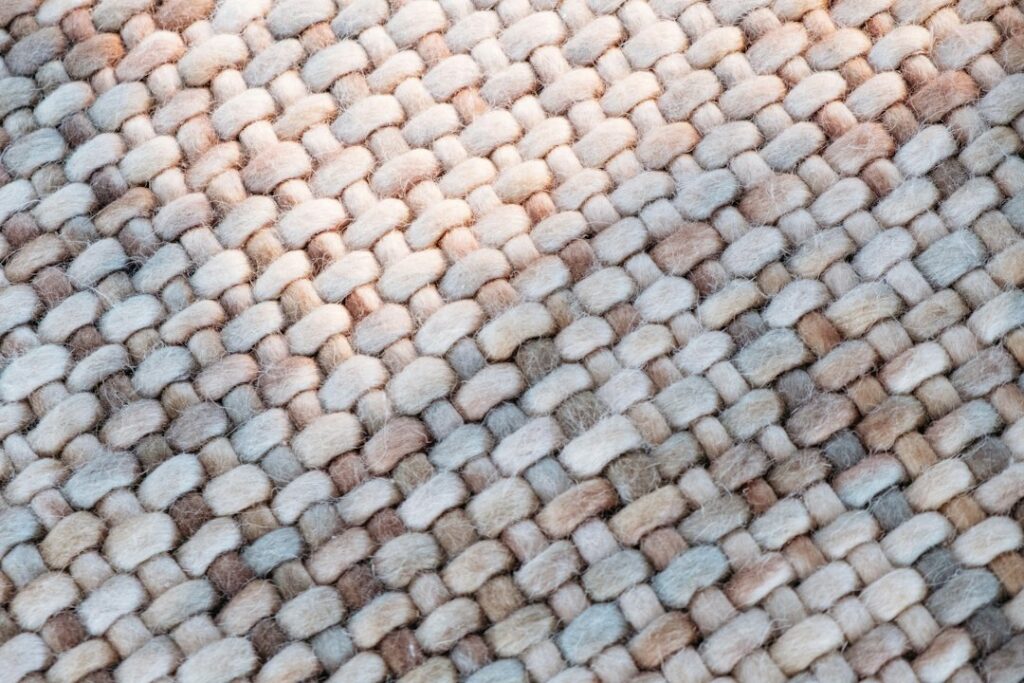
- Flatweave and jute: Low-profile and casual; a flatweave also lets dining chairs slide without catching on a thick pile.
- Wool-viscose blends: Add sheen and softness for a more formal living room, at the cost of a little durability.
Under a dining table, favor a low pile so chair legs move freely and crumbs vacuum out easily. In a seating zone where comfort matters more, a plusher wool or a soft synthetic shag rewards bare feet.
Placement Details That Make It Look Right
Getting a square rug to sit correctly comes down to centering and margin. In a dining setup, center the rug on the table, not on the room, and confirm you have at least 24 inches of rug beyond the table edge on all sides so chairs stay on when pulled out. In a seating zone, square the rug to the dominant furniture lines and keep a consistent border of exposed floor on all four sides.
Always use a rug pad sized just under the rug’s dimensions, roughly 7’8″ square for an 8×8. A pad adds cushion, keeps the rug from creeping on hard floors, and extends its life. On a large square especially, a pad also helps the rug lie perfectly flat, since any bowing shows more on a symmetrical shape.
Common Mistakes With Large Square Rugs
The most frequent error is buying a square rug for a clearly rectangular room simply because the price was right. In a long, narrow living room, an 8×8 leaves oversized borders on the short ends and reads as a mismatch, no styling can rescue a shape that fights the space. Match the rug to the geometry first, then worry about color and pattern.
A second misstep is undersizing at the dining table. People eyeball an 8×8 as “big” and forget that pulled-out chairs eat up 20-plus inches of that footprint on every side. Measure your table, add at least 24 inches of clearance all around, and confirm the math before you buy. The third mistake is skipping the rug pad, on a symmetrical shape, any curl or ripple at a corner is glaringly obvious, and a pad is what keeps a large square lying dead flat.
Is an 8×8 the Right Choice?
Reach for a rug 8×8 when your space asks for balance rather than direction. A square room, a round or square table, a symmetrical seating group, or a defined zone in an open plan are all textbook cases where the square shape resolves a layout that a rectangle would only unbalance. Accept that you will have fewer options to browse and may need a specialty or made-to-order source, but the payoff is a room where the rug’s geometry and the space finally agree, and that quiet sense of order is exactly what good design is built on.