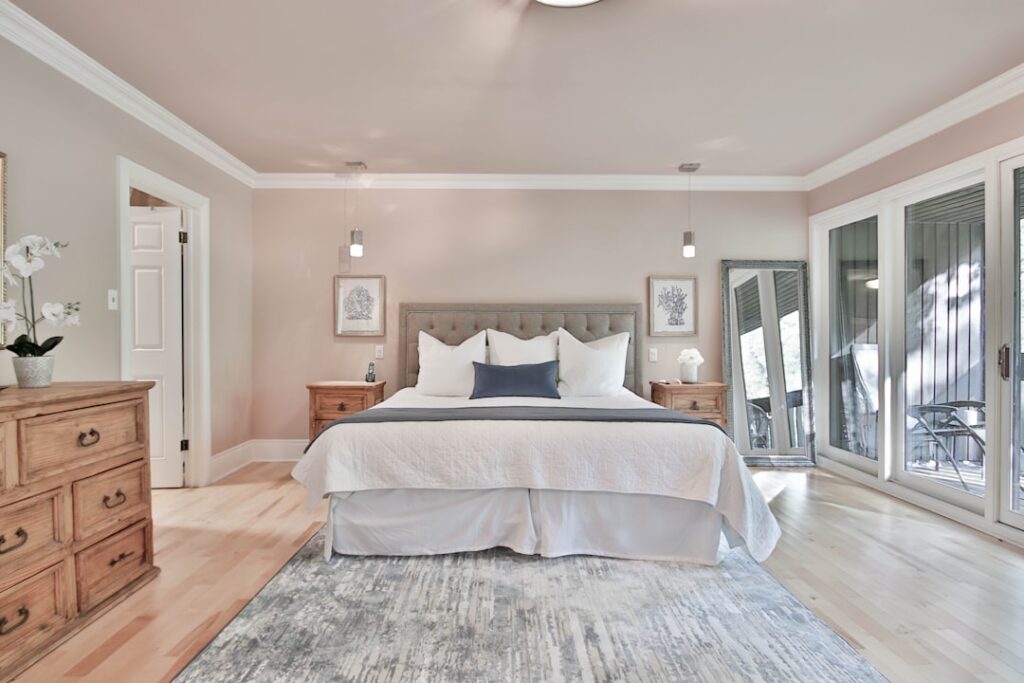
Choosing the right rug size for California king bed setups trips up more homeowners than almost any other rug decision, and it’s easy to see why. A Cal King measures 72 by 84 inches, which is 6 feet wide by 7 feet long, longer and narrower than a standard king. Drop an average-size rug under it and you end up with a stingy border that makes the whole room feel off. Get the size right, though, and the rug frames the bed, softens the floor where your feet land each morning, and pulls the whole bedroom together. This guide gives you the exact dimensions, layouts, and materials that work.
Start With the Bed’s Footprint
Before you shop, it helps to picture the full footprint the bed occupies. A California king mattress is 72 by 84 inches, but the frame, headboard, and any footboard add several inches on each side. Nightstands flanking the bed extend the footprint wider still, often to 8 or 9 feet total. The rug’s job is to reach out beyond the mattress far enough that you step onto a soft surface when you get out of bed and that the rug reads as a deliberate frame rather than an afterthought.
The general rule designers follow is to leave 18 to 24 inches of rug showing on each side and at the foot of the bed. That visible border is what creates the grounded, balanced look. Anything less than about a foot tends to look skimpy, while a border wider than two and a half feet can start to swallow the bed in a smaller room. Measure your bedroom first, because the room’s dimensions ultimately cap how large you can go.
The Best Rug Size: 9×12
For most California king bedrooms, a 9-by-12-foot rug is the ideal choice and the one I recommend first. Oriented with the 12-foot length running the same direction as the bed, a 9×12 gives you roughly 18 inches of exposed rug on each side and a generous stretch at the foot. That’s enough to place the bed plus a bench or the front legs of a pair of nightstands on the rug, which visually anchors the entire sleeping zone.
A 9×12 works best in bedrooms that are at least 12 by 14 feet, and it shines in larger primary suites. If you like to keep nightstands off the rug, simply slide the rug down so it starts a foot or two below the headboard; you’ll still cover the area around the sides and foot of the bed where it matters most. The 9×12 is the safest bet because it accommodates the Cal King’s extra length without leaving the foot of the bed floating on bare floor.
When to Choose 8×10
An 8-by-10-foot rug is the right call for medium-size bedrooms where a 9×12 would crowd the walls or overlap a closet swing. With an 8×10 under a Cal King, you’ll typically position the rug so it starts partway under the bed, roughly at the nightstand line or just below, leaving about 12 to 18 inches on the sides and foot. It won’t extend as far as a 9×12, but it still delivers a soft landing on both sides of the bed and a balanced frame.
The key with an 8×10 is placement. Because the rug is a bit short for the bed’s 7-foot length, avoid pushing it all the way up under the headboard, which would leave the foot of the bed on bare floor. Instead, pull the rug down so the coverage lands where you actually stand. If your room can’t comfortably fit an 8×10 either, a 6×9 works as a last resort but only extends a modest border, and I’d steer you toward the runner strategy below instead.
Placement Layouts That Work
There are three placement approaches worth knowing. The first and most common is the fully-under layout: the rug sits under the entire bed with the top edge starting just above or just below the nightstands, and the bed, nightstands, and a bench all rest on it. This is the most luxurious look and the reason a 9×12 is so popular for a Cal King.
The second is the two-thirds layout, where the rug slides under the lower two-thirds of the bed, starting around the nightstand line. This suits an 8×10 or a room where you don’t want the rug disappearing entirely under the headboard. The third is the horizontal layout, turning the rug so its length runs across the width of the room rather than along the bed; this can work in a wide, shallow bedroom, but it’s less common with a Cal King because the bed’s length wants a rug oriented the same way.
The Runner Alternative
If a large area rug doesn’t fit your budget or room, a pair of runners flanking the bed is a smart, affordable solution. Place a runner roughly 2.5 by 8 feet on each side, parallel to the bed, positioned so you step directly onto them when getting up. Runners typically cost $60 to $200 each, a fraction of a 9×12, and they cover the exact spots where softness matters most.
You can also add a single runner across the foot of the bed to complete the frame, or pair the side runners with a bench and a small accent rug. This approach is especially handy in bedrooms with heating vents, closet doors, or awkward layouts that a single large rug would fight against. The look is a little more casual and layered, but done well it feels intentional and cozy rather than like a compromise.
Materials for the Bedroom
Because bedrooms are low-traffic and you’re often barefoot, comfort underfoot outranks toughness here. Wool is the premium choice, soft, resilient, and naturally temperature-regulating, and it runs roughly $8 to $20 per square foot. A plush wool or wool-blend rug feels wonderful first thing in the morning and holds up for decades. For a large 9×12, that quality comes at a real cost, but the bedroom is arguably the best place in the house to splurge on it.
Softer synthetics and blends offer budget-friendly comfort. Polyester and viscose blends deliver a silky, plush hand at $2 to $6 per square foot, though they crush more easily under the bed’s weight over time. Natural fibers like jute and sisal look great but feel scratchy underfoot, so if you love the texture, layer a smaller soft rug on top or reserve them for the exposed border. Whatever fiber you pick, add a quality rug pad; it cushions the pile, keeps the rug from shifting, and extends its life considerably.
What It Costs and Final Tips
Budgets vary with size and material. A synthetic 9×12 in the bedroom runs roughly $200 to $700, a hand-tufted wool blend $800 to $2,500, and a fine hand-knotted wool piece well beyond that. An 8×10 typically costs 15 to 25 percent less than the equivalent 9×12, and the two-runner approach is the most economical path of all.
Before you buy, tape out the rug’s footprint on the floor around your bed so you can see the border with your own eyes, and account for door swings, closets, and vents.
It also pays to think about the rug’s thickness relative to your door clearance. A plush wool rug with a pad underneath can stand a half-inch to an inch tall, which is enough to catch a bedroom or closet door that was hung tight to the floor. Check the swing before the rug arrives, and if clearance is marginal, choose a lower-pile flatweave or plan to trim the door slightly. Getting the rug size for California king bed right comes down to that 18-to-24-inch border and matching the layout to your room, and once you nail it, the bed will finally look grounded and the whole space will feel finished.