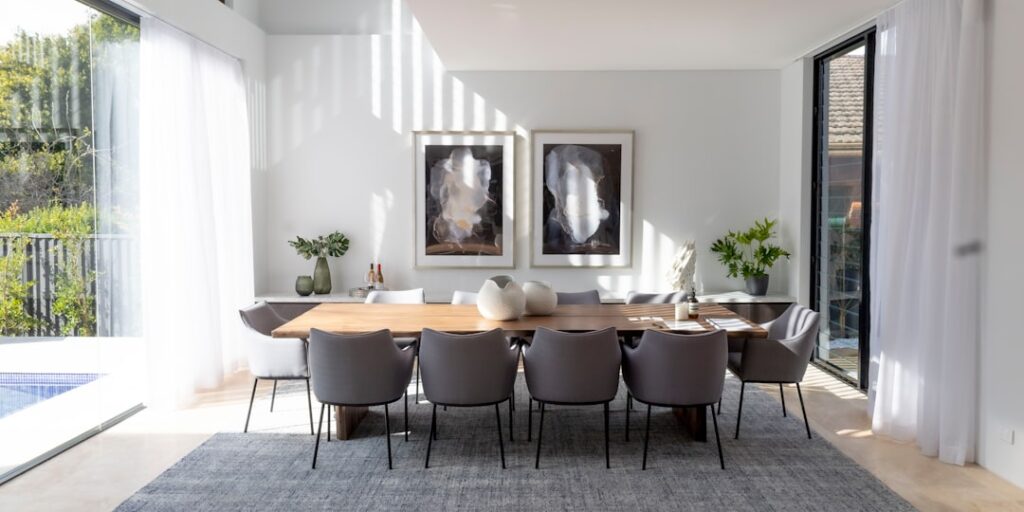
The dining room is where the wrong-size rug causes daily aggravation, chairs catch on the edge every time someone stands up. A properly sized rug under dining room table keeps all four chair legs on the rug even when pulled out to sit, so nothing tips or snags. The rule is simpler than most people realize: add at least 24 inches to your table’s footprint on every side. This guide covers exact sizing, shapes, materials, and the mistakes to avoid.
The Core Rule: 24 Inches on Every Side
A dining rug must be large enough that chairs stay fully on it when pulled back from the table. When you sit down or stand up, a chair slides back about 20 to 24 inches. If the rug is too small, the back legs drop off the edge and catch, which is both annoying and hard on the rug.
So the formula is: measure your table’s length and width, then add at least 48 inches to each dimension (24 inches per side). A 6-foot by 3.5-foot table needs a rug roughly 10 feet by 7.5 feet at minimum. Rounding up to a standard 8-by-10 or 9-by-12 usually gets you there.
Matching Rug Size to Table Size
Here is a quick reference from common table sizes to the rug size that keeps chairs on board:
- 4-seat table (about 36-48 in): 6-by-9 or 8-by-8 rug
- 6-seat rectangular table (about 60-72 in): 8-by-10 rug
- 8-seat rectangular table (about 84-96 in): 9-by-12 rug
- 10-seat table (about 108 in): 10-by-14 rug
- Round table for 4 (48 in): 8-foot round rug
- Round table for 6 (60 in): 9-foot round rug
When in doubt, size up. A rug slightly too large still reads as intentional, while one too small looks stingy and makes chairs catch. Leave at least 18 to 24 inches of bare floor between the rug edge and the walls so the room does not feel cramped.
Match the Rug Shape to the Table
The rug should echo the table’s shape for a balanced look. A rectangular or oval table pairs with a rectangular rug. A round or square table looks best on a round or square rug, which mirrors the table’s geometry and softens the room.
Some homeowners break this rule intentionally, a round rug under a rectangular table can work in a casual space, but the safe, always-correct choice is to match shapes. For a very long rectangular table, an oval or rectangular rug follows the line of the table and keeps proportions clean.
Best Materials for a Dining Rug
The dining room is a spill zone, so material choice matters more here than almost anywhere else in the house. Prioritize low pile and easy cleaning:
- Flat-weave and low-pile wool or synthetic: chairs slide easily, crumbs vacuum out, spills wipe up
- Indoor-outdoor polypropylene: highly stain-resistant and often washable with a hose, great for families
- Washable rugs: machine-washable designs are increasingly popular under dining tables for obvious reasons
Avoid deep, plush, high-pile, or shag rugs under a dining table. Chairs snag on thick pile, crumbs and food work down into it, and stains are hard to reach. A tight, flat weave is the practical, long-lasting choice. Darker colors and busy patterns also hide the inevitable dropped-fork stain better than a pale solid.
Placement and the Rug Pad
Center the rug under the table so the overhang is even on all sides. Measure from the table to each wall and split the difference, then set the table and rug together as a unit centered in the room, not necessarily centered on the light fixture if the room is asymmetrical, though ideally the table, chandelier, and rug all align.
Use a thin, low-profile rug pad underneath. In the dining room you want grip more than cushion, so a felt-and-rubber or thin gripper pad keeps the rug from sliding as chairs move across it, without adding a thick edge that chairs catch. A pad also protects the floor from the constant chair movement above.
Common Mistakes to Avoid
The number-one error is a rug that is too small, leaving chairs half on and half off. The second is choosing a thick, plush pile that fights every chair. Third is a rug that runs nearly wall to wall, which makes the room look like wall-to-wall carpet instead of a defined dining area; keep that border of bare floor around the edge.
Finally, do not forget maintenance realities. If you host often or have kids, a light-colored, dry-clean-only wool rug in the dining room is a recipe for stress. Choose something you can actually clean, and the rug will look good for years instead of retiring stained after one holiday season.
How to Measure for a Dining Rug
Getting the size right starts with an accurate measurement, and it takes only a minute. Measure the length and width of your table at its largest, including any leaves you use regularly, then add 48 inches to each dimension to account for the 24-inch chair pull-out on every side. That number is your minimum rug size. If it falls between two standard sizes, round up to the larger one so chairs never drop off the edge.
Then check the result against the room. Subtract your rug dimensions from the room dimensions and make sure at least 18 to 24 inches of floor remains around the rug on each side. If the calculated rug would nearly touch the walls, step down a size so the room does not feel like wall-to-wall carpet. This two-step check, table first and room second, keeps you from buying a rug that is either too small for the chairs or too big for the space.
Color, Pattern, and Style
Beyond function, the dining rug sets the tone of the room. A patterned rug hides the inevitable crumbs and small stains far better than a pale solid, which is why busy Persian, geometric, and multicolor designs are dining-room staples. Darker fields are more forgiving than light ones under a table where food and drink are constant. If your dining chairs and table are simple, a bold rug adds the personality the room needs; if the furniture is ornate, a quieter tone-on-tone rug keeps the space from feeling cluttered. Coordinate the rug with your window treatments or wall color to tie the room together, and the rug becomes a design anchor rather than just a chair-catcher.
Frequently Asked Questions
How big should a rug under a dining table be?
Add at least 24 inches to each side of the table’s footprint, so roughly 48 inches to both the length and width. This keeps all chair legs on the rug even when pulled out to sit.
What size rug fits a 6-seat dining table?
An 8-by-10 rug suits most 6-seat rectangular tables around 60 to 72 inches long. It gives enough overhang to keep chairs on the rug when pulled back.
Should a dining rug match the table shape?
Yes, for the most balanced look. Use a rectangular or oval rug under a rectangular or oval table, and a round or square rug under a round or square table.
What is the best material for a dining room rug?
Low-pile flat-weave wool, synthetic, indoor-outdoor polypropylene, or washable rugs work best. They let chairs slide, resist stains, and clean easily. Avoid thick, plush, or shag pile.
Do I need a rug pad under a dining room rug?
Yes, a thin low-profile grip pad keeps the rug from sliding as chairs move and protects the floor. Choose grip over cushion so chairs do not catch on a thick edge.