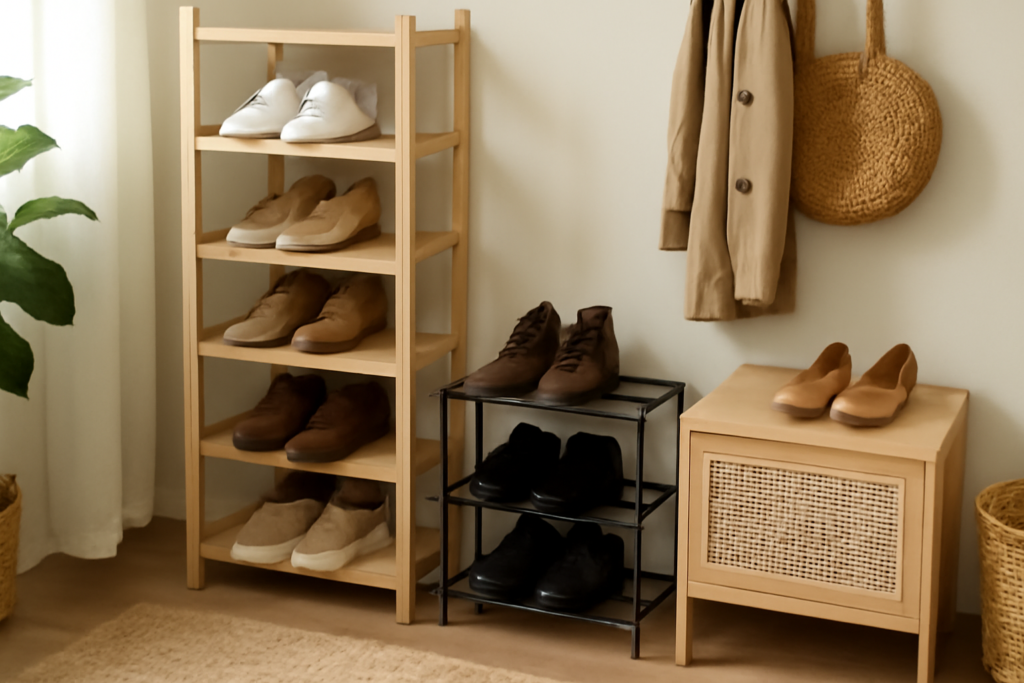
A pile of shoes by the door turns a tidy entryway into chaos fast, and in a compact home there is no spare floor to give. The right shoe organizers for small spaces solve this by going vertical, using doors, and tucking storage into gaps you forgot you had. With a smart system, even a tiny apartment or narrow hallway can keep footwear off the floor and easy to grab on the way out.
- Start by Measuring and Counting
- Over-the-Door Organizers
- Vertical Shoe Towers and Racks
- Under-Bed Storage
- Bench and Furniture That Doubles as Storage
- Wall-Mounted and Floating Options
- Closet Solutions for Small Spaces
- Stackable and Modular Systems
- Special Solutions for Boots and Tall Shoes
- Keep It Easy to Maintain
- Quick Tips to Keep It Working
- The Bottom Line
Start by Measuring and Counting
Before buying anything, count how many pairs you actually need to store and measure the space you have to work with. Note the height of a doorway, the depth of a closet, the clearance under your bed, and any awkward wall section that sits empty. A common mistake is buying a bulky rack that does not fit the spot you imagined. Knowing your numbers up front lets you choose an organizer sized to both your collection and your room.
Over-the-Door Organizers
When floor space is gone, look up and out. Over-the-door organizers hang from the top of a door and use the flat surface that would otherwise sit empty.
- Pocket organizers: Clear or fabric pockets hold several pairs and let you see each one at a glance. Great for flats, sneakers, and sandals.
- Wire or metal racks: Sturdier shelves that hook over the door for heavier shoes like boots and loafers.
These cost little, install without tools, and reclaim a surface most people ignore. Just confirm the door can close freely with the organizer in place.
Vertical Shoe Towers and Racks
When you have a narrow strip of floor, a vertical tower stacks shoes upward instead of spreading them out. A slim shoe tower in a corner or beside a dresser holds many pairs in a small footprint. Stackable cube shelves are another flexible option, letting you build up rather than out and add tiers as your collection grows. Look for adjustable shelves so you can fit both low flats and tall boots.
Under-Bed Storage
The space beneath a bed is prime real estate in a small home. Low-profile under-bed bins and rolling drawers slide out of sight and hold off-season or rarely worn shoes. Clear containers or those with labeled fronts let you find a pair without dragging everything out. This approach keeps the floor clear and frees your closet for daily wear.
Bench and Furniture That Doubles as Storage
In tight quarters, every piece of furniture should earn its keep. A storage bench by the entry gives you a place to sit and pull on shoes while hiding several pairs underneath. Ottomans with hollow interiors and console tables with lower shelves do the same job. Choosing furniture that doubles as shoe storage means you are not adding a separate rack at all, which keeps the room from feeling crowded.
Wall-Mounted and Floating Options
Mounting storage to the wall lifts shoes entirely off the floor, which makes a small room feel larger and easier to clean. Floating shelves, angled wall racks, and even sturdy hooks for hanging sandals or flats turn vertical wall space into a display. Group these near the entry so shoes have a clear home the moment you walk in. Just anchor anything wall-mounted into studs or use proper drywall anchors so it holds the weight.
Closet Solutions for Small Spaces
If you have a closet, even a slim one, a few additions stretch its capacity. Hanging fabric shelf organizers add tiers on a rod, slim shoe shelves line the closet floor, and over-the-door racks work on the inside of the closet door as well. The goal is to use the full height of the closet rather than letting shoes pile on the floor where they get lost and dusty.
Stackable and Modular Systems
For spaces that change over time, modular shoe storage offers real flexibility. Stackable shoe boxes, clear drop-front bins, and interlocking cube units let you start small and add pieces as your collection grows or your space allows. Drop-front boxes are especially handy because you can pull a single pair without unstacking the whole tower. Because these systems build vertically, they make excellent use of a closet corner or a narrow stretch of wall. The modular approach also moves easily, which is a plus for renters who relocate often.
Special Solutions for Boots and Tall Shoes
Tall boots are the trickiest footwear to store in a small space, since they flop over and take up disproportionate room. Boot shapers or rolled magazines inside the shafts keep them upright and compact. Hanging boot clips that grip the tops let you suspend pairs from a closet rod, using vertical space instead of floor. For off-season boots, flat under-bed bins protect them while they are out of rotation. Treating tall shoes as their own storage problem keeps them from overwhelming a small organizer built for everyday flats and sneakers.
Keep It Easy to Maintain
The best system is one you will actually use every day. Position your everyday shoe storage right where you take shoes off, usually by the entry, so kicking them into place is effortless. If the organizer is across the room or hard to reach, shoes will pile up by the door anyway. A small tray for wet or muddy shoes protects your floors and keeps the rest of the storage clean. The goal is a setup so convenient that putting shoes away takes less effort than leaving them out.
Quick Tips to Keep It Working
- Edit your collection: Donate or store pairs you rarely wear so the organizer is not overwhelmed.
- Keep daily shoes accessible: Put everyday pairs at eye level and tuck seasonal ones away.
- Use clear containers: Seeing what is inside saves time and prevents forgotten shoes.
- Go vertical first: In a small space, height is your friend; floor space is the scarcest resource.
The Bottom Line
The best shoe organizers for small spaces work by using surfaces you already have, doors, walls, under-bed gaps, and the inside of closets, instead of eating up precious floor. Measure first, count your pairs, then mix an over-the-door rack, a vertical tower, and storage furniture to fit your home. With the right setup, even the smallest entryway stays neat and your shoes stay easy to find.