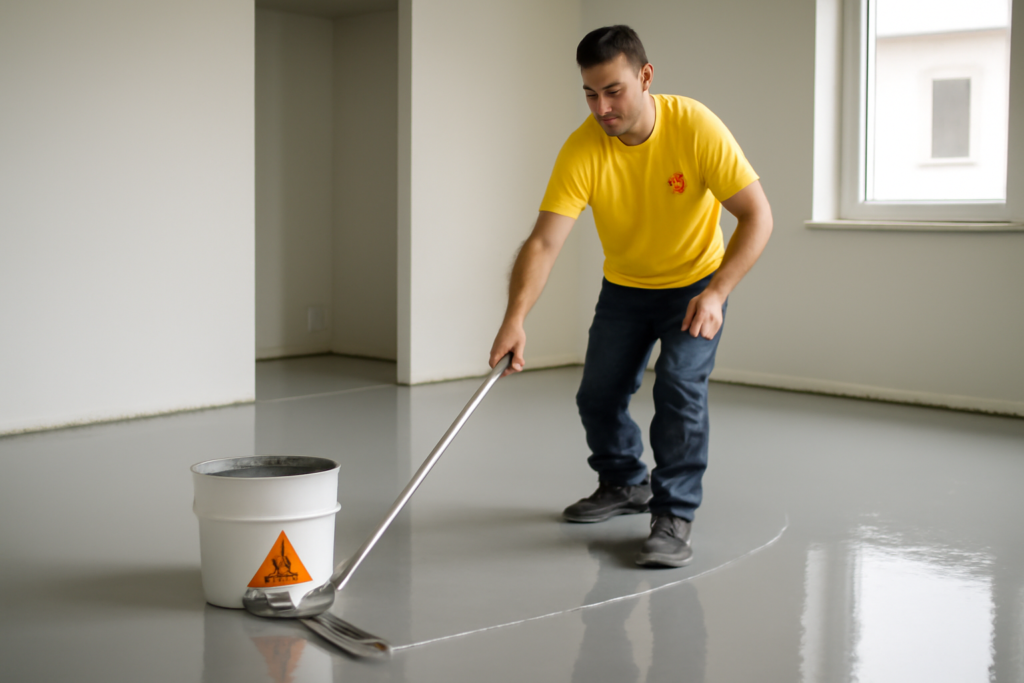
The Sika epoxy flooring price depends heavily on which product line you choose, how much surface prep your slab needs, and whether you install it yourself or hire a pro. Sika is a global leader in construction chemicals, and its epoxy and polyurethane floor coatings span everything from a weekend garage kit to industrial-grade systems built for warehouses. Understanding what you are actually paying for, materials, coverage, and labor, keeps your budget realistic. Here is how the numbers break down.
What You Are Buying With Sika Epoxy
Sika does not sell one epoxy; it sells a family of coatings under names like Sikafloor and Sikagard. Consumer and light-commercial garage kits differ sharply from the thick, self-leveling industrial systems designed for forklifts and chemical exposure. Price scales with the resin quality, film thickness, and additives like anti-slip aggregate or UV-stable topcoats. A basic single-coat garage kit sits at the low end; a multi-layer broadcast system with a colored flake and clear sealer costs several times more per square foot.
Material Cost Per Square Foot
For product alone, here are realistic ranges to plan around:
- Basic DIY garage kit — roughly $1.50 to $3 per square foot in materials for a thin roll-on coat.
- Mid-grade system with flake and topcoat — about $3 to $6 per square foot in materials.
- Self-leveling or industrial Sikafloor systems — $6 to $12-plus per square foot in materials, depending on thickness and additives.
Sika resin components are often sold by the kit or gallon set. Always check the stated coverage rate, a gallon that covers 250 square feet at one thickness may only cover 125 at double thickness, which directly doubles your material cost.
DIY vs. Professional Installation
Labor is usually the biggest swing in your total. A confident DIYer can coat a two-car garage over a weekend for materials cost alone, plus tools. Professional installation adds significant labor but includes the prep that makes epoxy actually last:
- DIY total — often $1.50 to $4 per square foot, materials and basic tools only.
- Professional installed — typically $4 to $10 per square foot for standard residential systems.
- High-build industrial installs — $8 to $15-plus per square foot installed.
For a 400-square-foot two-car garage, a DIY Sika kit might run $600 to $1,600 in materials, while a professional flake-system install commonly lands between $2,000 and $4,000.
What Drives the Price Up
Several factors push a Sika epoxy job toward the top of its range:
- Surface prep — grinding or shot-blasting a slab, filling cracks, and moisture mitigation add cost but are essential; skipping prep is the number-one cause of peeling.
- Number of coats — a primer, base, flake broadcast, and clear topcoat cost more than a single roll-on.
- Slab condition — oil-stained, cracked, or previously coated floors need extra remediation.
- Additives — anti-slip aggregate, UV-stable urethane topcoats, and custom colors raise material cost.
- Moisture — a slab with high moisture vapor may require a special primer to prevent delamination.
Why Prep Is Worth Paying For
Epoxy is only as good as its bond to the concrete, and that bond depends on mechanical profiling of the surface. Sika’s own technical data specifies grinding or shot-blasting to open the concrete pores. A cheap job that acid-etches or skips prep entirely may look fine for a season, then peel in sheets. When comparing quotes, a higher bid that includes diamond grinding and crack repair often delivers a floor that lasts a decade, while the bargain bid may fail within a year. Prep is not where you save money.
How to Estimate Your Project
To budget accurately, measure your slab in square feet, pick a Sika system that matches your use, garage, workshop, or commercial, and read the product’s coverage rate for the film thickness you want. Multiply your area by the material cost per square foot, then add labor if hiring out. Always buy 10 to 15 percent extra resin to account for a rougher-than-expected slab soaking up more product. Get at least two professional quotes and confirm each includes surface prep, since that line item is where bids diverge most.
Is Sika Epoxy Worth the Price?
Sika’s reputation rests on consistent, well-documented products backed by strong technical support, which matters when you are trusting a coating to bond for years. For a garage or basement, a mid-grade flake system installed over properly prepped concrete offers an excellent balance of durability, chemical resistance, and appearance for the money. If you want the lowest possible cost and have the patience for careful prep, a DIY kit can deliver solid results; if you want a guaranteed, warrantied finish, professional installation justifies its premium.
Epoxy vs. Polyaspartic and Other Coatings
Sika and other manufacturers also sell polyaspartic and polyurethane coatings, and knowing how they compare helps you judge whether epoxy is even the right product. Epoxy builds a thick, hard, chemical-resistant base and is the workhorse for garages and industrial floors, but standard epoxy can amber and chalk under direct UV, so it usually needs a topcoat outdoors or near big windows. Polyaspartic coatings cure much faster, sometimes allowing a one-day install, resist UV yellowing, and handle temperature swings better, but they cost more per square foot and set so quickly they are harder to apply by hand.
A common professional system pairs an epoxy base coat for build and adhesion with a polyaspartic or polyurethane topcoat for UV stability and scratch resistance. That layered approach costs more than a single epoxy coat but delivers the longest-lasting result, which is why premium installed quotes land at the higher end of the range. If you only need a basic garage refresh and can keep the space out of direct sun, a straightforward epoxy kit is the economical choice.
Hidden Costs to Budget For
Beyond the resin and labor, several line items can surprise first-time buyers. Concrete repair, filling cracks, patching spalled areas, and grinding down high spots, adds cost on an older slab. Moisture testing and, if needed, a moisture-mitigation primer are essential on slabs that show vapor transmission, and skipping them risks total delamination. You may also need to rent or buy a concrete grinder if you DIY, plus solvent-resistant rollers, spiked shoes, and a respirator. Factor in downtime, too: most epoxy systems need 24 to 72 hours of cure before you can drive on them, so plan where your vehicles go during the job. Building these into your estimate up front prevents the sticker shock of a quote that looked cheap on the resin alone.
The Bottom Line
The Sika epoxy flooring price ranges from about $1.50 per square foot for a DIY garage kit to $15 or more per square foot for a professionally installed industrial system. The single biggest budget lever is surface prep, never skip it, and the second is DIY versus pro labor. Measure carefully, match the Sika product to your use, and gather itemized quotes so you know exactly what your total will be.