Slate walkways break the formula of poured concrete or generic pavers and add genuine character to a front yard. The challenge is that slate is a metamorphic stone — sourced from quarries, varying wildly in thickness and shape — which makes installation more art than spec. Good slate walkway ideas account for base prep, pattern, color blending, and joint material before any stone hits the ground. Get those right and a slate path lasts 40 to 60 years with minimal maintenance. Get them wrong and you’re regrading and resetting stones within five years.
Slate Color Variations
Pennsylvania black slate from quarries in Slatington and Pen Argyl runs charcoal to gunmetal. Vermont green slate from Camara Slate or Hilltop Slate comes in slate green, gray-green, and purple. Brazilian multicolor slate (Black Rust, Multicolor, Copper Rust) blends rust, plum, and gold tones — the most popular import for residential walkways. Indian slate (Sagar Black, Kund Multicolor) hits a similar look at 20% lower prices but with slightly more variation in thickness.
Test the color in both wet and dry conditions. Wet slate often reads two to three shades darker than dry — important for designers matching slate to existing brick or stone on the house.
Pattern Layouts
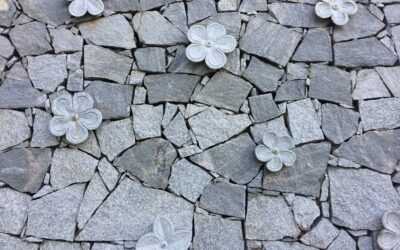
Random irregular flagstone reads casual and cottage-style. Stones run 8 to 24 inches in irregular polygons with 1 to 2-inch joints filled with polymeric sand or mortar. Material cost: $4 to $9 per square foot for irregular slate.
Cut rectangular slate in geometric patterns reads modern. The stones come pre-cut to 12×12, 12×18, 18×24, or 24×24 inches in 1-inch or 1.5-inch thicknesses. Layouts include running bond, basketweave, or French pattern (ashlar). Material runs $6 to $14 per square foot for cut slate.
For curving paths, irregular flagstone bends naturally around obstacles. Cut rectangular slate forces straight runs or stepped edges along curves.
Base Preparation: The Make-or-Break Step
Excavate to a depth of 8 to 12 inches below the finished walkway grade. Lay landscape fabric over the subgrade to prevent weed roots from pushing stones up over time. Spread 4 to 6 inches of 3/4-minus crushed stone, compacted in 2-inch lifts with a rented plate compactor ($75 per day from Sunbelt).
Top with 1 inch of coarse sand or stone dust, screeded flat. Skip the sand layer entirely and the slate sits directly on the gravel — fine for dry-laid installations but unforgiving when individual stones need leveling.
Dry-Laid vs Mortar-Set Installations
Dry-laid installations set slate directly on the sand bed with 1 to 2-inch joints filled with polymeric sand like Alliance Gator Maxx ($35 per 40-lb bag). Polymeric sand hardens when activated with water and resists weed growth, freeze-thaw heave, and ant tunneling. Reapply every 4 to 6 years.
Mortar-set installations build a 4-inch reinforced concrete slab as the base, then set slate in a 1-inch thick mortar bed using Type S mortar. Cost runs 60 to 90% higher than dry-laid but the walkway becomes permanent — no settling, no joint maintenance, no stones working loose.
In freeze-thaw climates (USDA zones 5 and colder), dry-laid systems handle ground movement better than rigid mortar-set walkways. Mortar-set installs in zone 4 often crack within 10 years from frost heave.
Joint Filling Options
- Polymeric sand — Alliance Gator Maxx or Sakrete PermaSand, $35 to $50 per 40-lb bag, covers 80 to 110 sq ft
- Stone dust — cheapest at $6 per bag but doesn’t bind, requires annual top-up
- Pea gravel — visually distinct, works between widely spaced stones, $5 per bag
- Mortar (cement-based) — permanent for mortar-set installs only, cracks under freeze-thaw if used on dry-laid
- Creeping thyme or Irish moss — living joints for cottage-style paths, $8 per 4-inch pot
Designs That Work for Front Yards
A curving slate walkway from driveway to front porch reads more welcoming than a straight concrete path. Plan a 42 to 48-inch wide walkway for primary front entries (two people can walk side by side) and 36 inches for secondary garden paths. Edge the walkway with low-growing plants like creeping phlox, sweet alyssum, or dwarf mondo grass to soften the transition to lawn.
For a formal look, line a straight cut-stone walkway with boxwood or low yew hedging. The geometric contrast between the rectangular slate and the rounded shrubs reads as intentional design rather than accidental.
Slate Walkway Maintenance
Power wash dry-laid slate walkways every 18 to 24 months to remove algae and biological staining. Use a 25-degree nozzle at 1,500 PSI maximum — higher pressure blasts polymeric sand out of joints. A Karcher K3 Follow-Me pressure washer ($179) handles a 100-foot walkway in about 40 minutes.
Reseal slate every 3 to 5 years with a penetrating sealer like Aqua Mix Sealer’s Choice Gold ($28 per 16 oz bottle, covers 250 sq ft). Sealer reduces moss growth and keeps the color vibrant against UV fading.
Cost Breakdown for a 4-Foot by 30-Foot Walkway
120 square feet of slate walkway at typical residential pricing: $480 to $1,080 for slate material, $180 for crushed stone base, $60 for sand, $100 for polymeric sand joint filler. DIY total: $820 to $1,500 in materials. Pro labor adds $1,800 to $3,400 for dry-laid installation, $3,200 to $5,800 for mortar-set over a concrete base.
Most homeowners DIY a slate walkway over a single weekend with a helper. Renting a plate compactor and a 4-foot screed board ($120 total for tool rental) is the biggest hidden cost beyond stone.
Designs to Avoid
Skip slate walkways in heavy-shade locations where moss takes over within two years and creates slip hazards. Avoid slate in driveways unless you use 2-inch thick stones over a reinforced concrete base — thinner stones crack under car weight. Skip thin slate (under 3/4 inch) for any walkway — it cracks during installation and frost-heaves out within five years.