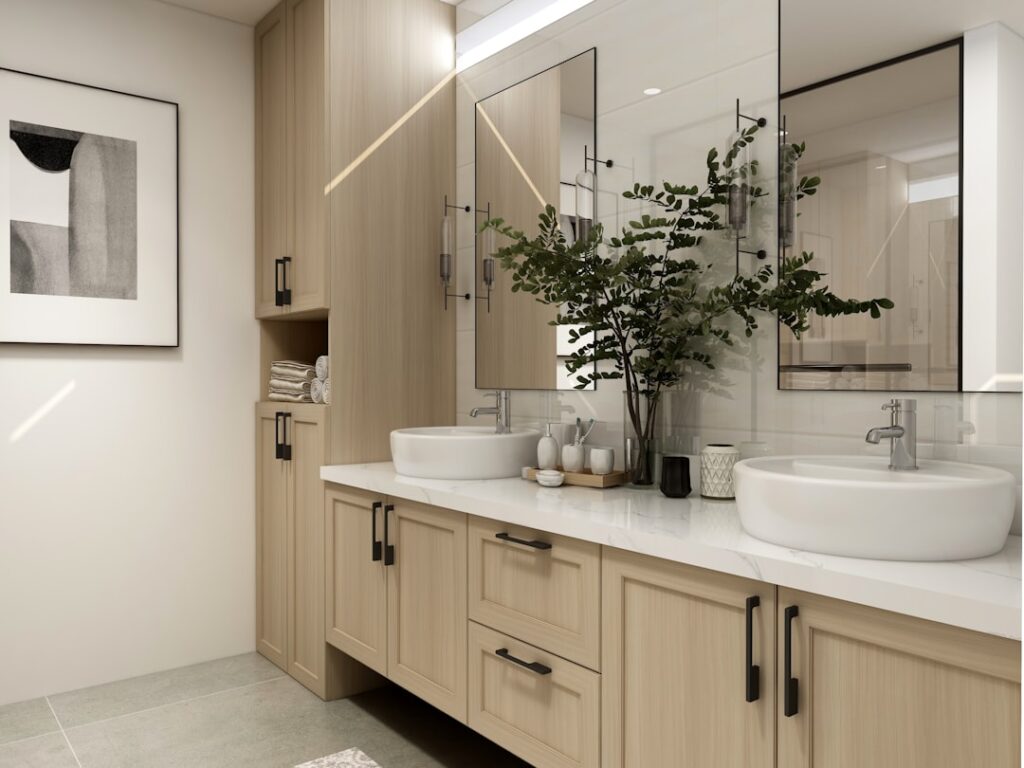
Two sinks used to mean a giant bathroom, but that is no longer true. A small double sink vanity can fit into a surprisingly tight space if you plan the widths, sink type, and plumbing correctly. I have installed doubles in bathrooms people swore could only hold a single, and the payoff — two people getting ready without elbowing each other — is worth the tighter tolerances. Here is how to make it work.
- The Minimum Width You Actually Need
- Sink Types That Save Space
- Faucet Sizing and Placement
- Plumbing Two Sinks in a Tight Space
- Maximizing Storage
- What a Small Double Sink Vanity Costs
- Countertop Material for Small Doubles
- Layout: Where to Put a Small Double Vanity
- Lighting a Two-Sink Vanity
- Small Double vs. Single With More Counter
- Installation Considerations
- Is a Small Double Right for You?
The Minimum Width You Actually Need
The number-one question is how narrow you can go. The honest answer:
- 48 inches is the practical minimum for a true double vanity. It is tight — two smaller basins with limited counter between them — but it functions.
- 60 inches is the comfortable standard where two people have real elbow room and usable counter space.
- Below 48 inches, a double becomes cramped to the point of frustration; a single with a wide counter usually serves better.
At 48-54 inches, the trade-off is real: you gain a second sink but lose most of the counter landing space. Be honest about whether two people using it at once matters more than surface area, because in a small vanity you cannot have both in full measure.
Sink Types That Save Space
Sink choice is where you buy back inches on a small double:
- Undermount sinks: mounted below the counter, they free up surface space and are easy to wipe clean. Good for tight builds.
- Integrated (one-piece) sink tops: the basins and counter are a single molded unit, maximizing usable width with no wasted rim.
- Vessel sinks: sit on top of the counter and can be smaller in footprint, but they eat vertical and visual space — use with care in a small room.
- Compact rectangular basins pack more efficiently than round bowls when width is scarce.
For a 48-inch double, integrated tops with two shallow rectangular basins give you the most functional result.
Faucet Sizing and Placement
On a small double, faucet choice matters more than usual. Single-hole faucets take up far less deck space than widespread three-hole sets, and they are the smart pick when the basins sit close together. Wall-mounted faucets are the ultimate space-saver — mounting them on the wall frees the entire counter deck — though they require in-wall plumbing, so plan them during a remodel, not as a retrofit. Keep faucet spouts modest in reach so two people are not fighting over the middle.
Plumbing Two Sinks in a Tight Space
Two sinks means two of everything, and that has to fit inside the cabinet:
- You will run two sets of supply lines and two drains, usually tied into a single vent and waste line.
- The P-traps and drain lines eat cabinet interior space, which cuts into storage. Plan around them.
- A plumber can often share a single drain stack between two closely spaced sinks, which simplifies the run in a narrow vanity.
If you are converting a single to a double, factor in the cost of adding a second drain and supply set — it is the part DIYers underestimate.
Maximizing Storage
The drains and traps steal the middle of the cabinet, so smart storage layout matters:
- Drawers on the ends, where there is no plumbing, give you the most usable storage.
- U-shaped drawers that wrap around the P-traps recover space a normal drawer would lose.
- A center bank of doors under the shared plumbing handles taller items.
- Wall cabinets or a mirror cabinet above take pressure off the vanity for daily items.
Choose a vanity designed for double-sink plumbing — its interior is already laid out to work around the traps, unlike a repurposed single.
What a Small Double Sink Vanity Costs
Realistic 2025 pricing for the vanity plus tops:
- Budget 48-60 in. double vanity with top: $600-$1,200
- Mid-range with quartz top and quality hardware: $1,200-$2,500
- High-end custom or solid-wood with stone top: $2,500-$5,000+
- Two faucets: $100-$500 total depending on quality
- Plumbing labor to add a second sink: $300-$800
A realistic all-in for a nice 60-inch double, installed, lands around $1,800-$3,500 depending on materials and whether new plumbing is needed.
Countertop Material for Small Doubles
With limited counter, choose a material that stays low-maintenance and looks clean:
- Quartz: the top pick — nonporous, no sealing, durable, and available in seamless integrated tops.
- Cultured marble/solid surface: budget-friendly and available as one-piece tops with molded basins, ideal for tight doubles.
- Granite: durable and attractive but needs periodic sealing.
- Natural marble: beautiful but stains and etches — a lot of upkeep for a hard-working small bath.
Layout: Where to Put a Small Double Vanity
Placement in a tight bathroom decides whether a double feels usable or cramped. Ideally the vanity sits on the longest uninterrupted wall, with the door swing and toilet clearances kept off to the side. Building codes and comfort call for at least 15 inches from the center of each sink to the nearest side wall, and around 21-24 inches of clear floor space in front of the vanity for standing room. On a 48-inch double, those two sinks sit close together, so plan the faucet and mirror layout to give each person a defined zone even if it is a small one.
Mirrors matter too. Two separate mirrors above each sink reinforce the “his and hers” feel and can make the wall look wider; a single large mirror spanning both sinks makes a small room feel more open. Either works — choose based on whether you value defined personal space or maximum sense of openness.
Lighting a Two-Sink Vanity
Good lighting makes a small double far more functional. The best setup is a light source at each sink rather than one central fixture, so neither person is working in their own shadow. Options that fit a tight double:
- Two sconces flanking each mirror — the gold standard for even, shadow-free face lighting.
- A pair of vanity bars, one over each sink.
- A single long linear fixture spanning both sinks if wall space is tight.
Mount sconces around 60-66 inches off the floor at eye level, and choose bulbs around 2700-3000K for flattering, natural-looking light. Proper task lighting is what makes a compact double feel like a real getting-ready station for two.
Small Double vs. Single With More Counter
The honest fork in the road for a tight bathroom is whether a second sink beats more counter space. Two sinks help when two people genuinely need to brush, shave, and get ready at the same time on busy mornings — that is the whole case for a double. But a single sink with a wide, uninterrupted counter gives you far more usable surface for toiletries, a place to set things down, and a roomier feel. In a bathroom under 48 inches of vanity width, the single almost always serves better day to day. Between 48 and 60 inches, it comes down to your household: schedules that collide favor the double, while a solo user or a couple with staggered routines is usually happier with the counter space. Be realistic about how often two people actually use the sink simultaneously before giving up that surface.
Installation Considerations
Installing a small double is mostly a plumbing exercise. If you are replacing an existing single, the biggest job is adding the second set of supply lines and a second drain, which a plumber ties into the shared waste and vent. Confirm your wall has room for two drain rough-ins at the right spacing before buying the vanity, and check that the floor is level so the top sits flat and the sinks drain properly. For a pre-plumbed double vanity, the rough-in locations must match the cabinet’s cutouts, so measure carefully or have the plumber set the rough-ins to match your chosen unit. Getting the plumbing layout right before the vanity arrives is what keeps a tight double-sink install from turning into a demolition project.
Is a Small Double Right for You?
A small double sink vanity is the right call when two people genuinely need the sink at the same time and you can commit to 48 inches or more. Below that, or if counter space is your priority, a single sink with a generous top will serve you better day to day. If you go double, use undermount or integrated basins, single-hole or wall-mount faucets, end drawers for storage, and a low-maintenance quartz or solid-surface top. Plan the plumbing early, and you can put a functional two-sink vanity in a bathroom that never seemed big enough for one.