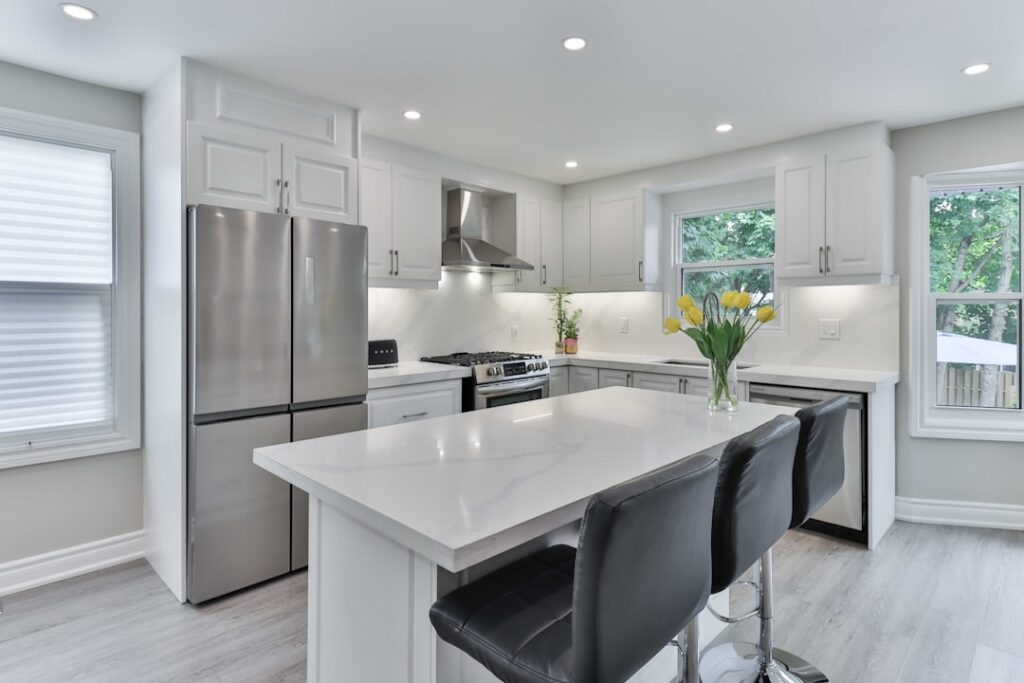
The kitchen used to be a place for ceiling cans and undercabinet strips, period. Then designers started slipping table lamps onto countertops and the look took off. A well-placed small kitchen lamp turns a working surface into a finished room, fills dark corners that recessed lighting cannot reach, and adds the kind of glow that overhead fixtures simply cannot produce. The trick is choosing one that earns its counter real estate. After helping clients pick lamps for kitchens of every size, here is how to find one that works.
Part of our Kitchen Remodeling guide — explore the full guide →
- Why a Lamp on the Counter Makes Sense
- Size and Proportion Rules
- Placement Spots That Work
- Cordless and Rechargeable: A Game-Changer
- Wattage and Bulb Choice
- Style Categories That Fit Real Kitchens
- Practical Considerations
- Lamps for Specific Kitchen Sizes
- Pairing With Other Kitchen Lighting
- Budget Ranges
- Final Lighting Notes
Why a Lamp on the Counter Makes Sense
Three lighting jobs benefit from a small lamp:
- Mood lighting after dinner: Turn off the recessed cans, click on the lamp, and the kitchen reads as a finished room rather than a brightly-lit work zone
- Targeted task light: Coffee bar at 6 a.m., cookbook on the counter, plating station near the stove
- Decorative anchor: Bridges the kitchen to the adjoining dining or living space, especially in open-concept floor plans
Designers consistently call out kitchen lamps as the single highest-impact upgrade in a finished kitchen, dollar for dollar.
Size and Proportion Rules
Counters are working spaces. A lamp that reads as small in a living room can dominate kitchen square footage. Sizing guide:
- Lamp height: 12 to 22 inches. Anything taller crowds upper cabinets. Anything shorter disappears.
- Base diameter: 4 to 7 inches. The lamp footprint should leave at least 8 inches of usable counter on each side.
- Shade width: 8 to 14 inches. A wide drum shade can throw soft light across the counter; a small bell shade reads more decorative.
- Cord length: 6 feet allows flexible placement. Battery and rechargeable lamps eliminate cord routing entirely.
Placement Spots That Work
The right location is as important as the lamp itself. Strong placements:
- Coffee station corner with mugs and the espresso machine
- End of an island or peninsula, where the kitchen meets the living area
- Above a bar cart or a designated bar nook
- On a baker’s rack or hutch that doubles as kitchen storage
- Tucked next to a microwave or a small appliance garage
Avoid placing lamps in active prep zones, near sinks (water and electricity), or directly behind the cooktop where heat and grease accumulate.
Cordless and Rechargeable: A Game-Changer
The single biggest shift in this category is the rechargeable lamp. No outlet required, no cord trailing across the counter. Top performers:
- Hay PC Portable: Iconic Danish design, USB-C charging, 12-hour runtime, $200 to $250
- Menu Carrie LED Lamp: Cleaner modern profile, magnetic charging stand, $250 to $300
- Ikea Pelarboj: Budget option at $30, multi-color, decent runtime
- Anker Lumos Series: Bedside-style rechargeable adaptable for kitchens, $40 to $80
- Pottery Barn Vivian Cordless: Traditional shape with hidden battery, $130 to $180
Charge overnight on a hidden dock and the lamp moves with you wherever it is needed. The cordless category dominates kitchen lamp sales because it solves outlet placement entirely.
Wattage and Bulb Choice
Kitchen lamps work best with warm light, even in modern white kitchens. Look for these specs:
- Color temperature: 2700K to 3000K. Warm and inviting. Skip 4000K (too clinical).
- Lumens: 250 to 600 for ambient glow. Higher lumens for task lighting.
- Bulb type: LED filament bulbs in a clear glass shade look intentional. Frosted globes diffuse softly.
- Dimmable: Always. Pair with an inline dimmer or smart bulb if the lamp does not include one.
Style Categories That Fit Real Kitchens
Modern Sculptural
The Hay PC Portable, Flos Bellhop, and Marset Ginger are clean shapes that read as art. Best for white, light-stained wood, and minimalist kitchens.
Traditional Ceramic
A small ceramic lamp with a linen shade in cream or charcoal works in farmhouse, transitional, and Hamptons-style kitchens. Look at Paloma Pottery, Bunny Williams Home, or Pottery Barn small ceramics in the 14 to 18 inch range.
Industrial Metal
Brass or blackened steel desk-style lamps suit kitchens with exposed beams, butcher block, and dark cabinetry. Schoolhouse Electric and Cedar & Moss carry strong examples.
Vintage Brass
Antique stores yield small Stiffel and Frederick Cooper lamps from the 1960s and 70s for $40 to $150. Rewire if needed and add a fresh shade. The patina works beautifully on a counter.
Practical Considerations
- Choose a lamp shade that does not stain easily (paper shades absorb grease vapors)
- Pick a base material that wipes clean (ceramic, glass, metal preferred over fabric-covered)
- Avoid open-flame style filament bulbs near a cooktop or oven vent
- Keep the lamp cord out of any path you carry hot pans across
- Test lumens at night to confirm the lamp throws useful light, not just decoration
Lamps for Specific Kitchen Sizes
Galley Kitchen Under 100 Square Feet
One small rechargeable lamp on a corner countertop. Nothing larger than 14 inches tall. Cordless preferred to keep counters clean.
Mid-Size Kitchen 100 to 180 Square Feet
One ceramic or modern lamp on the island or peninsula. Add a small under-cabinet plug-in puck if needed elsewhere.
Open-Concept Kitchen Over 200 Square Feet
Two coordinating lamps placed at opposite ends of the working area. They double as visual anchors and ambient light sources for the whole space.
Pairing With Other Kitchen Lighting
The small kitchen lamp does not replace overhead lighting. Layer it with: recessed cans for general task light, undercabinet LED strips for prep work, pendant lights over the island for focal lighting, and the lamp for atmosphere. Each layer serves a different function. The mistake is using only one source.
Budget Ranges
- Big-box affordable options: $25 to $80
- Mid-range design-store lamps: $100 to $300
- Designer rechargeable models: $200 to $500
- Vintage brass refurbished: $40 to $250
Final Lighting Notes
The best small kitchen lamp is the one you will turn on every evening. It does not need to be expensive or rare. It needs to fit the counter, throw a flattering warm glow, and survive the splash and humidity of a working kitchen. Buy with those three priorities in order and the lamp will earn its spot for years.