
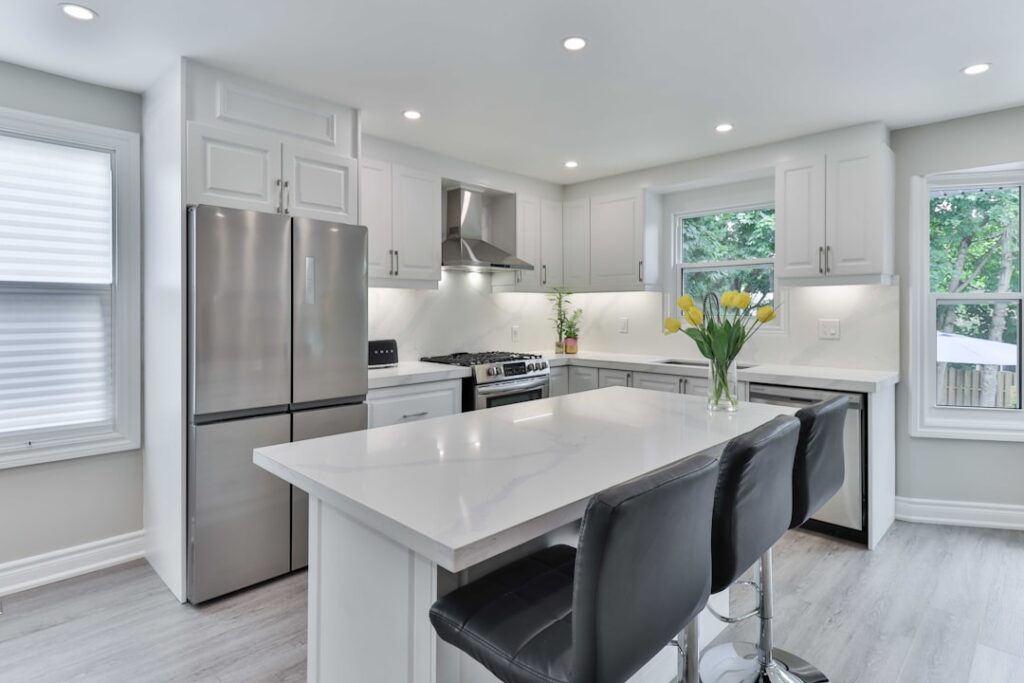
The 90-square-foot galley kitchen in a 1950s Cape Cod has the same square footage as a walk-in closet — and somehow has to hold dishes for four, three sets of cookware, the air fryer your spouse insisted on, and a coffee maker the size of a small refrigerator. Small kitchen shelf ideas are not really about shelves at all. They’re about finding the dead space your current cabinets ignore: the inside of doors, the wall above the sink, the corner where two cabinets meet at a right angle, and the gap between countertop and upper cabinets. Adding storage to these zones can reclaim 30 to 50 percent more usable space without replacing a single cabinet.
Open Shelving Above Counters
Removing one row of upper cabinets and replacing it with open shelves visually doubles the room. Two 8-inch deep wood shelves spanning a 36-inch wall stretch hold roughly the same dish capacity as a single 30-inch upper cabinet but read as half the visual mass.
Use 3/4-inch white oak, walnut, or maple boards for shelves and pair with heavy-duty floating brackets rated for 50 pounds per bracket. Space brackets every 24 to 32 inches. Mount the lower shelf 18 inches above the counter — high enough to clear coffee makers and toasters, low enough to reach plates without a stool.
Corner Shelves
The corner where two walls meet typically holds nothing. A floating triangular corner shelf — 14 inches per side — adds capacity for spice jars, small plants, or olive oil bottles without protruding into walking lanes. Stack three or four shelves vertically for a corner display unit that doubles as functional storage.
L-shaped corner shelves built into the gap between two perpendicular upper cabinets recover 6 to 12 inches of dead space per corner. Custom builds run $80 to $200 in materials.
Under-Cabinet Shelves
The 18-inch gap between countertop and upper cabinets is mostly wasted on most kitchens. A 4-inch deep ledge shelf running the length of the upper cabinets holds spice jars in two rows or single rows of decorative bottles, vinegars, and oils.
Magnetic spice racks mounted to the underside of cabinets keep frequently-used jars accessible without consuming counter or shelf space. Iron-backed magnetic strips run $20 to $40 and hold up to 20 spice jars in the gap directly beneath upper cabinets.
Behind-the-Door Storage
The inside face of upper cabinet doors is one of the most underused zones in any kitchen. Add a wire or wood door-mount shelf rack 4 to 6 inches deep to hold:
- Spices, with each jar visible at a glance
- Plastic wrap, foil, and parchment paper boxes standing upright
- Cutting boards stored vertically
- Pot lids on a vertical-slot organizer
Door-mount racks attach with screws into the cabinet door — verify door thickness (usually 3/4 inch) before buying. Brands like Spectrum Diversified and InterDesign sell racks for $20 to $50 each.
Pull-Out Pantry Shelves
If you have any cabinet 6 inches wide or more between the refrigerator and the wall, a pull-out pantry shelf transforms the gap into usable storage. Pre-built models from Rev-A-Shelf, ClosetMaid, and Hafele run $80 to $300 for 6 to 12 inch widths.
For deeper base cabinets, retrofit pull-out drawer kits convert fixed shelves into roll-out drawers. Each drawer runs $50 to $150 in materials. Two drawers in a 24-inch base cabinet doubles the accessible storage compared to a single fixed shelf 18 inches deep.
Above-the-Refrigerator Shelves
The cabinet above your refrigerator is usually one of the most awkward storage zones in the kitchen — too high to reach, too shallow for most cookware. Replace the cabinet door with open shelving and use the space for items you only access seasonally: holiday serving platters, oversized pots, party glassware.
Or remove the cabinet entirely and install two open shelves at 78 and 90 inches above the floor. The visual lift makes the kitchen feel taller and the items stored there double as decor.
Window Shelves
Glass shelves spanning a kitchen window hold herbs, small plants, and translucent items that catch the light. Install with cup hooks at each side and 1/4-inch tempered glass shelves in 8-inch depths.
Three shelves spanning a 30-inch window provide planting space for nine herb pots — a year-round indoor garden in a footprint that takes zero floor or counter space. Best near a south or east-facing window with at least 4 hours of direct sun.
Vertical Pegboard Walls
French country kitchens have used pegboards for hanging utensils for centuries. A 24-by-48 inch pegboard mounted on an open wall holds pots, pans, utensils, and decorative items on a flexible hook system.
Modern pegboard options range from painted plywood with dowel pegs ($60 in materials) to powder-coated steel grids from brands like Wall Control ($80 to $150). Best mounted at standing height where you can reach hooks without bending or stretching.
Toe-Kick Drawers
The 3 to 4 inch space between the bottom of base cabinets and the floor — the toe-kick — typically holds nothing. Toe-kick drawer kits convert the space into shallow drawers for baking sheets, cooling racks, and cutting boards. Kits run $100 to $250 per drawer with installation by a competent DIYer.
Open Shelf Styling Tips
Open shelves only work if they look intentional. Group like items together — all white plates on one shelf, all glass on another. Leave 30 to 40 percent visible empty space; fully packed shelves read as cluttered. Add one or two natural elements (a small plant, a wooden cutting board) per shelf to break up the dishware.
Match metal finishes throughout. Brass brackets with stainless flatware fight each other visually. Pick one finish and stick with it across shelves, hardware, and faucets for cohesion.
Start with One Zone
Don’t try to redesign all the storage in your small kitchen at once. Pick the zone that frustrates you most — the spice cabinet, the awkward corner, the gap above the fridge — and solve that one. The momentum from a single successful upgrade usually drives the next two or three.


