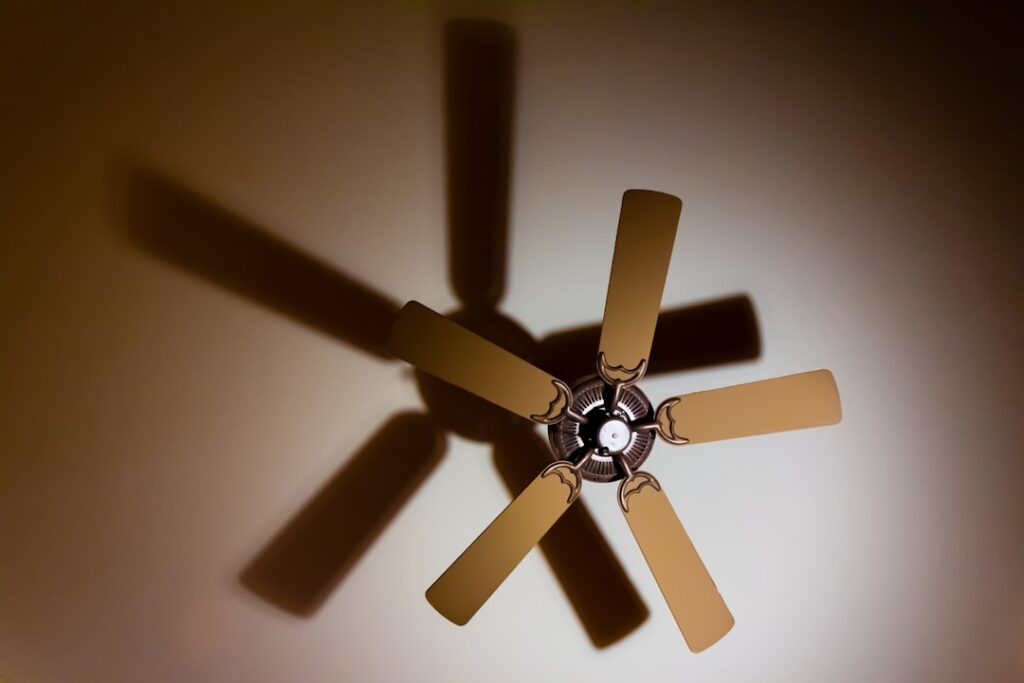
Air conditioning eats roughly 12 percent of the average American home’s electricity, but a ceiling fan sipping 30 watts of free sunlight can make a porch or gazebo feel 4 to 6 degrees cooler at zero operating cost. A solar powered ceiling fan pairs a low-voltage DC fan motor with a photovoltaic panel, giving you moving air anywhere the grid does not reach — pergolas, barns, off-grid cabins, greenhouses, and outbuildings. The catch is that this niche is full of underpowered gimmicks alongside a handful of genuinely capable setups. This guide sorts out the real options, what they cost, and how to size a system that actually moves air.
- How Solar Ceiling Fans Work
- Option 1: Purpose-Built Solar Fan Kits
- Option 2: DC Ceiling Fan Plus Your Own Solar Setup
- Sizing the Panel, Battery, and Fan
- Where Solar Ceiling Fans Shine — and Where They Fall Short
- Installation Notes
- Maintenance and Long-Term Ownership
- Is a Solar Powered Ceiling Fan Worth It?
How Solar Ceiling Fans Work
Every solar ceiling fan is built around a DC motor, usually running at 12 or 24 volts. DC motors are the key enabler: they use 60 to 70 percent less energy than the shaded-pole AC motors in traditional fans, so a modest solar panel can drive them. A typical 52-inch DC ceiling fan draws just 3 watts on low and 25 to 30 watts on high, compared to 60 to 90 watts for an older AC fan.
Systems come in two architectures. Direct-drive setups wire the panel straight to the fan — simple and cheap, but the fan only spins when the sun shines, and speed fluctuates with every passing cloud. Battery-buffered systems put a charge controller and a small lithium (LiFePO4) or AGM battery between panel and fan, delivering steady speed and evening runtime — critical, since the hours right after sunset are exactly when you want porch air moving. For anything beyond a daytime-only greenhouse vent, choose battery-buffered.
Option 1: Purpose-Built Solar Fan Kits
Several manufacturers sell complete kits with fan, panel, wiring, and sometimes battery included. These are the plug-and-play route for gazebos and sheds.
- Sunlar 12V solar ceiling fan kits — typically a 42 to 56-inch fan bundled with a 25 to 40-watt panel, running $110 to $200. Airflow is modest (about 2,000 to 3,500 CFM) but adequate for a 10 by 12 gazebo.
- ECO-WORTHY fan and panel bundles — around $130 to $180 with a 25W panel; a common pick for chicken coops and greenhouses.
- Camping-style hanging fans — small 12 to 16-inch fans with clip-on panels for $40 to $80. Fine inside a tent, nowhere near enough for a patio.
Check the CFM rating before buying. Anything under 2,000 CFM will disappoint outdoors, where breeze competition and open sides dilute the effect. Also confirm the fan is damp-rated or wet-rated for outdoor mounting; many budget kits are indoor-grade motors in outdoor marketing.
Option 2: DC Ceiling Fan Plus Your Own Solar Setup
The higher-performance route is to buy a quality low-voltage DC ceiling fan and power it from a small dedicated solar system. This is how off-grid cabin owners get full-size, full-power fans. A 52-inch 12V DC fan moving 5,000+ CFM pairs with a 50 to 100-watt panel ($60 to $100), a 10-amp MPPT charge controller ($25 to $60), and a 12V 20Ah LiFePO4 battery ($70 to $120). Total system cost lands between $350 and $600 and runs the fan day and night indefinitely in sunny climates.
If you already have an off-grid battery bank with an inverter, simpler still: buy any premium DC-motor ceiling fan designed for AC household wiring — a Hunter Trimaran or Minka-Aire Xtreme, for example — and run it off the inverter. Because DC-motor fans draw so little, even a modest inverter system barely notices a 30-watt load. An efficient 60-inch model can move 7,000 CFM on 35 watts, which is genuinely whole-room cooling on about the power of a single old incandescent night-light circuit.
Sizing the Panel, Battery, and Fan
Match three numbers: fan wattage, daily runtime, and sun hours. A worked example makes it concrete. Say you want a 25-watt fan running 10 hours a day — 250 watt-hours daily. In a location averaging 5 peak sun hours, a 100-watt panel produces roughly 400 to 500 usable watt-hours after system losses, comfortably covering the load with margin for cloudy days. A 12V 20Ah battery stores 256 watt-hours, buying you a full day of autonomy.
For fan sizing itself, the standard rules apply: rooms or covered areas up to 75 sq ft take a 29 to 36-inch fan; 76 to 175 sq ft takes 42 to 48 inches; 176 to 350 sq ft takes 52 to 56 inches; larger spaces need 60 inches or multiple fans. Mount blades 8 to 9 feet above the floor where possible and keep tips at least 18 inches from posts or walls. In open-air structures, size up one bracket — ambient breezes and the lack of walls mean you need more CFM to feel the same effect.
Where Solar Ceiling Fans Shine — and Where They Fall Short
Best-fit applications are unwired outdoor structures where trenching electrical conduit would cost $500 to $2,000: pergolas, gazebos, detached patios, pool cabanas, barns, stables, and greenhouses. They are also a favorite for hunting cabins and workshops beyond the grid, and for anyone who wants hurricane-season backup airflow independent of the utility.
Limitations are real, though. Direct-drive fans stall under clouds and stop at dusk. Panel placement matters enormously — a panel shaded by the very roof the fan hangs from is the most common installation blunder; run the included cable (usually 15 to 20 feet) to a south-facing spot with clear sky. And no ceiling fan, solar or otherwise, lowers air temperature; fans cool people through evaporative effect, so running one in an empty gazebo accomplishes nothing. In humid Gulf states, expect the perceived cooling to be closer to 3 to 4 degrees rather than the 6 degrees you might feel in dry climates.
Installation Notes
Mounting a solar fan follows normal ceiling fan practice: a fan-rated box or sturdy structural mount, not a plastic light box. In gazebos, lag a mounting block to the ridge beam or use a hook-mount designed for the fan’s weight — most solar fans are light, 8 to 15 pounds versus 20 to 50 for household fans, which simplifies things. Route panel wiring away from foot traffic, use the polarity-marked connectors (reversing DC polarity can damage cheap motors), and fuse the battery positive lead at 10 amps. In wet climates, add a drip loop where cable enters any junction and choose tinned-copper wire near the coast. Total install time for a kit is about an hour; a battery-buffered custom system takes a half day.
Maintenance and Long-Term Ownership
Upkeep on a solar fan system is minimal but not zero, and the panel is where most performance loss hides. Dust, pollen film, and bird droppings can cut panel output 15 to 25 percent, which on a marginal direct-drive system is the difference between a fan that spins and one that twitches. Wipe the glass with water and a soft brush every couple of months — more often during pollen season or near gravel roads. Check that nothing has grown into the panel’s sun window; a tree branch that was clear in April can shade the array by July, and partial shade hits output far harder than most owners expect.
Batteries are the one consumable. A LiFePO4 pack cycled daily typically delivers 2,000 to 3,500 cycles — call it six to ten years — while cheaper AGM batteries fade noticeably after two to three years of daily deep cycling. Two habits stretch battery life: keep the charge controller’s low-voltage disconnect enabled so the fan cannot flatten the pack overnight, and bring small batteries indoors or into an insulated box where winters drop below 20°F, since lithium cells must not be charged below freezing. On the fan itself, tighten blade screws once a season (vibration loosens them on lightweight outdoor mounts), blow dust out of the motor housing, and inspect outdoor wire runs for UV-cracked insulation every spring. Ten minutes of attention twice a year is genuinely all a well-built system asks.
Is a Solar Powered Ceiling Fan Worth It?
Run the comparison honestly. If a structure already has power, a standard DC ceiling fan costing $150 to $300 and pennies a month to run is the better buy — solar only wins where wiring does not exist. But for an unwired gazebo, a $180 kit versus a $1,200 electrician trench is a decisive victory for the solar powered ceiling fan, paying for itself before the first electric bill would even arrive. Choose a battery-buffered system with at least 3,000 CFM for outdoor comfort, put the panel in true full sun, and you will get a decade of silent, free airflow with the only maintenance being an occasional panel wipe-down and a battery swap around year eight.