Fire codes in most US municipalities require a fire pit to sit at least 10 feet from any structure, fence, or overhanging branch, and that single rule shapes almost every good backyard layout. A square patio with fire pit at the center is one of the most efficient ways to meet that clearance while creating a defined, symmetrical gathering space that seats six to eight people comfortably. The clean geometry works with modern and traditional homes alike, and a square is far easier to lay out and build than curves or circles. This guide walks through the right dimensions, seating clearances, materials, real costs, and layout ideas so your project looks designed rather than improvised.
The Right Size for a Square Fire Pit Patio
Size is where most DIY patios go wrong. People build too small, then discover the chairs barely fit. A 44-inch-diameter fire pit, which is average, needs at least 7 feet of clear space around it for chairs and walking room. That math points to a minimum patio of 16×16 feet, with 18×18 or 20×20 feet being far more comfortable.
- 14×14 feet: Tight but workable for a small pit and four chairs. Best for compact yards.
- 16×16 feet: The sweet spot for most families. Fits a 40-inch pit plus six chairs with room to pass behind them.
- 18×18 to 20×20 feet: Generous. Handles eight chairs, a walkway, and a side table without feeling crowded.
Center the fire pit in the square and you get equal clearance on all four sides, which is the whole point of the symmetrical shape. Leave a minimum of 3 feet between the pit edge and the front edge of any chair so knees stay a safe distance from the flame.
Seating Clearances You Cannot Ignore
Comfortable fire pit seating follows a predictable formula. From the center of the pit to the seating, allow roughly 5.5 to 6 feet. Behind the chairs, leave 3 feet for a walking path so guests are not squeezing past the fire. If you plan to add a wall or built-in bench, remember that people need about 24 inches of seat depth and 18 inches of standing space to get in and out.
For a 16-foot square with a 40-inch pit centered, you end up with about 6.3 feet from pit center to patio edge, which comfortably absorbs a chair plus a partial walkway. That is why 16×16 keeps coming up as the practical minimum.
Materials and What They Cost
Your patio surface and your pit are two separate budget lines. Here is what typical choices run installed or as DIY materials in most US markets:
- Concrete pavers: The DIY favorite. Expect $3 to $6 per square foot in materials, so a 16×16 patio (256 sq ft) runs $770 to $1,540 in pavers plus $150 in base gravel and sand.
- Poured concrete: $6 to $12 per square foot installed by a contractor, or roughly $1,500 to $3,000 for a 16-foot square.
- Natural flagstone: $15 to $30 per square foot installed. Beautiful but pricey and harder to lay in a crisp square.
- Gravel: The budget option at under $1 per square foot, though it shifts and is harder to set chairs on.
For the pit itself, a prefab steel bowl runs $150 to $400, a gas insert kit $300 to $900 plus a propane or natural-gas line, and a DIY stacked-block wood-burning pit about $200 in retaining-wall blocks and fire brick.
Wood-Burning Versus Gas
Wood-burning pits deliver the crackle and bigger flames people picture, and they cost the least to build, but they produce smoke, sparks, and ash you must clean out. Gas pits light instantly, throw no sparks, and let you cook nothing but marshmallows over ceramic logs, but they need a fuel line and cost more up front. In drought-prone or fire-restricted areas, gas is often the only legal option during burn bans, so check local rules before you commit.
Layout Ideas for a Square Patio With a Fire Pit
The square shape gives you flexibility that circles do not. A few configurations that consistently look polished:
- Corner accent: Set the square off one corner of the yard with an L-shaped built-in bench along two sides, opening the other two to lawn views.
- Framed border: Lay the field pavers in a running-bond pattern, then edge the perimeter with a contrasting soldier course of the same paver on end for a picture-frame effect.
- Pergola overhead: A pergola centered over a gas pit adds vertical interest and string-light support, but never build a solid roof over a wood fire.
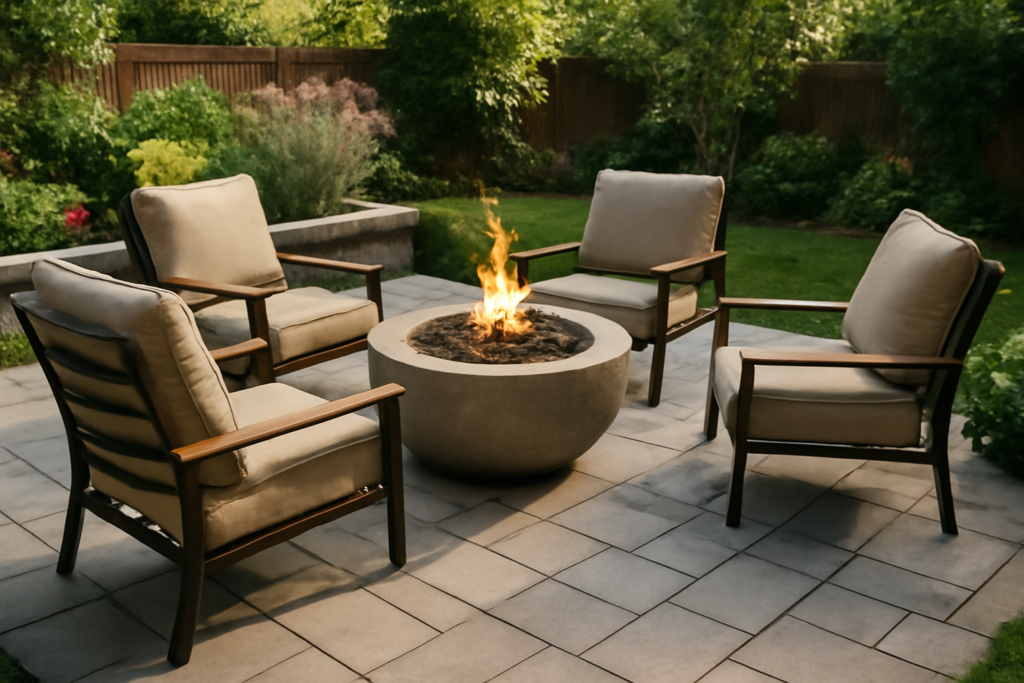
- Four-chair symmetry: Place one chair or loveseat on each side of the centered pit for a formal, balanced look that suits the geometry.
- Sunken square: Drop the patio 12 to 18 inches below grade with a low surrounding wall to create an intimate conversation pit.
Building It: Base and Drainage Basics
A patio is only as good as its base. Excavate 7 to 9 inches deep, then build up with a 4 to 6-inch layer of compacted crushed stone (called Class 5 or 21A gravel), followed by an inch of leveling sand. Slope the whole surface away from the house at a quarter inch per foot so rain drains off. Skimp on the base and pavers will heave and rock within a year. Run a plate compactor over the gravel in 2-inch lifts, renting one for about $60 a day, rather than trusting a hand tamper on a patio this size.
Keep the fire pit on a non-combustible footing. If you place a steel bowl on pavers, set a fire-resistant pad or an extra course of concrete beneath it, because sustained heat can crack and discolor standard pavers directly under the flames.
Safety Rules That Keep the Fun Going
Maintain the 10-foot clearance from structures and overhanging trees. Keep a garden hose or a full bucket of water within reach. Never use gasoline or lighter fluid to start or revive a fire. On gas pits, install the burner with a listed safety shutoff and keep the connection accessible. And check wind before lighting; a gusty evening pushes sparks and smoke straight into seating.
Frequently Asked Questions
How big should a square patio be for a fire pit?
Aim for 16×16 feet as a practical minimum for a centered pit and six chairs. Go to 18×18 or 20×20 feet if you entertain larger groups or want a walking path behind the seating.
How far should a fire pit be from the house?
At least 10 feet from any structure, fence, or overhanging branch is the common code requirement. Some jurisdictions require 15 to 25 feet, so confirm with your local fire department before building.
Can I put a fire pit directly on pavers?
You can, but add a heat shield or an extra course of fire brick beneath a wood-burning pit. Prolonged high heat can crack, spall, or discolor standard concrete pavers placed directly under the flames.
What is the cheapest way to build a square fire pit patio?
Compacted gravel patio with a DIY stacked-block wood pit is the lowest cost, often under $700 for a 16-foot square. Concrete pavers with the same pit land around $1,000 to $1,500 and are far more comfortable underfoot.
A square patio with a fire pit rewards planning up front. Get the size right at 16 feet or larger, respect the 10-foot clearance and seating distances, build a properly compacted base, and choose materials that fit your budget and fuel type. Do that, and you end up with a symmetrical, low-maintenance gathering space that anchors the backyard for years.