
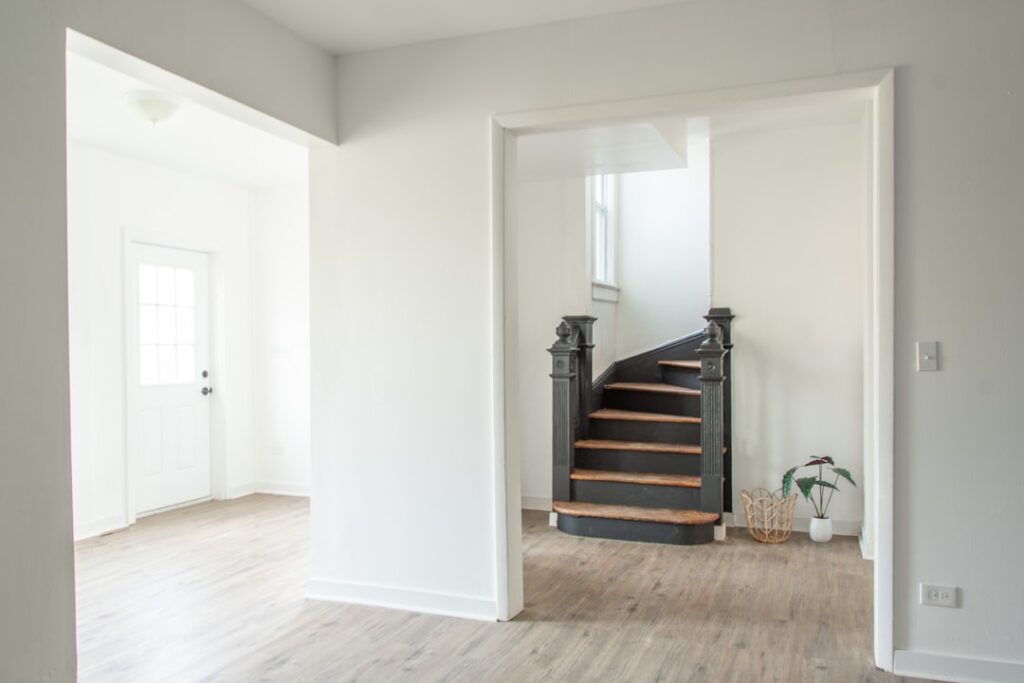
Choosing the right stair flooring options is more complex than selecting flooring for a flat room. Stairs must handle concentrated foot traffic on small surfaces, meet safety requirements for slip resistance, accommodate nosing and bullnose details, and look good from multiple angles since stairs are often a focal point of the home.
This guide compares the five best stair flooring materials — hardwood, luxury vinyl plank, carpet runners, tile, and laminate — covering cost per step, safety, DIY difficulty, appearance, and installation considerations unique to staircases.
Hardwood Stairs: The Classic Choice
Hardwood is the gold standard for stair flooring. It is durable, beautiful, refinishable, and adds significant resale value. The warmth and natural grain of real wood on a staircase creates a timeless look that works in virtually every home style — from colonial to contemporary.
Best species for stairs: White oak and red oak are the most popular choices. Their hardness ratings (1,290 to 1,360 Janka) handle the concentrated foot traffic that stair treads endure. Hickory (1,820 Janka) is even more durable and hides wear well with its bold grain. For more on species selection, see our hardwood flooring guide.
Cost per step: $50 to $150 per step for materials and professional installation, depending on species, tread width, and whether you are using pre-made stair treads or custom-milled pieces. For a typical 13-step staircase, budget $650 to $1,950 total.
DIY difficulty: Moderate to difficult. Cutting stair treads to fit, mitering returns, installing risers, and achieving a professional finish requires woodworking skills and precision tools (miter saw, router, nail gun). This is not a beginner project.
Pros: Timeless beauty, refinishable multiple times, highest resale value, durable for decades.
Cons: Most expensive option, professional installation recommended, can be slippery without a finish or runner.
LVP Stairs: Budget-Friendly Modern Option
Luxury vinyl plank on stairs has become increasingly popular as LVP manufacturers now offer matching stair nosing profiles. The wood-look appearance, waterproof properties, and low cost make LVP an attractive alternative to hardwood for budget-conscious homeowners. Learn more in our LVP flooring guide.
Cost per step: $25 to $75 per step for materials and installation. Stair nosing pieces cost $15 to $40 each. For a 13-step staircase, budget $325 to $975 total — roughly half the cost of hardwood.
DIY difficulty: Moderate. LVP on stairs requires adhesive application (unlike click-lock floor installation), careful cutting, and proper nosing installation. Each step must be individually measured and cut. It is slower than flat-floor LVP installation but manageable for experienced DIYers.
Installation method: LVP on stairs is always glued down — floating installation does not work on steps. Apply construction adhesive to the tread surface, press the LVP plank into place, and finish with a matching stair nosing at the front edge of each step. The nosing is critical for both appearance and safety.
Pros: Affordable, waterproof, realistic wood looks, easy to clean, good for homes with pets and children.
Cons: Not refinishable, less prestigious than hardwood, nosing profiles can look obviously synthetic, 15 to 20 year lifespan.
Carpet Runner Stairs: Comfortable & Safe
A carpet runner on wood or painted stairs combines the beauty of a hard-surface stair with the comfort and safety of carpet. The runner covers the center of each tread while the finished wood edges remain visible — creating a layered, designer look. Visit our carpet flooring guide for more on carpet options.
Cost per step: $30 to $100 per step for a quality wool or nylon runner, professionally installed with a pad. DIY installation with stair rods costs less. For a 13-step staircase, budget $390 to $1,300 total.
DIY difficulty: Easy to moderate. Hollywood-style (wrapped) installation is professional territory, but a flat runner secured with stair rods is a manageable DIY project. Runners can also be secured with carpet tack strips along the tread edges.
Best runner materials:
- Wool — Durable, naturally stain-resistant, ages beautifully. The premium choice at $8 to $30 per linear foot.
- Nylon — Very durable, stain-resistant, more affordable at $4 to $15 per linear foot.
- Polypropylene (olefin) — Budget-friendly at $3 to $8 per linear foot, but less durable and can look flat over time.
- Sisal/jute — Natural fiber, visually appealing, but rough on bare feet and difficult to clean. Best for low-traffic or decorative stairs.
Pros: Excellent slip resistance, reduces noise, comfortable underfoot, adds visual interest, protects wood treads underneath.
Cons: Shows wear patterns in center, needs replacement every 5 to 10 years, traps dust and allergens, not waterproof.
Tile Stairs: Durable & Distinctive
Tile on stairs is common in Mediterranean, Spanish, Southwestern, and modern designs. Porcelain tile is the best choice for stair applications due to its hardness, low water absorption, and slip-resistant options.
Cost per step: $75 to $200 per step for materials and professional installation. Decorative tile risers (patterned or handpainted) can push costs higher. For a 13-step staircase, budget $975 to $2,600 total.
DIY difficulty: Difficult. Tile stair installation requires precise cuts (including bullnose nosing cuts), thin-set application on vertical risers that fight gravity, and grouting on multiple planes. This is one of the most challenging tile applications and is strongly recommended for professionals.
Design opportunity: One popular approach is pairing plain tile treads with decorative patterned tile risers. Since risers are vertical and not walked on, you can use decorative ceramic tiles (Talavera, encaustic, Moroccan-inspired patterns) that would be too delicate for floors. This creates a stunning staircase at moderate cost since the decorative tile is used only on the smaller riser surfaces.
Pros: Extremely durable, distinctive design options, easy to clean, water-resistant, long lifespan.
Cons: Cold and hard underfoot, slippery unless textured/rated for slip resistance, very difficult to install, expensive, loud (no sound absorption).
Laminate Stairs: Affordable Alternative
Laminate offers a wood look at the lowest hard-surface price point. Most laminate manufacturers sell matching stair nosing pieces, making full staircase installation possible.
Cost per step: $20 to $60 per step. Laminate stair nosing costs $10 to $30 each. For a 13-step staircase, budget $260 to $780 total.
DIY difficulty: Moderate. Similar to LVP — each tread requires adhesive, precision cutting, and nosing installation. The main challenge is cutting laminate cleanly (a miter saw produces the best results; a utility knife does not work on laminate like it does on LVP).
Pros: Very affordable, wide range of wood-look designs, reasonably durable for moderate traffic.
Cons: Not waterproof, not refinishable, nosing profiles can look plastic, wear layer is thinner than LVP, slippery on stairs. For more details, check our flooring installation guide.
Full Comparison Table
| Factor | Hardwood | LVP | Carpet Runner | Tile | Laminate |
|---|---|---|---|---|---|
| Cost per step | $50 – $150 | $25 – $75 | $30 – $100 | $75 – $200 | $20 – $60 |
| 13-step staircase | $650 – $1,950 | $325 – $975 | $390 – $1,300 | $975 – $2,600 | $260 – $780 |
| Lifespan | 30 – 50+ years | 15 – 20 years | 5 – 10 years | 30 – 50+ years | 10 – 15 years |
| Slip resistance | Moderate | Good | Excellent | Varies (choose rated) | Low to moderate |
| Noise reduction | Moderate | Good | Excellent | Low | Moderate |
| Refinishable | Yes (multiple times) | No | N/A (replace) | No | No |
| Waterproof | No | Yes | No | Yes | No |
| DIY difficulty | Hard | Moderate | Easy-Moderate | Very hard | Moderate |
| Resale value | Excellent | Good | Good | Good | Fair |
Nosing & Bullnose Requirements
Every stair tread needs a nosing — the rounded, slightly protruding front edge that extends past the riser below. Nosing serves two critical functions: it provides a clear visual definition of each step edge (safety) and it creates a comfortable transition for your foot as it rolls from riser to tread.
Nosing types by material:
- Hardwood nosing: Milled from solid wood to match the tread. Available as flush nosing (same thickness as the tread) or overlap nosing (slightly thicker, lips over the tread edge). Custom profiles are available from millwork shops.
- LVP nosing: Manufacturer-specific profiles that match the LVP color and texture. Typically a rigid PVC or aluminum piece with a color-matched vinyl cap. Available in flush-mount and overlap styles.
- Tile bullnose: A tile with one rounded, finished edge. Available as a standard bullnose (radius on one edge) or double bullnose (radius on two edges). Not all tile lines include bullnose pieces — verify availability before purchasing.
- Laminate nosing: Similar to LVP — a color-matched molding piece. Usually available from the same manufacturer as the laminate planks.
Building code note: Most building codes require a nosing projection of 3/4 inch to 1-1/4 inches beyond the riser face. Uniform nosing depth on every step is also required — inconsistent nosing is a tripping hazard. Check your local code before installation.
Safety & Slip Resistance
Stairs are the most dangerous surface in most homes. Falls on stairs send hundreds of thousands of people to emergency rooms every year. Slip resistance should be a primary consideration when choosing stair flooring.
Slip resistance ranking (best to worst):
- Carpet / carpet runner — Best grip, most forgiving surface for falls.
- Textured LVP — Embossed wood-grain texture provides good grip; better than smooth surfaces.
- Wire-brushed or hand-scraped hardwood — Texture improves grip vs smooth hardwood.
- Textured/anti-slip tile — Rated slip-resistant tile (R10 or higher) is safe; smooth glazed tile is dangerous on stairs.
- Smooth hardwood (polyurethane finish) — Slippery when wearing socks; improved with matte finish.
- Laminate — Smooth surface with less texture; can be slippery, especially in socks.
Safety improvements:
- Add non-slip adhesive stair treads (transparent grip strips) to any hard-surface stair.
- Add a carpet runner to hardwood, tile, or laminate stairs for improved grip and fall cushioning.
- Choose matte or satin finishes over high-gloss for any hard surface.
- Ensure adequate stairwell lighting — poor visibility is a major fall risk factor.
- Install handrails on both sides if the staircase is wide enough (code typically requires at least one).
Frequently Asked Questions
What is the best flooring for stairs?
Hardwood is the overall best choice for stairs — it is durable, beautiful, refinishable, and has the highest resale value. For budget-conscious homeowners, LVP offers a wood look at roughly half the cost. For maximum safety and comfort, a carpet runner over hardwood combines the best of both worlds.
How much does it cost to floor a staircase?
For a standard 13-step staircase: hardwood costs $650 to $1,950, LVP costs $325 to $975, carpet runner costs $390 to $1,300, tile costs $975 to $2,600, and laminate costs $260 to $780. These include materials, nosing, and professional installation.
Can I put vinyl plank on stairs?
Yes. LVP is glued directly to each stair tread (not floated like on flat floors), and matching stair nosing pieces finish the front edge. Most major LVP brands now offer stair nosing in their collections. The result is a clean, wood-look staircase that is waterproof and affordable.
Is carpet or hardwood better for stairs?
Carpet is safer and quieter; hardwood is more durable and has higher resale value. The best compromise is hardwood stairs with a carpet runner — you get the durability and beauty of wood with the safety and noise reduction of carpet. The runner can be replaced inexpensively when it wears out.
Do I need stair nosing?
Yes. Stair nosing is required by most building codes (typically 3/4″ to 1-1/4″ projection). Beyond code compliance, nosing is critical for safety — it defines the edge of each step visually and provides a comfortable transition for your foot. Never install flooring on stairs without proper nosing.
Can I install stair flooring myself?
LVP, laminate, and carpet runners are manageable DIY projects with moderate skill. Hardwood stair installation requires woodworking experience and precision tools. Tile stair installation is the most difficult and is strongly recommended for professionals. Regardless of material, take extra care with measurements — stairs are unforgiving of cutting errors.
Prefer to explore on your own?
See how new flooring looks in your actual room in seconds — free, no signup.
Try the free Floor Studio →

