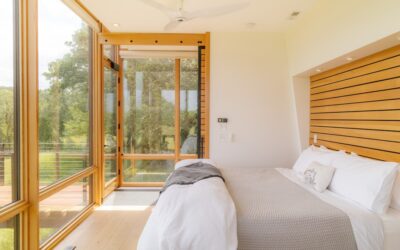
A well-designed three season porch gives you roughly eight usable months in most of the US — April through November across Zones 5 and 6, even longer in milder climates. It costs about half of a full four-season addition because it skips insulation code requirements and expensive HVAC tie-ins. Done right, it reads as an extension of your living room from spring to late fall, then shuts down gracefully for winter. Done wrong, it becomes a musty, mosquito-filled box nobody uses after Memorial Day.
Understand What Separates Three from Four Seasons
The practical difference comes down to insulation and conditioning. A three-season room has uninsulated or lightly insulated walls, single-pane or basic dual-pane windows, and no permanent heating or cooling system tied to the home’s HVAC. It relies on natural ventilation and occasional space heaters or portable AC units. Because it is not conditioned year-round, building codes in most jurisdictions allow lighter construction and smaller footings.
A four-season room is, by code, treated as living space: R-19 to R-21 walls, R-38 to R-49 ceiling, low-E glass, and a sized HVAC zone. That pushes the cost from roughly $150 to $250 per square foot for three-season up to $300 to $500 per square foot for four-season construction in 2026 dollars.
Choose the Window System Carefully
Windows define the porch experience more than any other decision. There are three practical options:
- Screened with vinyl window panels: Companies like Eze-Breeze or Sunspace sell four-track vertical sliding panels that let you switch between full screen and vinyl glazing. Price runs $40 to $60 per square foot installed. They shed rain and cut wind but are not airtight.
- Combination storm windows: Traditional three-track aluminum storms with integrated screens. Budget option at $25 to $40 per square foot. They seal better than Eze-Breeze but look dated.
- True operable casement or awning windows: Pella, Marvin, or Andersen dual-pane windows installed in framed openings. Most expensive at $70 to $120 per square foot installed but give you the best draft control and longest season extension.
Most homeowners land on Eze-Breeze style panels because the open-air feel in summer is the whole point of a porch. If you want to push deep into December, go with real windows.
Pick Flooring That Handles Temperature Swings
A three season porch sees temperature swings from 30°F to 95°F and humidity shifts from 30 to 90 percent. Solid hardwood will cup and gap; engineered hardwood only slightly better. The flooring types that actually last:
- Porcelain tile: Indestructible, dimensionally stable, and handles cold. Budget $7 to $15 per square foot installed. Use an uncoupling membrane like Schluter Ditra over the subfloor to prevent cracks from deck movement.
- Luxury vinyl plank (rigid core SPC): Good down to about 20°F storage temperature. Check the spec sheet — some brands warranty for three-season use, others do not. Expect $4 to $8 per square foot.
- Composite decking brought indoors: Trex or TimberTech installed with hidden fasteners over sleepers. Works well if the porch has a traditional decking look and slight slope. About $12 to $18 per square foot installed.
- Stained concrete: If the porch sits on a slab, acid-stain and seal the concrete for the cheapest finished floor at $4 to $8 per square foot.
Frame the Walls for Long-Term Durability
Skip the temptation to build with 2×4 studs on 24-inch centers just because code allows it for unconditioned space. Use 2×6 walls on 16-inch centers. The upgrade adds perhaps $400 to a typical 12×16 porch and gives you three benefits: a beefier wall cavity for future insulation if you convert to four-season, enough depth to hide wiring runs, and a wider sill plate that feels more substantial under windows.
Roof framing should use 2×10 rafters minimum or engineered I-joists, pitched at least 4:12 for snow load and drainage. Cathedralize the ceiling with tongue-and-groove cedar or pine boards at $3 to $5 per square foot — it is one of the single best aesthetic upgrades for the money.
Plan Heating and Cooling Realistically
Because a three season porch is not conditioned year-round, your options are portable or zoned. A good formula: 20 BTU per square foot for cooling, 30 BTU per square foot for shoulder-season heating. A 200-square-foot porch needs a 4,000 BTU cooler, which a $150 window unit handles easily.
For heat, a wall-mounted electric infrared heater from Bromic or Dr. Infrared Heater at $200 to $400 warms bodies rather than air — perfect for porches with imperfect seals. A propane patio heater works too but produces moisture that can fog windows. Avoid kerosene heaters indoors.
If budget allows, a ductless mini-split head costs $3,500 to $5,500 installed and extends your usable season to 10 months. Some homeowners install a mini-split and never convert to four-season because the porch already performs that well.
Budget Every Line Before You Break Ground
A 12×16 (192 square feet) three-season porch in the Midwest in 2026 typically breaks down like this: footings and deck structure $5,000 to $8,000, framing and roofing $8,000 to $12,000, window system $10,000 to $18,000, flooring $1,500 to $3,000, electrical $1,800 to $3,000, finishes and trim $2,500 to $4,500. Total: $28,000 to $48,000, depending on window choice and finish level.
Expect permits to cost $300 to $1,200 in most jurisdictions. Factor 10 to 15 percent contingency for rot discoveries if you are converting an existing deck.
Maintain It So It Lasts Thirty Years
The enemies of a three-season porch are water, UV, and skipped inspections. Re-caulk window perimeters every five years with a high-grade sealant like OSI Quad Max. Rinse screens in late spring. Inspect the deck structure annually for standing water against ledger boards. If you see dark stains on the house siding below the roofline, check flashing immediately — that is the number one failure point on porch additions. With steady upkeep, you get a room the whole family uses from the first daffodils to the last fallen oak leaf.