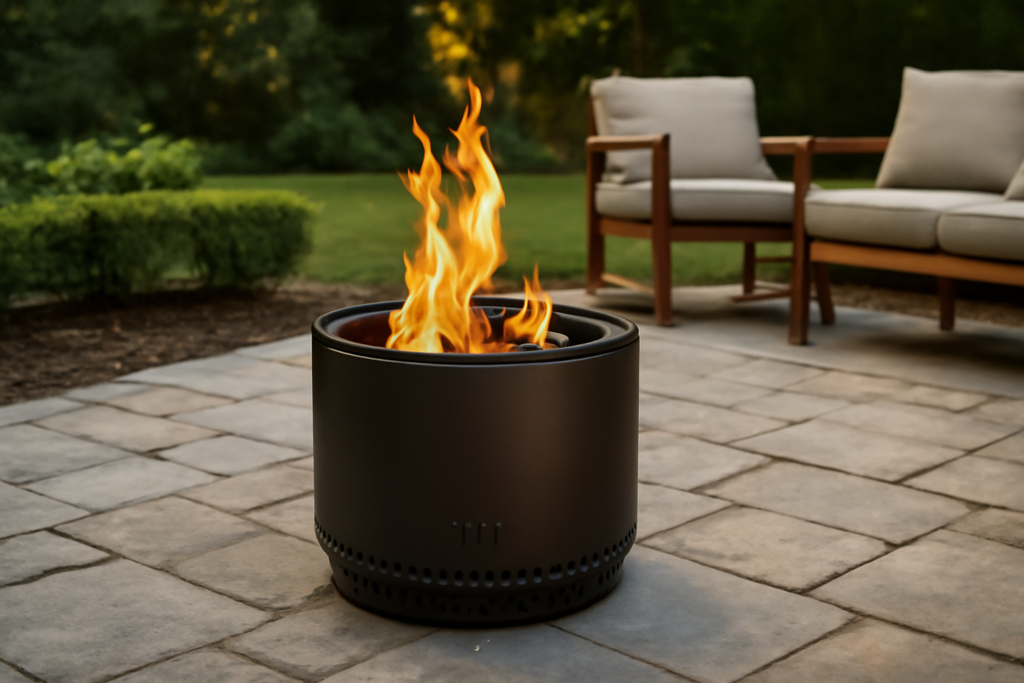
Backyard fires have one universal problem: the smoke finds you, follows you around the circle, and sends everyone inside smelling like a campground. The tiki brand patio smokeless fire pit attacks that problem with double-wall secondary combustion — the same principle behind Solo Stove’s rise — wrapped in a design that looks more like patio furniture than a steel drum. TIKI, the company best known for citronella torches, entered the fire pit market with a distinctive squared silhouette, a removable ash pan, and a wood-pellet quick-start system, and the result is one of the more livable smokeless pits you can buy for around $300-$400.
How the Smokeless Design Actually Works
“Smokeless” is engineering, not magic. The pit’s body is a double-walled stainless and powder-coated steel shell. Cool air enters through vents at the base; part of it feeds the fire from below through the perforated interior floor, while the rest rises between the walls, heating as it climbs. That preheated air jets out of a ring of holes just below the rim, directly into the smoke column. Smoke is mostly unburned fuel — particulates and combustible gases — and hitting it with a curtain of hot oxygen ignites it in a secondary burn before it can escape.
The visible payoff is a clean, tall flame with the rim jets producing the characteristic “dancing” secondary flames, and smoke output cut by a large majority once the fire reaches temperature. Two honest caveats apply to every pit in this category, TIKI included: the first 10-15 minutes of a cold start still smoke while the walls heat up, and wet or green wood overwhelms secondary combustion entirely. Dry, seasoned hardwood under 20 percent moisture is the price of admission to smokeless performance.
Design and Build: What Sets TIKI Apart
Most smokeless pits are cylinders; TIKI’s flagship Patio Fire Pit is a rounded square, roughly 25 inches across and 19 inches tall, with a stainless burn chamber inside a weather-resistant powder-coated shell and a wide, flat rim. It reads as a deliberate furniture piece on a patio rather than shop equipment, and the rim gives marshmallow roasters somewhere to steady a skewer. At about 45 pounds it is a two-person move but stays put in wind.
The feature that owners praise most is the removable ash pan. Cylinder pits without one make you tip the entire hot-or-cold unit over to dump ash — awkward at 30-plus pounds. TIKI’s pan slides out from the base and dumps in seconds, which materially changes how often the pit gets cleaned and therefore how well it breathes. A rain-blocking lid ships with several bundle configurations, and TIKI sells a stand for use on combustible decks (still pair it with a heat shield mat on wood or composite surfaces — the base runs hot enough to matter).
Fuel: Cordwood or Pellet Packs
TIKI’s second differentiator is dual-fuel flexibility. The pit burns standard seasoned cordwood — 12- to 16-inch splits stacked loosely to keep the floor vents clear — like any smokeless unit. It also accepts TIKI’s proprietary wood pellet packs: paper-wrapped bundles of hardwood pellets with an integrated starter that light with a single match and burn 30-45 minutes with minimal ash and near-zero fuss. Pellet packs cost roughly $6-$10 each, which is expensive per hour versus cordwood but genuinely convenient for a quick weeknight fire with no wood pile, no kindling, and no smoke even during startup.
Most owners settle into a hybrid pattern: pellet pack as a fast starter, cordwood on top for a long evening. Whatever the fuel, resist overfilling — stacking wood above the secondary air holes defeats the whole system and brings the smoke back. The visual cue is simple: keep the fuel below the ring of rim jets.
Performance in Real Use
Heat output is strong and directional in the way all deep-bowl smokeless pits are: intense above and around the rim, moderate at seated distance. A circle of chairs at 3-4 feet is comfortable in fall temperatures; in genuine cold, deep pits lose to open shallow bowls because the flame sits below the rim. Burn efficiency is excellent — a typical evening’s fire consumes wood faster than an open pit (secondary combustion eats fuel) but leaves remarkably little ash, often a cup or two from a three-hour burn, and the ash pan makes disposal trivial.
On the smoke promise itself, performance matches the category leaders: once hot, with dry wood, you can sit downwind in ordinary clothes and not smell like a bonfire afterward. Sparks are moderate; a screen accessory is worth it under trees or near structures. The powder-coated shell holds up well but is not invincible — leave the pit uncovered through a wet winter and surface rust will find seams and fastener points, as with every steel pit. The included or add-on cover and a dry storage spot in the off-season are the difference between a 3-year and a 10-year appearance.
Price and the Solo Stove Question
The Patio Fire Pit typically retails around $325-$395, with frequent sales into the $250-$300 band, putting it head-to-head with Solo Stove’s 19.5-inch Bonfire (roughly $250-$400 depending on bundle) and below the 27-inch Yukon ($500-$700). Against the Bonfire, TIKI offers a larger burn area, the ash pan, the pellet-pack system, and a more furniture-like look; Solo counters with lighter weight (the Bonfire is about 23 pounds and portable), a huge accessory ecosystem, 304 stainless throughout, and stronger resale recognition. Breeo’s smokeless pits add sear-plate cooking at a higher price and weight.
The decision splits cleanly on use case. Campers and tailgaters should buy the lighter Solo. Homeowners parking a pit permanently on a patio — the actual product name is telling — are the buyers TIKI designed for, and for them the ash pan alone wins many comparisons. Budget shoppers should note that sub-$150 smokeless clones exist at big-box stores; they burn acceptably but use thinner steel and rarely include ash management.
Accessories and the Rest of the Lineup
TIKI has built out the platform since launch. The weather cover and stand are the two accessories most owners should treat as standard equipment, and a spark screen earns its keep under trees. A grilling grate turns the pit into a capable open-fire cooker — secondary-combustion pits burn hot and clean, which is exactly what you want under a steak — though dedicated cook-focused pits like Breeo remain better tools for regular fire cooking. The company also sells a smaller portable version in the 22-inch class and periodically runs bundle pricing that packages pit, stand, cover, and a starter supply of pellet packs for $50-$100 less than buying separately. Watch the fuel line too: the pellet packs appear seasonally at big-box stores, so owners who rely on them tend to stock a case in spring rather than hunting for them in October.
Living With It: Practical Tips
A few habits get the most out of the design. Start fires top-down — larger splits on the floor, kindling and starter on top — so the walls heat fast and the smoky startup window shrinks to minutes. Burn only dry, seasoned hardwood; a $15 moisture meter settles arguments with the wood pile. Empty the ash pan every two or three burns, since ash buildup chokes the floor vents that drive the whole system. Keep the pit 10-plus feet from structures and overhangs, on stone, concrete, or a heat shield, and check local burn ordinances — smokeless pits are still open fires to most fire codes.
Ash disposal deserves one caution every fire pit owner learns eventually: coals insulated under ash stay ignition-hot for 24-48 hours, so the pan’s contents go into a metal can with a lid, never a plastic bin or paper bag, and never onto mulch. Store the emptied pan back in the pit so it is not sitting on the lawn killing a rectangle of grass when guests arrive.
As a total package, TIKI’s smokeless pit is a well-executed second-generation take on the category: it assumes you want the fire on your patio, next to real furniture, cleaned up in thirty seconds, and lit without a Scout badge. If that describes your backyard, it belongs on a shortlist of two or three — and the ash pan may be what settles it.